

Most teams discover their phishing blind spots during a live BEC or vendor-fraud investigation, not from a clean quarterly training completion report. Working across different tech companies, we have seen programs turn around only after tackling real issues like multi-channel phishing beyond email, just-in-time coaching inside Slack or Teams, and automated follow-ups for repeat clickers.
In 2026, the data backs this up, with 62 percent of breaches involving the human element and mobile-centric phishing showing higher success than email, according to the 2026 DBIR coverage by SecurityWeek. That human impact also carries a price tag, with IBM's 2026 report citing a $4.99M global average breach and $6M for AI-enabled incidents (IBM Newsroom).
The list below reflects clear differentiation on threat-intel depth, behavioral interventions, admin effort, and measurable risk reduction. You will learn which vendors excel at realistic simulations, which tie reported phish to SOC outcomes, and where just-in-time nudges and human-risk scoring actually move the needle, supported by findings from the 2026 Verizon DBIR and IBM's latest Cost of a Data Breach research.
Security Awareness and Phishing Simulation Platforms at a Glance
| Platform | Best for | Pricing | Highlights |
|---|---|---|---|
| KnowBe4 | Standalone SAT with a large template library and AI risk scoring | Public SAT Foundation and Advanced list, 3-year term | AIDA and SmartRisk on Advanced. Unlimited phishing tests. Vishing and QR-in-email. Phish Alert Button |
| Proofpoint ZenGuide | Shops already on Proofpoint email security that want threat-intel-driven sims | Quote | Adaptive Groups and Pathways. ThreatFlip from live attacks. Human Risk Explorer signals. Report Suspicious button |
| Hoxhunt | Adaptive, gamified sims across email, Teams, SMS, voice, and deepfake | Per-employee quote after a scoping call | Per-user difficulty and cadence. Agentic spear-phish. Instant coaching on click or report |
| Cofense PhishMe | Mature response teams that want sims plus Reporter and Triage into the SOC | Quote | Email, smishing, vishing, and QR sims. One-click report into Triage. Competency Dashboard, not completion-only |
| Mimecast Awareness Training | Existing Mimecast customers. New buys are Engage Core or Engage Pro | Quote. Awareness Training is end-of-sale | Short monthly modules and email sims. Human Risk Command Center on Engage. QR in templates |
| Curricula | Story-based microlearning plus sims for mid-market teams that will not staff campaign ops | Quote. Sold as Huntress Managed SAT | Curriculaville episodes. Huntress-managed scheduling. Phishing Defense Coaching. Custom Content Creator |
| Living Security | Human risk management with randomized sims and report-driven remediation | Quote. Email phishing is an add-on on the public plan grid | Human Risk Index. Unify action plans. Random sim delivery. SMS, vishing, and quishing as add-ons |
KnowBe4
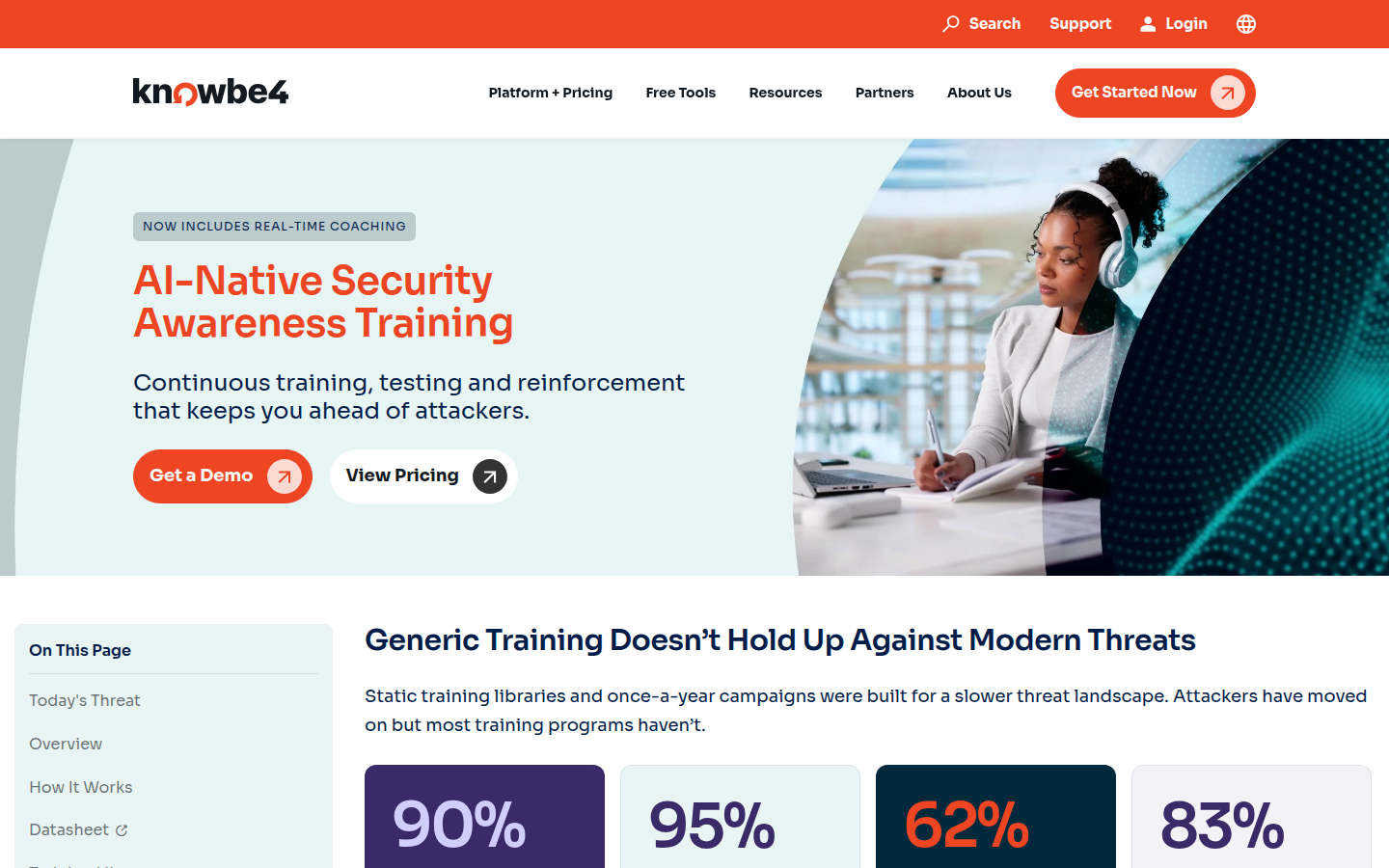
KnowBe4 is the default standalone SAT pick on this shortlist: a large phishing-template and training library, plus AI risk scoring, without requiring your email gateway vendor. SAT Foundation and SAT Advanced are the live tiers as of May 2026 (the older Silver/Gold/Platinum/Diamond ladder is legacy). Foundation covers the core library and unlimited phishing tests. Advanced adds the full library, AIDA (AI Defense Agents), and the SmartRisk engine that scores users from training, simulation, and coaching data. KnowBe4's SAT datasheet lists tens of thousands of system phishing templates and a ModStore of 1,300-plus training items. Confirm which SKU actually opens the full ModStore on your order form.
Simulations on the current product pages are email phishing (including QR codes in the message body, attachments, data entry, reply-to, callback/vishing-style tests, and ClickFix) plus Simulated Vishing. Microsoft Teams appears as a Phish Alert Button and as a Real-Time Coaching channel, not as a native Teams phishing simulator. AIDA Orchestration can generate and send personalized tests and remedial training without an admin building every campaign. PhishER Plus is a separate add-on if reported mail needs SOC triage and removal. Public list rates are per seat per month on a 3-year term, in volume bands, up to 1,000 seats. Above that is quote.
Best for: Teams that want a standalone SAT console with a large library, printed seat math, and AI-driven scoring, and do not need the SAT SKU to share a Proofpoint or Mimecast gateway.
Key features:
- Unlimited phishing tests, AIDA template generation, and SmartRisk user scoring on SAT Advanced
- Vishing and QR-in-email tests, plus a Phish Alert Button for Outlook and a Teams report button
- Training in dozens of languages, 60-plus built-in reports, and optional PhishER Plus for SOC intake
Why we like it: AIDA can pick the next sim and the remedial module from the user's risk score, so the program still runs in a week when the awareness owner is in audit hell.
Notable limitations:
- Native Microsoft Teams phishing (a fake Teams message, not a report button) is not documented the way Hoxhunt documents it. SMS/smishing is discussed in older KnowBe4 materials, but the September 2026 PST-types article does not list an SMS test. Confirm channels on the SKU
- SAT Advanced is the AIDA/full-library tier. Do not assume Foundation includes SmartRisk orchestration
- PhishER Plus is a paid add-on. Reporter-to-SOC is not the base SAT meter
Pricing: SAT Foundation starts at $2.40 per seat per month for 25 to 50 seats on a 3-year term. SAT Advanced starts at $3.75 in the same band (May 2026 MSRP, USD). Bands step down through 1,000 seats. 1,001-plus is quote. Add-on list rates exist for integrations, Compliance Plus, and PhishER Plus. Confirm those lines separately. Taxes and region variants are extra.
Proofpoint ZenGuide
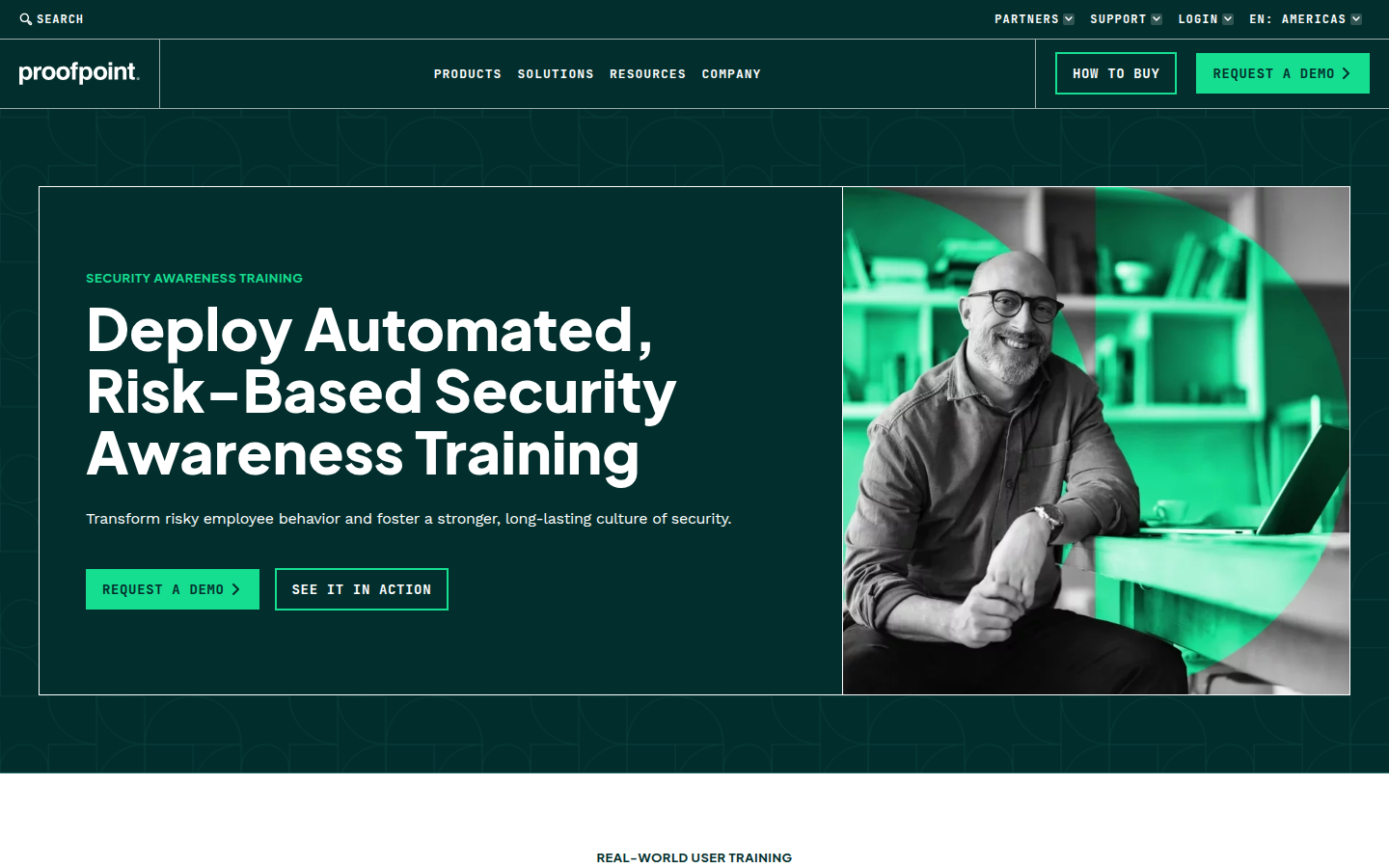
Proofpoint ZenGuide is the current Proofpoint security-awareness product. It is not EOL. Proofpoint describes ZenGuide as the next evolution of Proofpoint Security Awareness Training (PSAT), still sold as SAT inside the human-risk platform. The reason it is on this list is threat intel, not a bigger video catalog. ZenGuide scores people from role, access, threat exposure, and phishing performance (Human Risk Explorer), then Adaptive Groups and Adaptive Pathways auto-enroll them in training, phish tests, and nudges. Satori Phishing Simulation Agent and AI ThreatFlip can turn a real attack seen in the Proofpoint environment into a safe simulation template.
That loop is strongest when you already run Proofpoint email security. Without that telemetry, ZenGuide is still a cloud SAT console with gamified learning, just-in-time coaching, WCAG accessibility settings, and a Report Suspicious button on email and mobile. It is not a reason to rip a working KnowBe4 tenant unless the Proofpoint bundle is the cheaper path at renewal. Public pages do not print a per-seat rate. Treat commercial terms as a quote scoped to seats, modules, and whether ZenGuide rides a larger Proofpoint contract.
Best for: Organizations already on Proofpoint email security that want simulations built from attacks that actually hit them, with auto-enrollment by risk.
Key features:
- ThreatFlip and Satori agents that clone live phishing into a safe sim
- Adaptive Groups and Pathways that assign training and tests from risk signals
- Report Suspicious on email and mobile, plus just-in-time coaching at the point of risk
Why we like it: The next sim can be last week's real lure, stripped of the payload, so finance practices on the invoice thread they already almost paid, not on a generic "IT password reset" from 2019.
Notable limitations:
- The SAT value is tied to Proofpoint human-risk and email telemetry. Standalone, you lose the ThreatFlip story
- No public per-seat card. You will quote seats and modules
- Email is the documented ZenGuide sim channel. Teams, SMS, voice, and QR are not listed as first-class ZenGuide sim channels on that product page. Collaboration Security Prime is a separate Proofpoint product. Confirm the channel pack on the order form
Pricing: Quote. Proofpoint does not publish a ZenGuide list rate. Ask for seat count, which adaptive modules are in, and whether the SKU is bundled with email security.
Hoxhunt
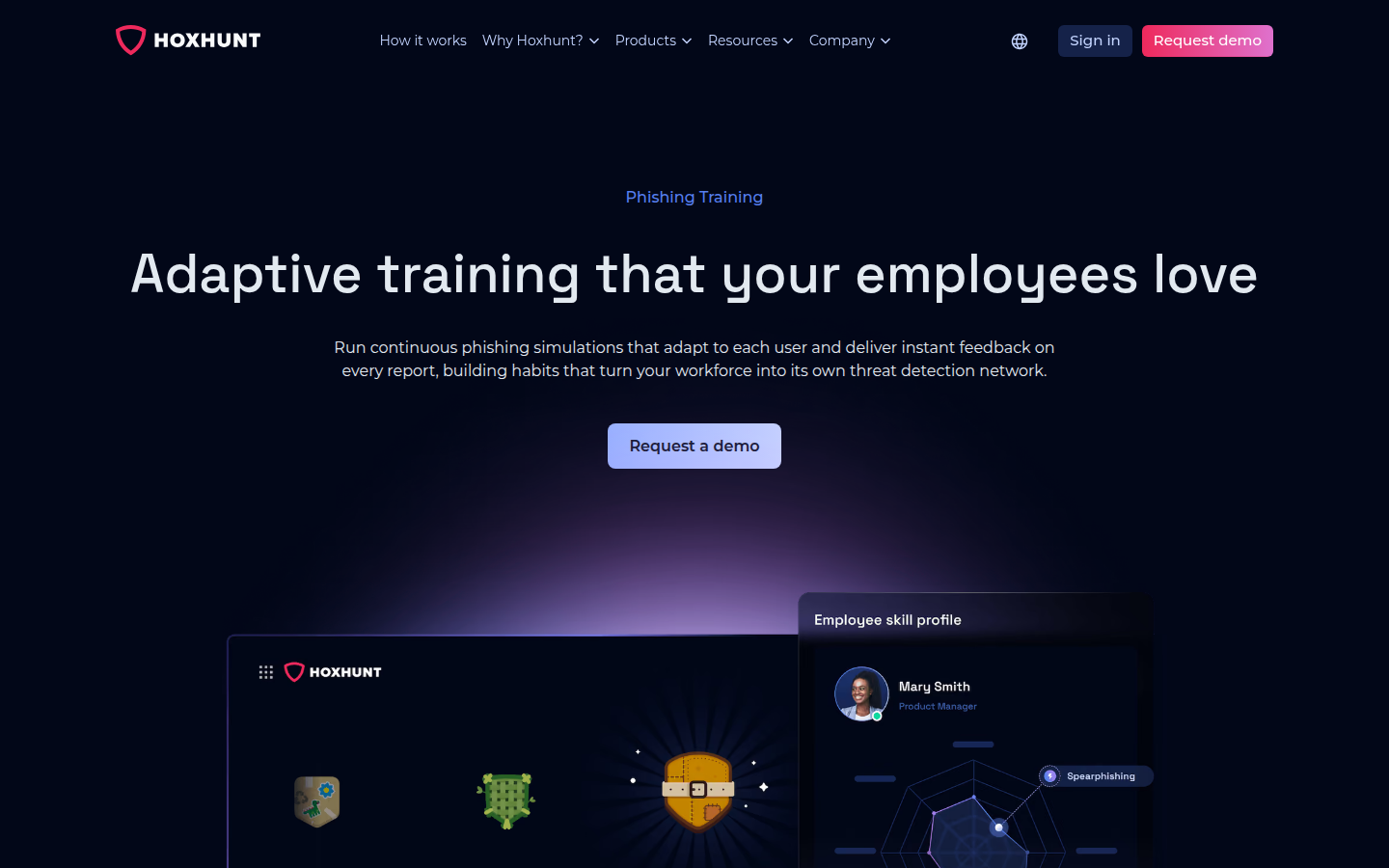
Hoxhunt is the adaptive, multi-channel pick. Simulations cover email, smishing (SMS), vishing and callback, Microsoft Teams, and deepfake video (including executive impersonation with cloned or generated voice, with the customer's consent). An agentic reasoning engine sets difficulty, cadence, and scenario type per person. Repeat clickers get a faster cadence until they improve. People who report get a micro-lesson at that moment. Hoxhunt says employees receive gamified simulations and interactive training roughly every 10 days, and that simulations update weekly from live threat intelligence. Optional OSINT can tailor spear-phish. Reporting buttons exist for Outlook and Gmail, desktop, web, Android, and iOS.
This is a continuous sim program that moves click rates and report rates, not a once-a-year LMS. Hoxhunt also ships a compliance content library (GDPR, HIPAA, and similar topics) in 40-plus languages, so you are not forced into a second vendor for the checkbox modules. SOC 2 Type II, GDPR, and CCPA are claimed on the product page. Confirm the report. Pricing is per employee. The public pricing page does not print a number. You get a quote after a 30-minute scoping call, based on headcount and which capabilities you turn on.
Best for: Organizations that want adaptive sims in the channels attackers already use (email, Teams, SMS, voice, deepfake), and will measure report rate, not course completion.
Key features:
- Email, SMS, Teams, vishing/callback, and deepfake simulations on one adaptive engine
- Per-user difficulty and cadence, with coaching on click or report
- Outlook and Gmail report buttons, 40-plus languages, optional OSINT spear-phish
Why we like it: A helpdesk callback and a fake Teams file-share can sit on the same person's path as the email sim, so the "I only train on Outlook" gap is not the default.
Notable limitations:
- Quote only. There is no public seat ladder to put in a spreadsheet before the scoping call
- QR-code phishing is not listed among Hoxhunt's named sim channels
- Deepfake executive clones need likeness and voice consent. Budget that legal step, not only the license
Pricing: Per employee, quote after a scoping call. Public pages do not print a per-seat figure. Ask which channels (SMS, voice, deepfake, Teams) are in the SKU you are buying, not only email.
Cofense PhishMe
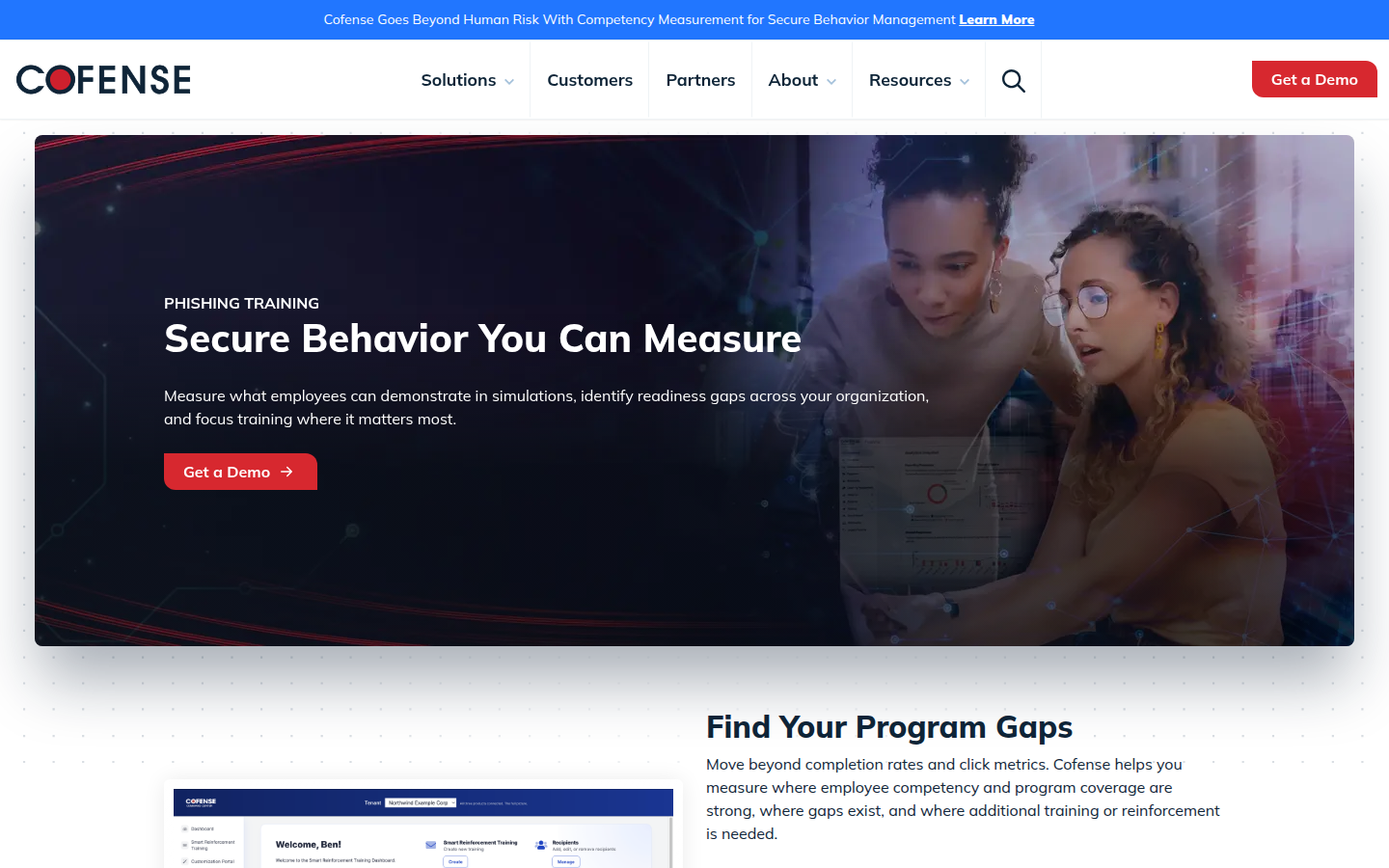
Cofense PhishMe is phishing-first SAT with a response loop behind it. The training platform runs adaptive simulations from Cofense's phishing data, including smishing, vishing, and QR-code phishing, then measures competency and coverage rather than completion rates. AI-assisted campaign building is positioned to speed template work. The reason mature SOC teams buy this row is the rest of the Cofense Phishing Defense Platform: Reporter (a one-click button that forwards suspicious mail, and separates PhishMe sims from unknown reports) and Triage (prioritizes those reports with reporter reputation, clusters campaigns, and automates response). Vision is the related detection SKU. Command Center's Competency Dashboard, announced September 2026, is Cofense's published move away from completion-only metrics. Phishing Remediation data from Triage and Vision was slated to connect into Command Center in Q4 2026. Confirm whether that join is live on your tenant.
PhishMe itself is not EOL. Cofense still sells it as the SAT layer of a post-perimeter phishing-defense platform. If you only need videos and a quarterly phish, this is the wrong weight class. If reported mail currently dies in a shared mailbox, Reporter plus Triage is the product. Public Cofense pages point to a pricing inquiry. They do not print a per-seat SAT card. Do not use reseller SKU stickers as list rates.
Best for: Security teams that already (or will) treat employee reports as SOC work, and want sims, Reporter, and Triage on one vendor.
Key features:
- Adaptive email simulations plus smishing, vishing, and QR-code phishing
- Reporter one-click intake that distinguishes sims from unknown mail
- Triage for analyst queues, with reporter reputation and campaign clustering
Why we like it: A user who reports a real payload and a user who reports a sim hit the same Triage pipe, so the awareness program is feeding incident response instead of an unused CSV of clickers.
Notable limitations:
- You are buying a phishing-defense platform. SAT-only shops will over-buy if they never open Triage
- No first-party public SAT list rate
- Microsoft Teams as a sim channel is not documented on Cofense's PhishMe SAT page. Confirm if you need collab-channel tests
Pricing: Quote. Cofense does not publish a PhishMe per-seat card on the product site. Price SAT, Reporter, and Triage as separate lines unless the bundle on the order form says otherwise.
Mimecast Awareness Training
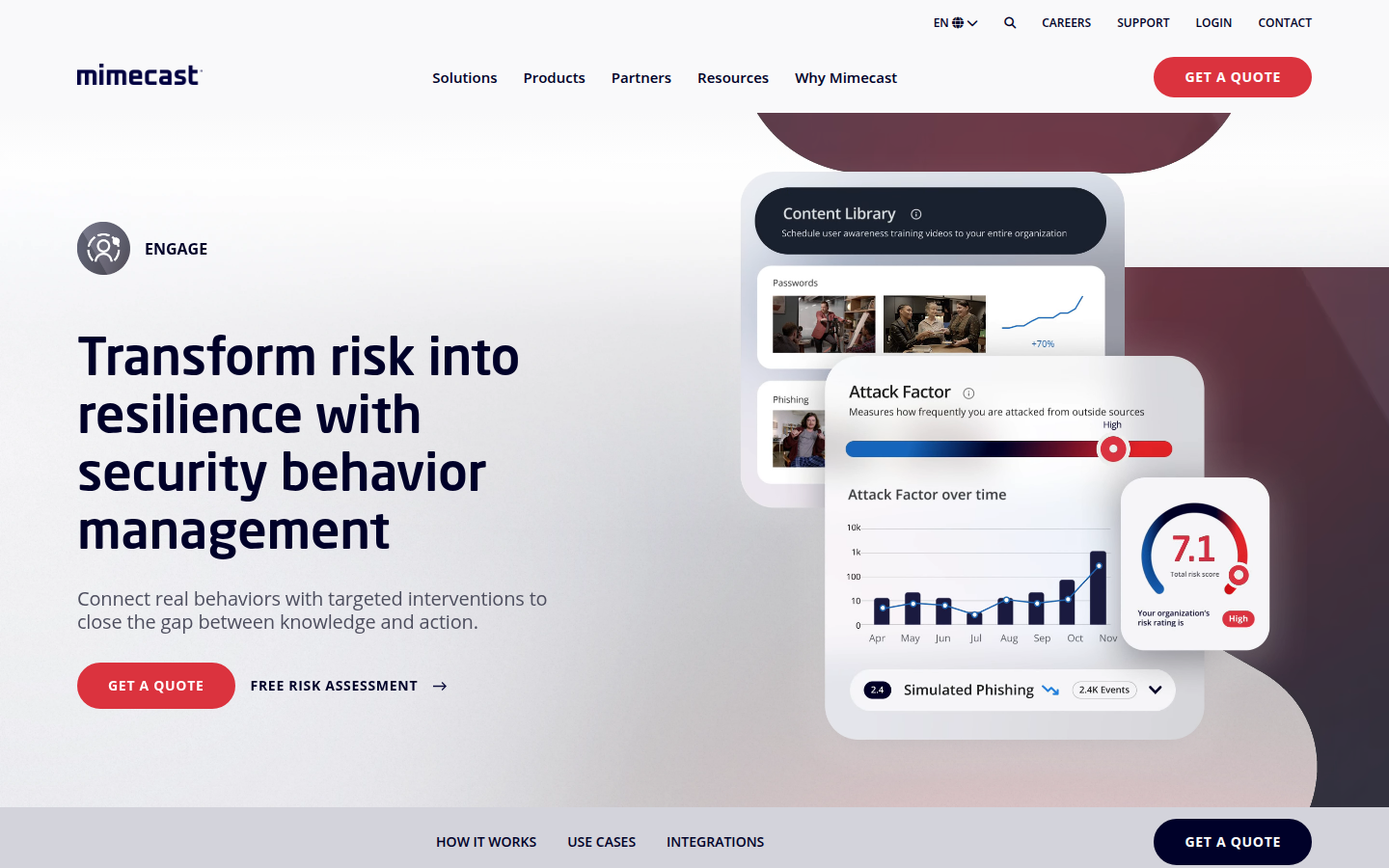
Mimecast Awareness Training is still the name on this shortlist because that is the SKU thousands of Mimecast customers already run. It is not a dead product for those tenants, but it is end-of-sale for new logos. Mimecast's community announcement says Awareness Training sales have ended. At renewal, those customers move to Engage Core at their existing Awareness Training price, and pick up the Human Risk Command Center. Brand-new buyers are told to quote Engage Core or Engage Pro. Engage Core is phishing simulation, the full training library (200-plus modules, TV-style and mentor-style, 27 languages on the product page), and the Command Center. Engage Pro adds behavioral nudges via email, Slack, or Teams, and personalized scorecards. Short monthly modules remain the teaching pattern.
Email simulations include staggered sending, dummy attachments (rolled out February 2026), and QR codes via a [qrcode] placeholder in templates. SAFE Phish can turn a de-weaponized URL-Protection click into a custom template if Targeted Threat Protection is on. Nudges in Slack or Teams are Engage Pro interventions, not a documented native Teams phishing simulator. Public pages do not print Engage list rates. Strongest fit is still "we already run Mimecast." The Human Risk Command Center can run as a standalone Engage product with 17-plus third-party integrations, so you do not strictly need the rest of the Mimecast stack, but that is not why most teams will pick this row.
Best for: Current Mimecast Awareness Training or Engage customers, and Mimecast email shops that want SAT in the same vendor family.
Key features:
- Short monthly training modules and email phishing campaigns, including QR and dummy attachments
- Human Risk Command Center risk scores and Watchlist Manager groups on Engage
- Engage AI Generator for customizable phishing templates by attack type, industry, and difficulty
Why we like it: A click on a Mimecast-rewritten URL can become the next simulation template, so the workforce drills on the lure that already got through to them, inside the same admin console they use for mail.
Notable limitations:
- Awareness Training is end-of-sale. New contracts are Engage Core or Engage Pro. Do not write a 2026 RFP against the retired SKU name without the Engage mapping
- No public per-seat card
- SMS and voice sims are not documented on Mimecast's Engage product page. Teams appears as a nudge channel on Pro, not as a fake-Teams-message sim
Pricing: Quote. Existing Awareness Training renewals are described as moving to Engage Core at the current subscription price. New logos quote Core vs Pro. Public pages do not print a dollar figure.
Curricula
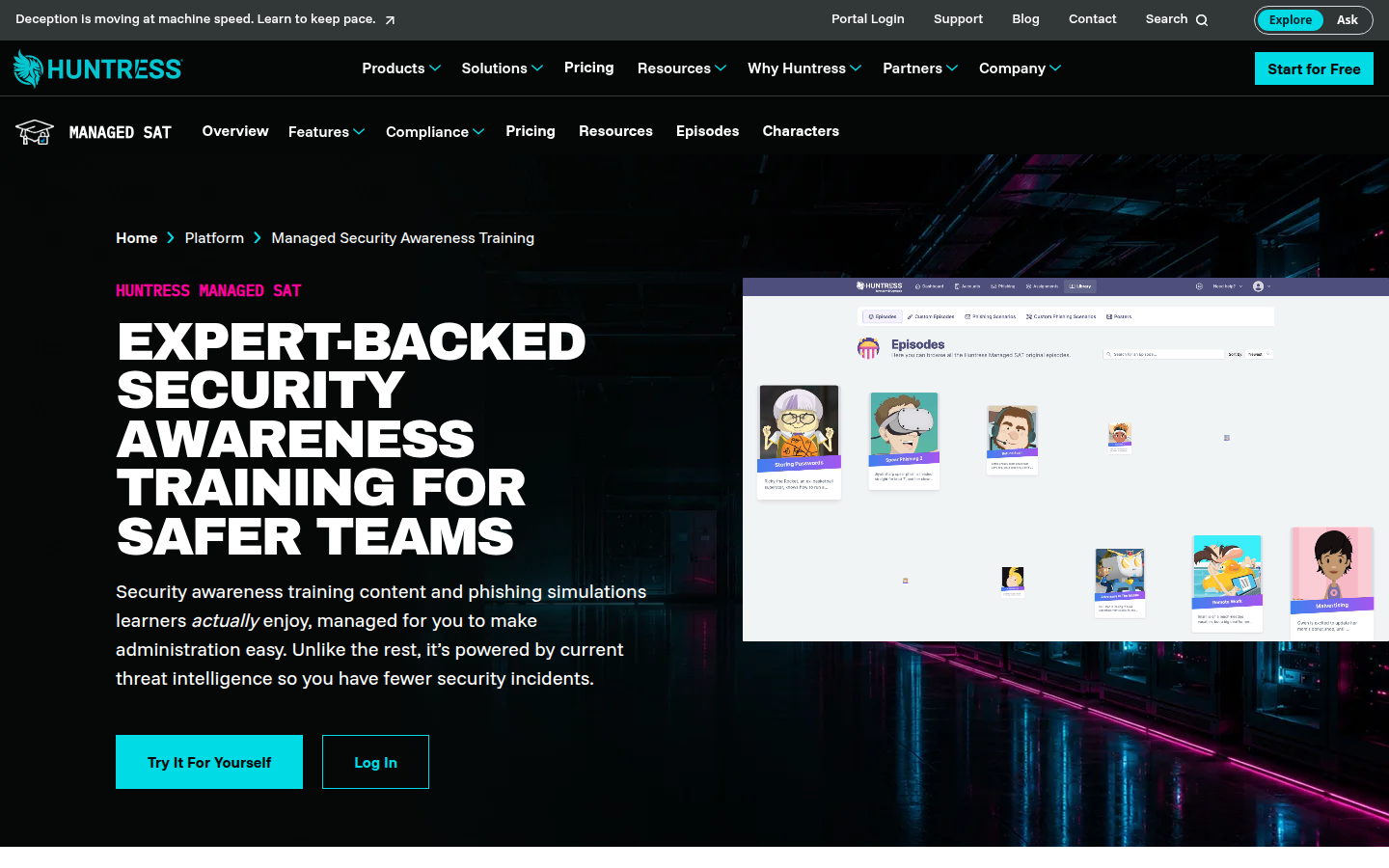
Curricula is the story-based, engagement-first mid-market pick, and it is not EOL. Huntress acquired Curricula on 19 July 2022. The live product is Huntress Managed SAT. Curricula.com now serves that Huntress page. The teaching model is still the one the brief named: short story episodes in Curriculaville (most episodes about 7 to 10 minutes), an integrated phishing simulator, gamification, and a Custom Content Creator. Huntress security staff schedule the learning plan and the phishing assignments. Admins are not expected to build weekly campaigns. After a simulated compromise, recovery training and Phishing Defense Coaching fire. Manager reminders go out when people miss deadlines. Huntress also sells this as a managed overlay on its broader SMB security platform (EDR/ITDR), which is a different reason to buy than "we only need SAT."
Huntress does not print a public SAT list rate on the product page. Treat commercial terms as a quote. Channels on the public SAT page are email-centric simulations plus reporting. Teams, SMS, voice, and QR are not listed there as first-class sim channels.
Best for: Mid-market and SMB teams that want story-based microlearning and phishing sims without staffing a campaign operator, and will accept Huntress as the vendor of record.
Key features:
- Story episodes (Curriculaville) plus an integrated phishing simulator
- Huntress-managed scheduling, reminders, and monthly reporting
- Phishing Defense Coaching, recovery training after a failed sim, and a custom content authoring tool
Why we like it: The next episode and the next phish go out on Huntress's calendar, so a three-person IT shop is not pretending to be a full-time awareness team.
Notable limitations:
- Curricula is a Huntress product now. Contracts, support, and the admin UI are Huntress Managed SAT. If you need a vendor that is SAT-only, this is the wrong row
- No first-party public per-seat card on the Huntress SAT page
- Multi-channel sims (Teams, SMS, voice, QR) are not documented on that page. Email is the sim you should expect unless the order form says more
Pricing: Quote. Huntress Managed SAT does not publish a per-seat table on the product page. Ask whether SAT is standalone or bundled with other Huntress products, and what the employee minimum is on the form you sign.
Living Security
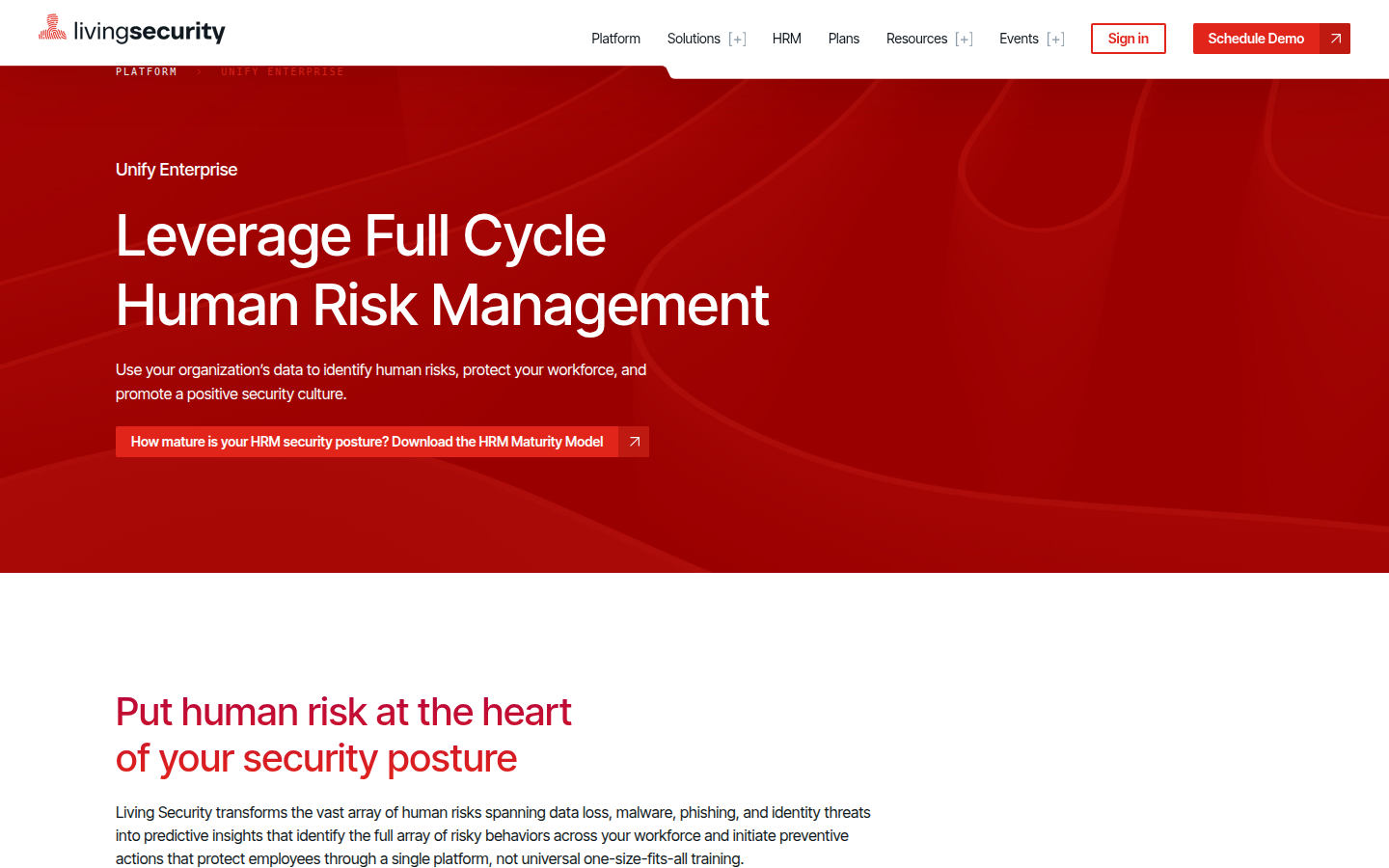
Living Security is human risk management first, SAT second. Unify builds a Human Risk Index from real and simulated phishing clicks, plus (on Unify Enterprise) data-loss, identity, and malware signals from the rest of the stack. Action plans then assign nudges, training, and phishing. The phishing simulator itself is documented as AI-powered scenarios, including MFA spoofing, with multiple scenarios randomly delivered to employees. Living Security cites 1,600-plus email phishing scenarios in 160-plus languages, 600-plus smishing templates, and 200-plus vishing simulations. Multi-channel packs (SMS, vishing, quishing) sit as add-ons on the public plan grid. Email phishing simulations are also an add-on on Train, Engage, and Adapt. Do not assume sims are in the base Train package.
Unify Go is the lighter social-engineering view (email security + phishing + training integrations). Unify Enterprise extends past email. Plans are Train, Engage, and Adapt on top of the Living Security Platform. All of that is "contact us for enterprise pricing." Living Security also sells Email Threat Simulator, which fires payloads at a test inbox to exercise the gateway. That is control validation, the job on our BAS page, not employee SAT. Keep ETS off this contract unless you mean to buy both jobs. Randomized sims plus Unify remediation is the row.
Best for: Teams that want a human-risk score, randomized phishing, and an action plan that assigns the next training from those results, not a standalone LMS.
Key features:
- Human Risk Index at person, cohort, and org level, with Unify action plans
- Randomized phishing scenarios, including MFA spoofing, with optional SMS, vishing, and quishing
- Employee and manager scorecards, and just-in-time nudges on the Engage package (Slack, Teams)
Why we like it: Unify can see a real phish click and a failed sim on the same person, then drop an action plan instead of waiting for the next quarterly campaign calendar.
Notable limitations:
- Email phishing is an add-on on the published Train/Engage/Adapt grid. Quote the sim pack explicitly
- No public dollar card
- Email Threat Simulator tests the gateway. It is not a substitute for employee sims, and it is not this category
Pricing: Quote. The public plans page lists Train, Engage, and Adapt on the Living Security Platform, with phishing simulations as add-ons, and says to contact Living Security for enterprise pricing. No per-seat figure is printed.
Channels compared
| Platform | Microsoft Teams | SMS, voice, and QR | |
|---|---|---|---|
| KnowBe4 | Yes. Unlimited tests, including QR in the message, attachments, callback | Report button and Real-Time Coaching. Native Teams phish not documented | QR in email, yes. Simulated Vishing, yes. SMS not on the Sep 2026 PST-types list |
| Proofpoint ZenGuide | Yes, including ThreatFlip from live attacks | Not listed as a ZenGuide sim channel | Not listed as first-class ZenGuide sim channels on that page. Confirm the pack |
| Hoxhunt | Yes, adaptive, weekly-updated library | Yes. Simulated phishing messages inside Teams | SMS and vishing/callback, yes. Deepfake video, yes. QR not listed |
| Cofense PhishMe | Yes. Adaptive sims from Cofense phishing data | Not documented on the PhishMe SAT page | Smishing, vishing, and QR-code phishing are listed |
| Mimecast Awareness Training | Yes, including dummy attachments and SAFE Phish templates | Engage Pro nudges in Teams. Native Teams phish not documented | QR in email templates, yes. SMS and voice not documented on the Engage page |
| Curricula | Yes, Huntress-managed phishing assignments | Not listed on the Huntress SAT page | Not listed on that page. Expect email unless the order form adds channels |
| Living Security | Yes, as a phishing add-on. Randomized scenario delivery | Engage-package nudges. Native Teams phish not documented | SMS, vishing, and quishing as multi-channel add-ons |
Program model compared
| Platform | Library depth | Adaptive difficulty | Reporting to SOC |
|---|---|---|---|
| KnowBe4 | Datasheet: tens of thousands of phishing templates, 1,300-plus training items. Advanced opens the full library | AIDA and SmartRisk personalize tests and remedial training on Advanced | Phish Alert Button on SAT. PhishER Plus is the SOC triage add-on |
| Proofpoint ZenGuide | Proofpoint content plus simulations cloned from live attacks (ThreatFlip) | Adaptive Groups and Pathways auto-enroll from risk and performance | Report Suspicious button. Depth depends on the rest of the Proofpoint stack |
| Hoxhunt | Weekly-updated, threat-led sim library, plus a compliance training library | Per-user difficulty, cadence, and scenario type. Faster cadence for repeat clickers | Outlook/Gmail report buttons. Incident-response automation is a separate Hoxhunt product line |
| Cofense PhishMe | Dynamic library fed by Cofense phishing intelligence | Adaptive sims and AI-assisted campaign building from readiness gaps | Reporter into Triage is the product. This is the SOC-native row |
| Mimecast Awareness Training | 200-plus modules on Engage. Email template library plus SAFE Phish from real clicks | Risk scores and Watchlist groups on Engage. AI Generator for template difficulty | Report Phishing into Mimecast processes. Not a Cofense-style Triage console |
| Curricula | Story episode library (Curriculaville), not a mega-template SAT catalog | Huntress-managed assignments and recovery training after a failed sim, not a per-click difficulty engine like Hoxhunt | Integrated phishing reporting. Not a full SOC triage platform |
| Living Security | 1,600-plus email scenarios cited, plus SMS and vishing libraries as add-ons | Randomized delivery and Unify action plans from the Human Risk Index | Phishing Reporter into Incident Responder (a separate SKU). Unify is the risk layer |
Strategic Decision Framework
Four questions before you sign. Stay inside this shortlist.
| Critical question | Why it matters | What to evaluate | Red flag |
|---|---|---|---|
| Will you measure clicks and reports, or course completion? | BEC and deepfake lures punish programs that only export a completion CSV for audit. | Risk scores, report rates, repeat-clicker handling, and whether failed sims assign coaching automatically. | Completion-only metrics. A 100% trained workforce with no report button and no sim cadence. |
| Which channels do attackers actually use on your people? | An email-only SAT program leaves Teams, SMS, voice, and QR as unpracticed paths. | Named sim channels on the order form: email, Teams, SMS, voice, QR. Coaching-in-Teams is not a Teams phish. | No multi-channel sims, and no plan to add them, in a workforce that lives in Teams and SMS. |
| Can you do seat math before legal reviews the paper? | Most of this category is quote-only. KnowBe4 is the exception with a public banded list. | Published per-seat bands vs a scoping call. What is in the base SKU vs add-on (AIDA, PhishER, SMS, vishing). | Quote-only pricing with no seat math, and add-ons (phishing, Reporter, multi-channel) revealed after you have already picked the vendor. |
| Is this annual checkbox content, or a program someone will run weekly? | A giant library dies if nobody schedules it. Adaptive and managed SAT exist because campaign ops is the bottleneck. | Who clicks "send" every week: your admin, AIDA/Hoxhunt automation, or Huntress managed ops. SOC handoff if reports will pile up. | Annual checkbox content sold as human risk reduction, with no automation and no owner for weekly campaigns. |
What usually goes wrong when buying a security awareness platform
Most mismatches happen because the team bought a control-validation product for an employee-sim job, because they bought a giant library they will never campaign, because they treated a gateway vendor's SAT add-on as a standalone program, or because they scored success on completion instead of reports.
| Problem | Solution |
|---|---|
| You bought BAS or an email-gateway test (including Living Security Email Threat Simulator) when the job was teaching people not to wire money | Keep BAS on the control-validation shortlist. Buy employee sims here. Gateway testing and SAT can coexist. They are not substitutes |
| You bought the largest content library, then ran two campaigns a year | If nobody will operate weekly campaigns, pick automation (KnowBe4 AIDA, Hoxhunt adaptive cadence) or managed SAT (Huntress/Curricula). A library without a sender is a compliance video with extra SKUs |
| You assumed Proofpoint ZenGuide or Mimecast Engage would work the same without that email stack | Quote ZenGuide when Proofpoint telemetry is the point. Quote Mimecast Engage when you already live in Mimecast. Otherwise start with KnowBe4 or Hoxhunt |
| Reports of real phish land in a shared mailbox, while sims live in a separate LMS | Cofense Reporter and Triage, KnowBe4 PhishER Plus, or another SOC intake SKU. Do not call SAT "done" if nobody triages what people report |
Bottom line
If you want a standalone SAT console with a large library and a printed seat ladder, start with KnowBe4 SAT Advanced and confirm AIDA is in that tier. If you already run Proofpoint email security, start with ZenGuide and ask for ThreatFlip on the order form. If the job is adaptive practice in email, Teams, SMS, voice, and deepfake, start with Hoxhunt. If the SOC must work employee-reported mail, start with Cofense PhishMe plus Reporter and Triage.
If you already pay Mimecast, quote Engage Core or Engage Pro. Do not sign a new Awareness Training SKU; that name is end-of-sale, with Engage Core as the renewal path. If you want story episodes and someone else to run the calendar, start with Curricula as Huntress Managed SAT. If you want a human-risk index that assigns the next sim and the next module from real and simulated clicks, start with Living Security Unify and put phishing on the order form as an add-on. Employee sims, email security gateways, and breach and attack simulation are three purchases. Sign the one in front of you.