You think you know which virtual recording studio will work for your band or podcast until the first remote take clips, the latency jumps, and the upload fails mid-session. From our experience in the startup ecosystem, the fastest way to avoid that pain is to check three things early: your round-trip latency budget and buffer size, whether the platform offers local, double-ender recording, and how your DAW routes a lossless send bus. The sweet spot for live performance tends to be under roughly 20 to 30 ms one way, as documented by researchers at Stanford's mediaX program, which tested how delay impacts ensemble timing stability. See their latency findings here.
The market is expanding. The global digital audio workstation market was valued around 4.1 billion dollars in 2024 and is projected to reach about 6.65 billion dollars by 2030, an 8.6 percent CAGR, which tracks the shift toward cloud and collaboration features inside production tools. Grand View Research details those figures.
Waveroom
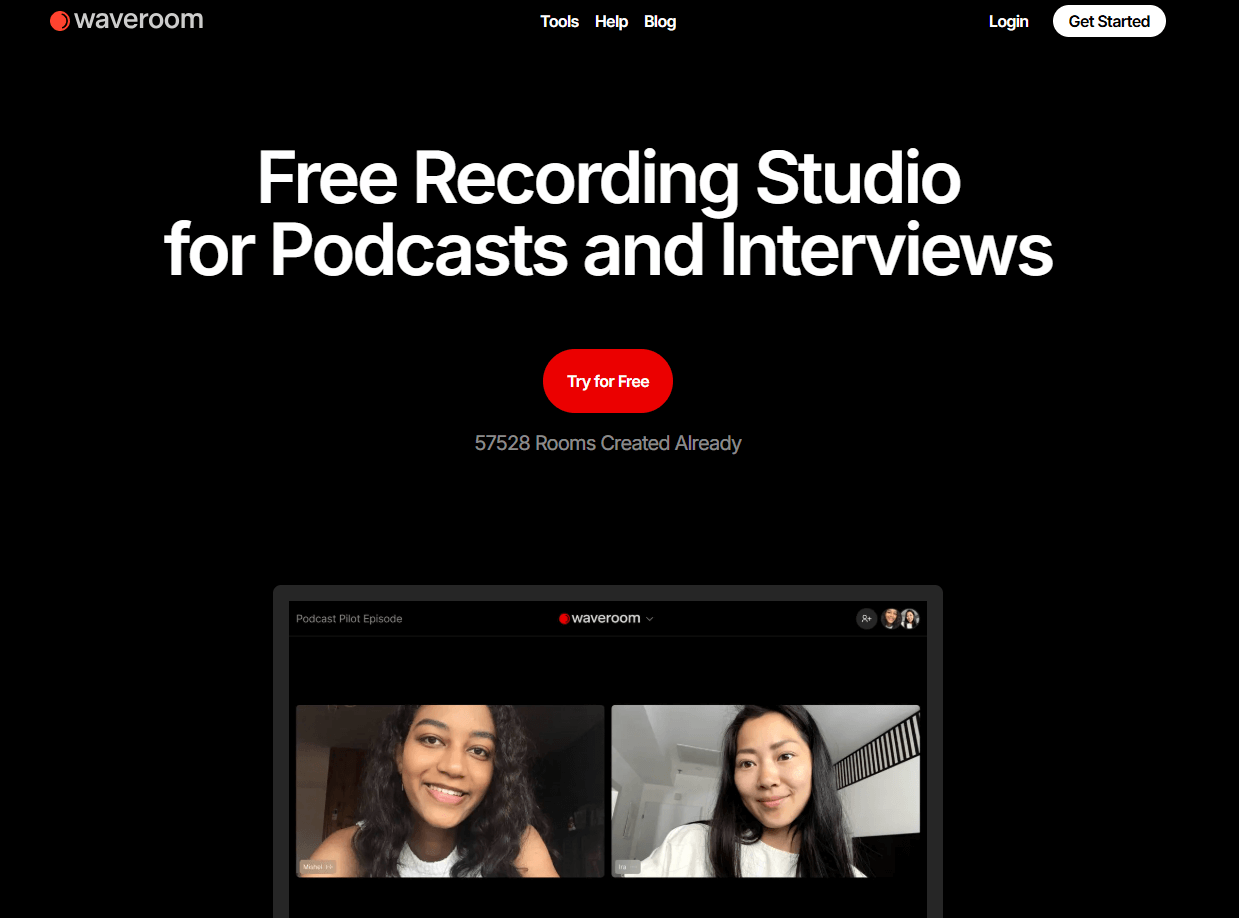
Browser-based remote studio for multi-track audio and video recordings. Local and cloud recording options for higher reliability during flaky connections.
Best for: Podcasters, interview shows, and small teams that want fast setup with local, separate tracks.
Key Features:
- Local, separate-track recording for each participant, with uncompressed 48 kHz WAV export, per vendor documentation
- Up to 2K video capture and multi-participant rooms, per vendor documentation
- AI noise removal and automatic backup to cloud, per vendor documentation
Why we like it: Simple guest onboarding through a browser, plus local tracks give you a safety net when networks hiccup.
Notable Limitations: Reported upload stalls and missing recordings in some sessions, and occasional freezes that required page reloads, based on internet reviews.
Pricing: Free plan available, Enterprise pricing not publicly listed. If you need contractual SLAs or higher participant counts, contact the vendor. For user-reported reliability feedback, see aggregated reviews on Trustpilot.
JackTrip
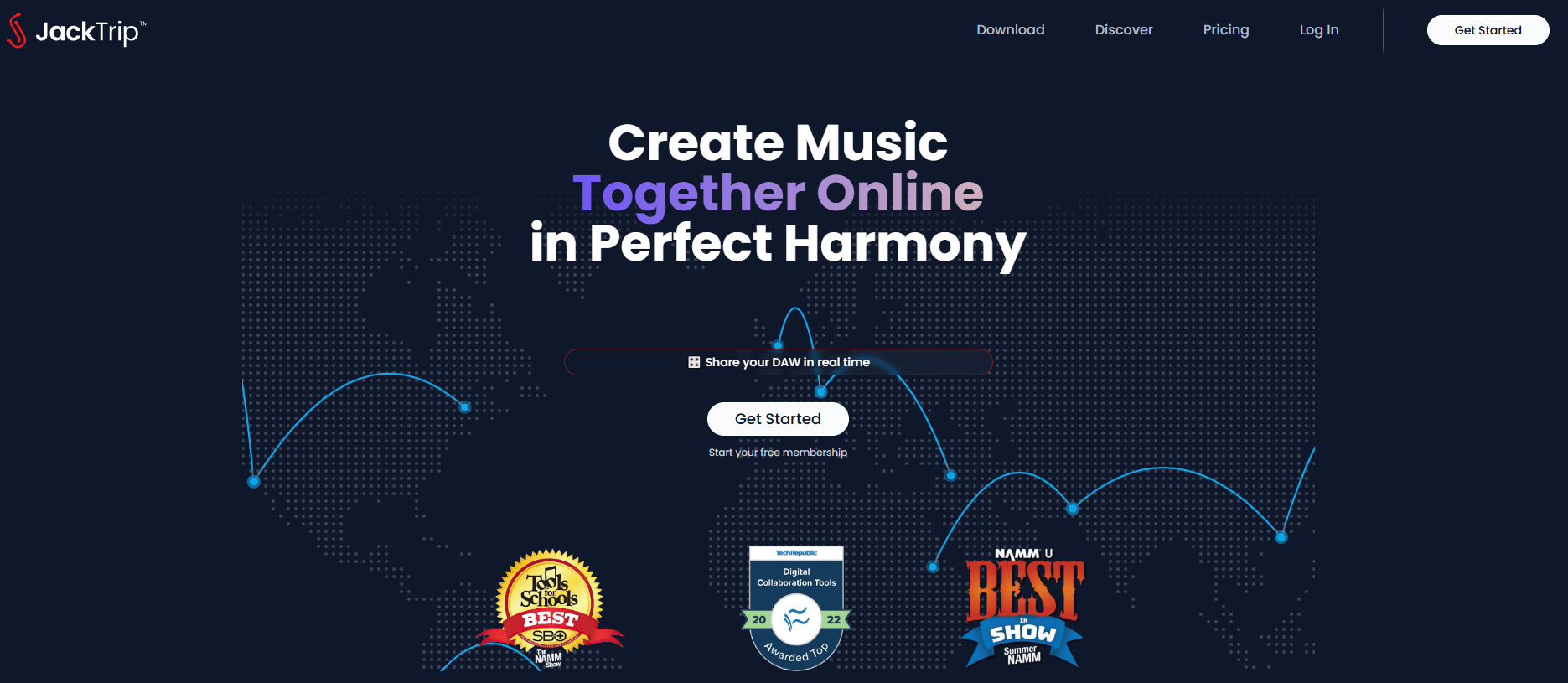
Open-source, low-latency virtual studio designed for real-time, high-definition collaboration. Built out of Stanford's CCRMA research, with managed cloud studios and a self-hosted option.
Best for: Bands, choirs, and educators who need to play in time together, not just share mixes.
Key Features:
- Sub-30 ms, uncompressed, bidirectional audio under proper conditions, validated in academic and field reports
- Managed cloud studios, plus a self-hosted mode for advanced users
- Hardware Bridges for plug-and-play I/O and wide geographic studio coverage in the US and globally, per community and project documentation
Why we like it: When participants are on wired Ethernet and reasonably close to a regional server, JackTrip feels like a real room. It is the closest we have come to a convincing live jam online.
Notable Limitations: Requires Ethernet for best results, proximity to a regional node, and some technical setup. Very long distances add delay that no software can remove.
Pricing: Joining sessions is free. Hosting managed studios requires a paid subscription as of November 1, 2025, per company announcements. Exact plan pricing is published by the vendor but not consistently mirrored by third-party sources, so verify directly. For background on the open-source project and capabilities, see the JackTrip GitHub repository and Stanford's writeup on low-latency performance over the internet in the Stanford Report.
Sessionwire
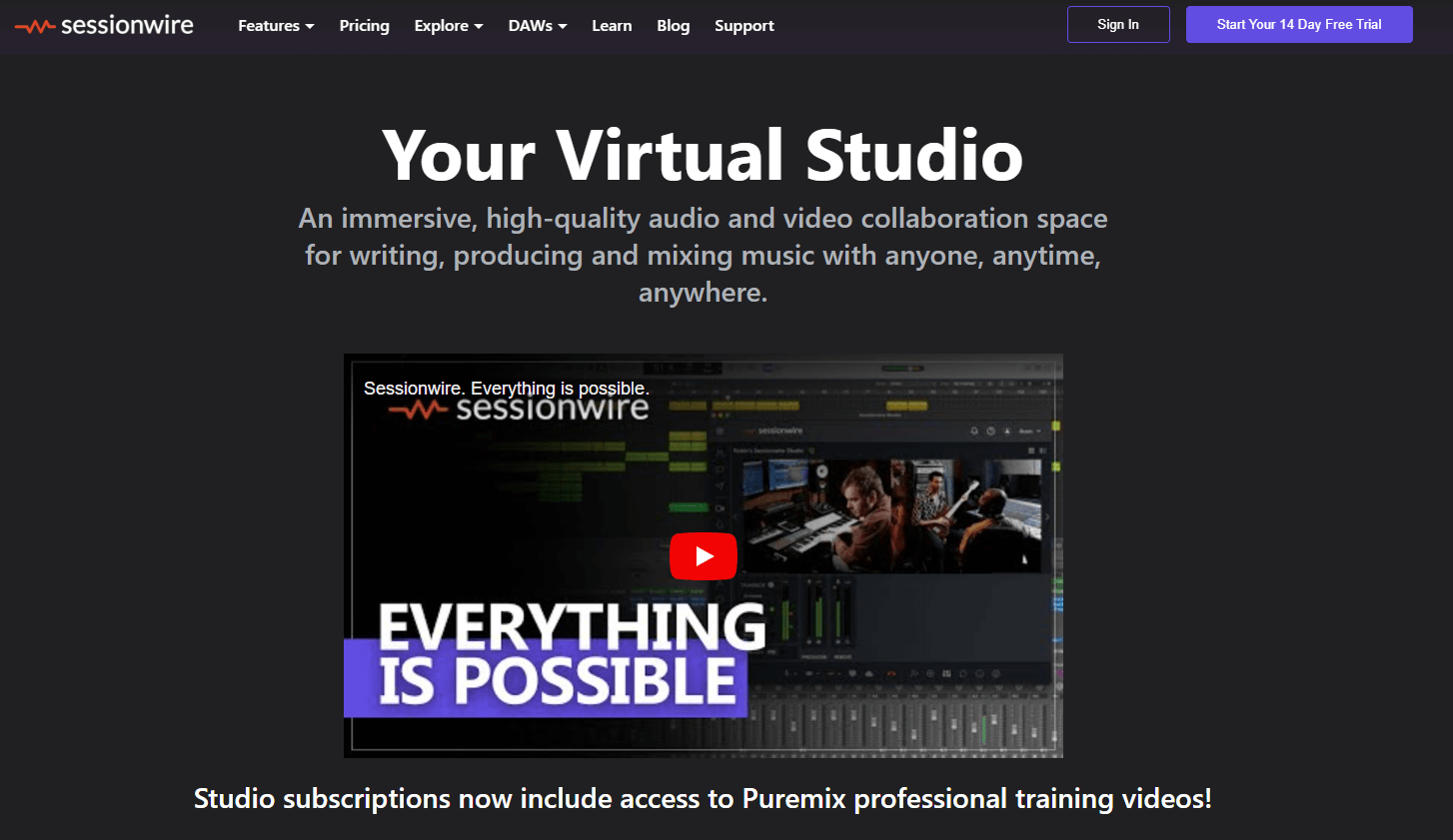
Virtual recording studio for producers and mix engineers, combining HQ audio, talkback, screen share, and DAW plug-ins.
Best for: Mixing and production teams that want live approvals, DAW-to-DAW audio, and client sessions without shipping files.
Key Features:
- Dedicated HQ stereo audio stream that targets 48 kHz, 32-bit float around 400 kbps, plus a separate talkback stream
- DAW plug-ins in VST3, AU, and AAX to send and receive HQ audio directly inside Pro Tools, Logic, Cubase, Studio One, and more
- Browser guest links, screen sharing, file drag and drop, and remote desktop control in beta, per third-party coverage
Why we like it: The plug-in suite removes the usual routing gymnastics, so clients hear exactly what comes off your mix bus, and you keep talkback separate.
Notable Limitations: Guests typically need a Chromium-based browser in our experience, and older plug-in formats like VST2 are not supported. A few users report that Zoom workflows are "good enough" for approvals, so evaluate your client base.
Pricing: Subscription product with a one-time 14-day Studio trial per vendor documentation. Current monthly prices are not publicly listed on credible third-party pages, so confirm in-app before you budget. For an overview of plug-in workflows and feature set, see this review in Music Connection.
BandLab
Cloud-based DAW for collaborative creation, recording, editing, and sharing, on web and mobile. Membership adds distribution and pro tools.
Best for: Solo creators and distributed songwriting teams that want a free, always-on collaborative DAW with optional upgrades.
Key Features:
- Cross-platform Studio with collaboration, mastering, and AI tools, plus a social layer
- Membership adds distribution via FUGA partnership and extra creation features
- Mobile and desktop apps with a large creator community
Why we like it: It removes cost and install friction for collaborators. Sessions live in the cloud, and the Membership tier can handle release logistics when you are ready.
Notable Limitations: Parts of the Sounds library and some advanced features have moved behind Membership, and community threads show mixed reactions to those changes.
Pricing: Core app is free on iOS and Android, as listed on the Apple App Store page. BandLab Membership is typically 14.95 dollars per month, and has run seasonal discounts, like 5.80 dollars per month on a Black Friday annual promo, according to MusicTech's coverage. Distribution access through Membership and inclusions are detailed in industry reporting from Music Ally.
Virtual Recording Studio Tools Comparison: Quick Overview
| Tool | Best For | Pricing Model | Highlights |
|---|---|---|---|
| Waveroom | Podcasting and interviews with local multitrack safety | Freemium, enterprise for higher limits | Local, separate tracks, 2K video, AI noise cleanup |
| JackTrip | Live, in-time playing for ensembles and lessons | Free join, paid to host managed studios | Sub-30 ms uncompressed audio under proper conditions, self-host option |
| Sessionwire | Producer and mixer approvals inside the DAW | Subscription with trial | HQ stereo return from your DAW, separate talkback, screen share |
| BandLab | Songwriting, mobile collaboration, and cloud projects | Freemium with paid Membership | Cloud DAW, social collab, Membership adds distribution |
Virtual Recording Studio Platform Comparison: Key Features at a Glance
| Tool | Feature 1 | Feature 2 | Feature 3 |
|---|---|---|---|
| Waveroom | Local, separate-track capture | 48 kHz WAV export | 2K video recording |
| JackTrip | Lossless, low-latency rooms | Managed or self-hosted | Optional hardware Bridges |
| Sessionwire | VST3/AU/AAX plug-ins | HQ audio plus talkback | Browser guest links |
| BandLab | Cloud DAW on web and mobile | Social collaboration | Distribution via Membership |
Virtual Recording Studio Deployment Options
| Tool | Cloud API | On-Premise | Integration Complexity |
|---|---|---|---|
| Waveroom | Not publicly documented | No | Low |
| JackTrip | Not publicly documented | Yes, self-host | Medium to High, networking matters |
| Sessionwire | Not publicly documented | No | Medium, plug-ins and I/O routing |
| BandLab | Not publicly documented | No | Low |
Virtual Recording Studio Strategic Decision Framework
| Critical Question | Why It Matters | What to Evaluate | Red Flags |
|---|---|---|---|
| Do you need to play in time, or just review mixes? | Real-time ensemble work demands very low latency | Measured ping to nearest region, wired Ethernet, interface buffer sizes | Wi-Fi, long distances, no regional server plan |
| Do you require separate local tracks for edit safety? | Cloud glitches happen, local tracks save sessions | True double-ender capture per participant | Single mixed cloud file only |
| Will clients join from locked-down corporate laptops? | Browser choice and permissions can block sessions | Browser requirements, no-install guest links | Narrow browser support, admin installs required |
| How will you route HQ audio to and from the DAW? | Clean monitoring and talkback saves time | Plug-in support, sample rate matching, driver stability | Only screen share, no discrete HQ path |
Virtual Recording Studio Solutions Comparison: Pricing & Capabilities Overview
| Organization Size | Recommended Setup | Monthly Cost | Annual Investment |
|---|---|---|---|
| Solo creator | BandLab free for ideation, Sessionwire trial for client approvals | Free to Trial | Free to Trial |
| 2-5 person podcast | Waveroom for local multitrack safety | Free, enterprise if needed | Free, enterprise if needed |
| School ensemble or choir | JackTrip managed studio with Ethernet policy | Varies by plan, confirm current pricing in app | Varies by plan, confirm current pricing in app |
| Small commercial studio | Sessionwire for approvals, BandLab for quick collabs | Subscription plus optional Membership | Subscription plus optional Membership |
Problems & Solutions
-
Problem: Latency ruins live performance.
- Why it happens: Over distance, audio round-trip delay exceeds what players can tolerate for tight timing. Stanford researchers observed that ensembles are sensitive to delay and that sub 20 to 30 ms one-way is the workable range for natural performance.
- Solution: Use JackTrip when you must play in time. It streams uncompressed audio and has been shown in Stanford's reporting and community fieldwork to support real-time collaboration when participants are on wired connections near regional servers. Read Stanford's overview of JackTrip's approach.
-
Problem: Browser studios drop or stall uploads.
- Why it happens: Packet loss, browser permissions, or server hiccups can interrupt cloud uploads. Some users have reported lost or stuck uploads on Waveroom.
- Solution: Favor platforms that record locally, double-ender style, so quality is preserved even if the call degrades. Waveroom markets local, separate-track recording, so you can download WAVs per participant after the session, then verify with a short rehearsal and a parallel backup recorder.
-
Problem: DAW routing is time-consuming and error prone during client approvals.
- Why it happens: Screen share compresses audio, and ad-hoc virtual drivers can drift or collapse to mono.
- Solution: Sessionwire's plug-ins let you send the exact mix bus in stereo and receive a high-quality return, with separate talkback, which third-party coverage has highlighted since the 2.0 release.
-
Problem: Your collaborators are mobile first and do not want to install desktop apps.
- Why it happens: Friction kills sessions, especially for casual co-writes.
- Solution: BandLab's cloud DAW and mobile apps remove install overhead for the basics, and the core app remains free on the major app stores, so getting a take is easy. When it is time to release, Membership adds distribution through a FUGA partnership, as covered by industry press.
-
Problem: Budget constraints, need something free that still works.
- Why it happens: Small teams and schools often cannot absorb new subscriptions.
- Solution: BandLab's core is free, and Waveroom's free tier covers many podcast use cases. Membership pricing for BandLab has also seen seasonal discounts, which can reduce annual cost.
The Takeaway for Choosing a Virtual Recording Studio
If you need to perform in time, pick a low-latency, lossless room and build an Ethernet-only workflow - JackTrip leads here and its approach aligns with latency research from Stanford's community. For producer and post workflows, Sessionwire's HQ send, receive, and talkback save hours compared with screen share. For podcasts and interviews, Waveroom's local tracks protect you from cloud blips. For ideation and fast collabs, BandLab removes cost and friction, with Membership adding distribution, which recent industry coverage confirms. The broader production market is growing, which means more options and faster iteration, but also more noise, so test your top two picks with a 20-minute rehearsal and keep a backup recorder running.