
Updated: September 13, 2026
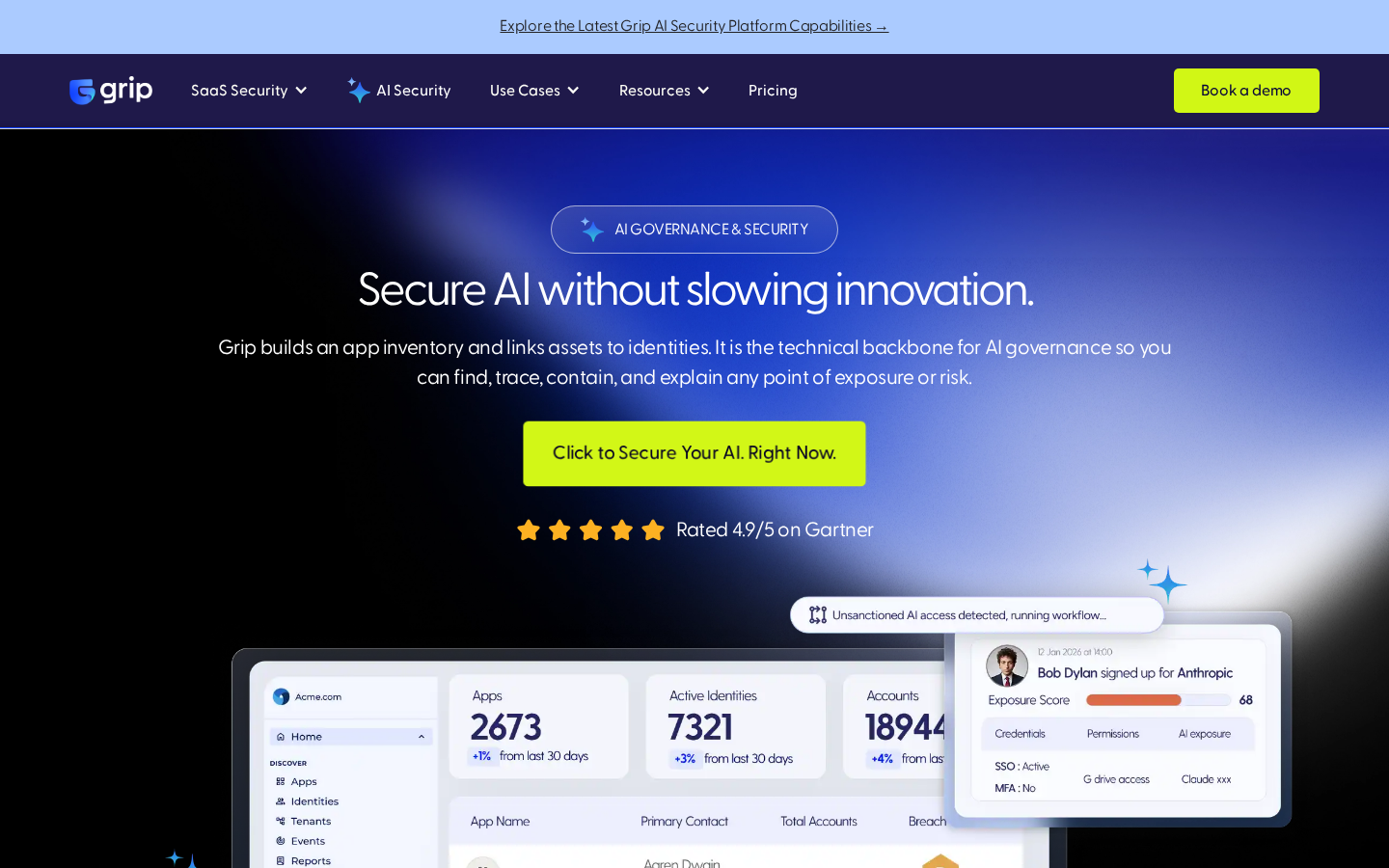
Most SaaS security shortlists end with these two because they attack the same problem from opposite ends. Grip starts at your identity provider and finds every app an employee has ever signed into, sanctioned or not.
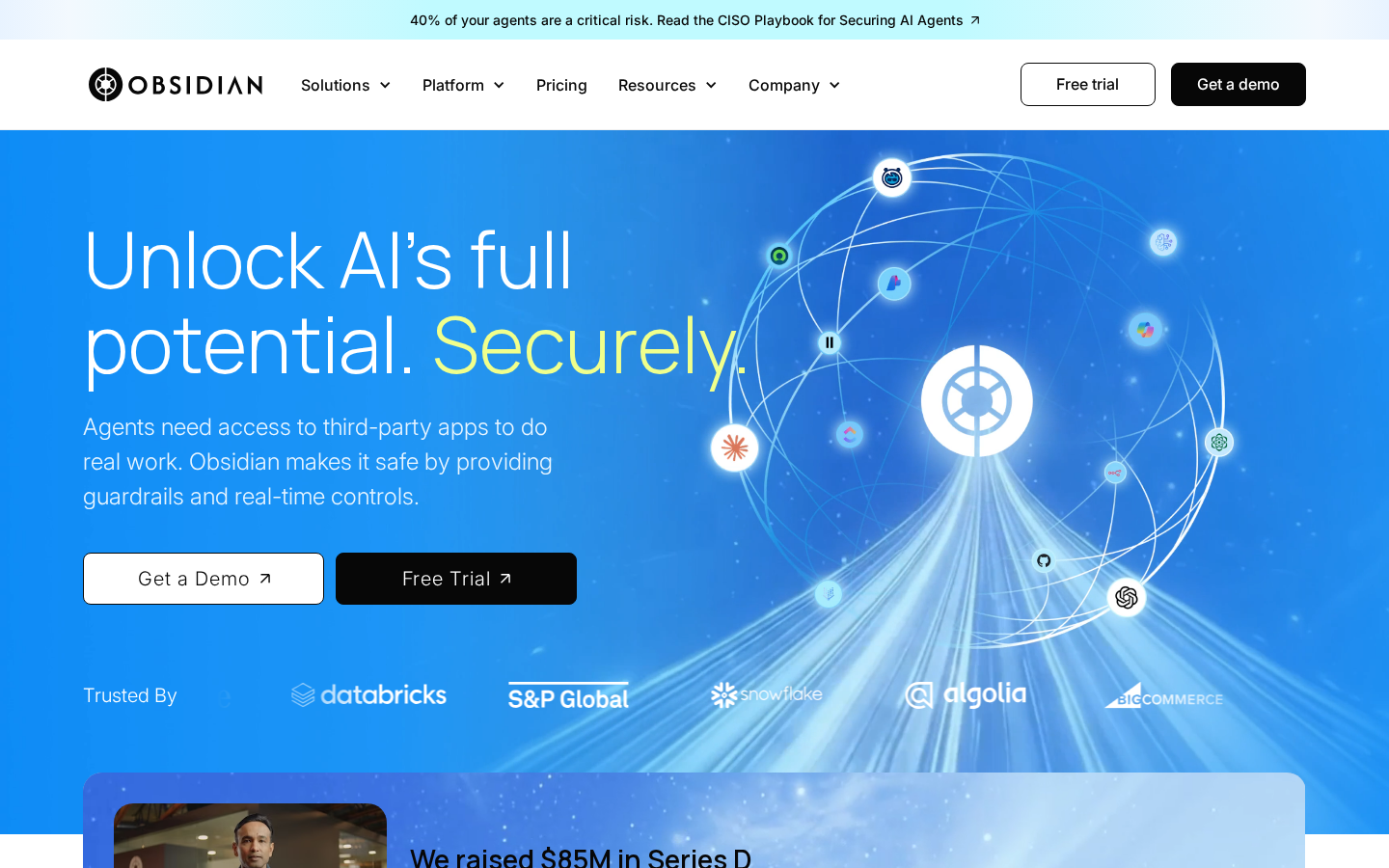
Obsidian starts with the apps you already know matter, connects them into a Knowledge Graph, and watches who does what inside them, with identity threat detection and response (ITDR) and AI agent guardrails on top.
So the question for this quarter is which hurts more: not knowing what's out there, or not seeing what's happening inside what you have. That answer sets how fast you get an inventory, how deep you can go, and what you pay per user.
We pulled the numbers from both vendors' pages on September 8, 2026.
What each one is
Grip is a SaaS security vendor that starts from identity. It reads your identity provider (IdP), SSO logs, OAuth grants and corporate email, with an optional browser extension, and builds a list of every app employees signed into, sanctioned or not, tied back to a person. Fixes run through identity too: rotate a credential, revoke an OAuth grant. A SaaS Security Posture Management (SSPM) module was added in February 2025. It sells to SMB and mid-market teams whose SaaS inventory is still a spreadsheet.
Obsidian Security is a SaaS and AI security platform built around a Knowledge Graph. It connects the applications you already care about, then adds ITDR plus guardrails for AI agents on the paid Advanced line. Free covers sprawl inventory for up to 1,000 users. Foundations and Advanced are quote-only. The company closed a Series D in August 2026 while pushing Claude Code and Cowork agent governance. Buyers are teams that already know their crown-jewel suite and need who-touched-what with response.
The Job row is the whole page in one line. Price floor, deploy time, and who it's for stay here so later tables can go deeper without repeating them.
 Obsidian Security |
Grip |
|
|---|---|---|
| Job | Knowledge Graph SaaS and AI security with ITDR and agent guardrails | Identity-signal discovery and governance across sanctioned and shadow SaaS/AI |
| Price floor | Free $0/mo up to 1,000 users; paid tiers quote-only | From $2/user/mo under 1,000 people; 1,000+ custom |
| Deploy time | Agentless connectors; mid-market Detect also as a browser extension | About 10 minutes via API; roughly five days to gather historic and current usage |
| Who it's for | Teams that already know the suite and need depth plus response | SMB and mid-market teams still building the inventory from identity |
Editions and pricing
Read Public price against Meter first; What you get is what Free or the SMB pack actually unlocks before you talk to sales.
| Obsidian Security |
Grip |
|
|---|---|---|
| Public price | Free $0/mo up to 1,000 users. Foundations and Advanced are Get a quote | Starting at $2/user/mo for organizations under 1,000 people. 1,000+ custom |
| Meter | Paid tiers sales-quoted; Advanced is typically headcount-based | Annual, per human user. Final quote depends on features and contract length |
| What you get | Free: sprawl inventory and spear-phishing detect. Foundations: inventory plus governance. Advanced: detection, live guardrails, and incident response | SMB pack: AI+SaaS discovery, identity-driven security, threat workflows, AI Security Posture Management (AI-SPM) / SSPM. Enterprise: tailored |
Obsidian is free up to 1,000 users for inventory. Grip starts at $2 a user under 1,000 people. So a 500-person org that only needs a list is choosing between $0 and at least $12k a year, and the $12k buys the apps that never touched SSO.
Grip's pricing page is the rare card with a published starting rate. Obsidian's pricing page is clear on Free and quote-only on everything else. Neither posts a full enterprise rate card; the numbers above came from those two pages on September 8, 2026.
Where discovery starts
Primary signals is the fork. What appears first and First-week strength tell you whether week one is a long list or a deep graph.
| Obsidian Security |
Grip |
|
|---|---|---|
| Primary signals | SaaS admin APIs, identity providers, activity streams, browser telemetry into one Knowledge Graph | IdP/SSO logs, OAuth grants, corporate email, optional Grip Extend browser extension |
| What appears first | Connected apps with users, entitlements, tokens, and relationships you can query | Broad inventory of sanctioned and unsanctioned SaaS/AI tied back to people |
| First-week strength | Depth on apps you connect; graph context for posture and threat paths | Breadth of shadow apps that never hit SSO or procurement |
If you still cannot name what employees signed up for, Grip's identity pass is the shorter path because it does not wait on a connector per app. If the crown-jewel suite is already known and the gap is who-touched-what with response, Obsidian's graph is the bet because posture and ITDR sit on that correlated model.
Shadow inventory vs depth and response
Shadow SaaS inventory vs Config / SSPM depth is the ownership split. ITDR and AI runtime guardrails show what only the paid Obsidian line really owns.
| Obsidian Security |
Grip |
|
|---|---|---|
| Shadow SaaS inventory | Yes, including Free sprawl discovery; deepest value still tracks connected apps | Core strength: find unsanctioned and unfederated apps at scale |
| Config / SSPM depth | SSPM on the connected graph; Foundations and Advanced expand governance and detection | SSPM module on top of identity discovery (added February 2025) |
| ITDR | Native ITDR for OAuth abuse, session hijack, and account takeover | SaaS-first ITDR with automated identity risk response |
| AI runtime guardrails | Advanced: live enforcement and agent governance; depth differs by connected platform | Discover and govern AI usage and OAuth; not positioned as live action blocks |
After the inventory exists, either SSPM path can own posture hygiene on the apps that matter. Grip is not a substitute for Obsidian's live agent guardrails. Obsidian Free is not a substitute for Grip's identity-breadth finding on a messy mid-market fleet.
Obsidian unveiled SaaS AI agent defense in September 2025, then used its August 2026 Series D to push Claude Code and Cowork agent governance plus runtime guardrails.
Pros and cons
Grip
Pros
- Finds apps that never hit SSO or procurement.
- Ties every find back to a person and an OAuth grant.
- Publishes a $2/user floor for organizations under 1,000 people.
Cons
- Initial setup and configuration take longer than the ten-minute API claim suggests.
- The SSPM module is still young (added February 2025).
- Full coverage needs IdP, email, and often the browser extension.
Setup friction shows up across reviews. On G2 (Jul 10, 2024), Nitin Y. wrote: "Its initial setup and configuration are complex. There may still be a learning curve for users." That is a setup issue more than a hard product limit, and it hits small security teams that expected day-one governance from the inventory alone. Ask in the demo how many people and how many weeks they budget before findings turn into owned workflows.
Obsidian Security
Pros
- Knowledge Graph plus native ITDR on the apps you connect.
- Free inventory for up to 1,000 users.
- Advanced adds live agent guardrails identity-first tools do not match.
Cons
- Paid Foundations and Advanced stay quote-only.
- Connector automation and UI polish still trail the investigation strength.
- Guardrail and detection depth differ by connected platform.
Connector and investigation depth is the complaint that shows up after the demo. On PeerSpot (Jun 29, 2026), Kemar Wilks wrote that Obsidian "could offer more automated integrations" and that "the user interface is important, and I think there is room for improvement there," while still rating investigations highly. That is partly a setup and product-maturity issue: Microsoft 365 paths are strong, niche apps need more work. Ask which of your three priority apps have the same detection and remediation depth as M365, and whether reporting exports match what your auditors expect in week one.
Verdict
Start from the pain you can name this quarter: missing inventory, or missing activity inside known apps.
- Buy Grip when shadow SaaS and AI still hide outside SSO and you need identity-tied discovery before connector coverage exists. Budget onboarding time; the G2 setup complaint is real for lean teams.
- Buy Obsidian when you need Knowledge Graph depth, ITDR, and AI-agent guardrails on the tools you already run. Confirm connector depth on your non-M365 apps and what exports look like before you sign Advanced.
- Run both only if one owner maps Grip findings into what Obsidian will monitor, so you are not paying twice for the same alerts.
FAQs
Is Grip only an SSPM tool?
Grip's pricing FAQ says yes, it is an SSPM tool, and that it also discovers and governs sanctioned and unsanctioned SaaS/AI beyond classic config scanning.
Does Obsidian publish paid list prices?
No. Free is $0/mo up to 1,000 users on the pricing page. Foundations and Advanced are Get a quote.
Can Obsidian block AI agent actions at runtime?
Advanced markets live guardrails and agent governance. Vendor materials say enforcement depth differs by platform through 2026, with Copilot called out early.
How fast does Grip deploy?
Grip's pricing FAQ says about 10 minutes via API, with roughly five days to gather historic and current AI+SaaS usage depending on organization size. Reviewers still flag a learning curve after that first connect.
More from Startup Stash
Method: How we review tools. More side-by-sides on the Compare hub. Shortlists under Top Tools. Related: Best SSPM platforms, Top ITDR platforms, and Best shadow AI discovery tools.
More coverage: Grip SSPM launch (vendor press, Feb 2025), Obsidian AI agent defense (Sep 2025).

 Obsidian Security vs Grip: knowledge graph or identity discovery?
