


Choose the engine for the game you are making, then look at the license. Are you building 2D or 3D? Is this a solo project or a studio with a hiring plan? Which language does the team already write, which platforms must you ship, and how easy is it to hire people who already know the editor? Unity, Unreal Engine, Godot, GameMaker, and the smaller engines on this page can all ship a good game. They are optimized for different teams and projects, so a feature-list comparison is the wrong first step.
Unreal is the usual starting point for high-end 3D. Unity stays strong for C# teams and multi-platform work, including mobile. Godot gives smaller teams a capable open-source editor with no licensing cost. GameMaker and Construct 3 are much more focused on 2D, with GML or event sheets instead of a general 3D renderer.
Licensing still matters once a game starts earning money or moves to consoles. Unity Personal is $0 up to $200,000 in revenue and funding; Pro is $2,310 per seat per year. Unreal takes 5% after $1 million on the product. GameMaker Professional is $99.99 to sell on PC, mobile, and web. We compare the development experience and what each engine costs if the project succeeds. The method is on How we review tools.
What actually matters when choosing a game engine
Most teams pick an editor screenshot, then discover the license when the game starts earning money or a console port appears. Write the project first, then the bill.
| Problem | Solution |
|---|---|
| A royalty and a seat get modeled as the same bill | Write whether you pay per seat, a royalty, nothing (MIT), or a commercial key |
| Consoles are a second product after you ship | Ask whether console export is in the engine license |
| The public price is an asset pack | Budget the engine license, not an asset pack |
| A 2D tool is sold into a 3D ship plan | Write whether the game you are shipping is 3D |
How we evaluated game development tools
Four checks: whether the editor is built for 2D, 3D, or a named genre; which language and hiring pool it assumes; whether consoles are included or a second product; and what you pay if the game succeeds (seat, royalty, MIT, or commercial key). Trailer screenshots did not move a ranking. Neighbor products sit under Other game development tools worth considering.
TL;DR: The 8 Compared
| Engine | Best for | What to check |
|---|---|---|
| Unity | A C# team that already thinks in seats, especially mobile and multi-platform |
How pricing worksSeat. Personal is free under the revenue and funding cap. No runtime fee
PricePersonal $0 up to $200,000. Pro $2,310 / seat / year
Watch-outFunding counts. A well-raised startup that has not shipped still pays Pro
|
| Unreal Engine | 3D that has to look like a trailer, if you will take a royalty when the title works |
How pricing worksRoyalty on lifetime gross after the product threshold. Engine download is $0
Price5% of worldwide gross after the first $1 million on that product. 3.5% while Launch Everywhere with Epic applies
Watch-outThe rate reverts to 5% going forward if you stop qualifying. Custom licenses replace the EULA. Non-game work can be a seat
|
| Godot | MIT and a 4.x editor, if you will write GDScript or C# and can wait on consoles |
How pricing worksMIT. No seat. No royalty. The Development Fund is not a license term
Price$0. Optional donations
Watch-outConsole shipping is not a built-in export
|
| GameMaker | 2D rooms you intend to sell, with a one-time commercial key |
How pricing worksFree for non-commercial use. Professional unlocks selling on PC, mobile, and web. Enterprise is the console unlock
PriceProfessional $99.99 one-time. Enterprise from $79.99 / month
Watch-outA surprise Switch port is not $99.99. You still need to be a registered platform developer
|
| Construct 3 | Event-sheet 2D teams that will pay a subscription and will not take a royalty |
How pricing worksSubscription editor. No royalties on the public terms
Price$15.99 / month or $129.99 / year Personal
Watch-outConstruct 2 is retired. New work belongs in Construct 3
|
| GDevelop | Events-first 2D teams that want MIT and will read the $50k Pro rule |
How pricing worksMIT editor. Paid cloud seats
PriceFree engine. Paid: check at checkout
Watch-outOver $50k must use Pro
|
| Defold | Lua teams that want a free engine with no royalties and named console paths |
How pricing worksFree engine. No royalties
PriceFree
Watch-outConsole certification is still yours
|
| RPG Maker MZ | 2D RPG teams that want a perpetual editor and will stay inside that genre |
How pricing worksPerpetual genre editor
Price$79.99 MZ
Watch-outNot a general 3D engine
|
Unity
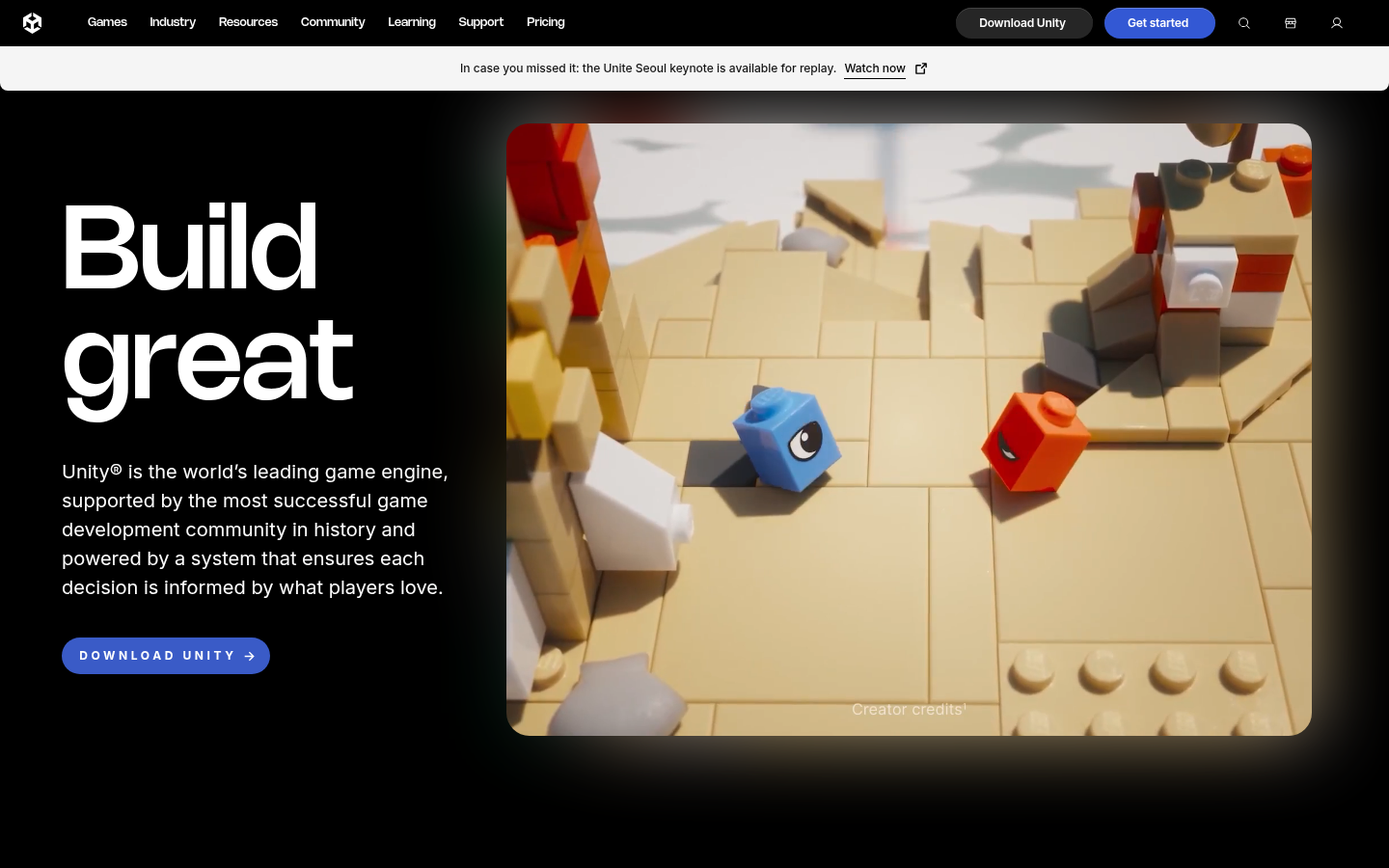
Unity is the C# engine most teams already know: 2D, 3D, mobile, consoles, Vision Pro. The 2023 Runtime Fee is cancelled. You pay for seats. Personal is free up to $200,000 in annual revenue and funding. Above that, Pro is required at $2,310 per seat per year.
Unity 6.3 LTS no longer includes Havok Physics on Pro; Microsoft still sells it as an add-on. Cloud Version Control no longer bills per seat. Egress after 100 GB is extra. The hiring pool and C# prefab workflow are why most teams stay.
Best for: C# teams shipping mobile or multi-platform who already think in seats.
What you get:
- One editor for 2D and 3D, C# scripting, visual scripting if you want it, and console / Vision Pro export on Pro.
- Unity 6 LTS line. Havok is gone from 6.3+ seats; plan physics before you climb LTS versions.
- Cloud Version Control and Build Automation with a free-tier bump. Egress is billed after 100 GB.
- Asset Store and a deep hire pool.
Why we like it: A seat you can forecast beats a per-install surprise. If the team already thinks in C# and prefabs, switching engines to save the $2,310 is usually more expensive than the invoice, and the hiring pool is the other reason to stay.
Limits:
- Pro is required at $200,001 in revenue or funding. A well-raised startup that has not shipped still pays.
- Enterprise above $25 million is a conversation. Custom pricing, minimums possible.
- Havok users on 6.3+ are buying from Microsoft. Do not discover that at upgrade time.
- DevOps egress is $0.10 / GB after 100 GB / month. The seat is not the all-in cloud bill.
Price: Personal is $0 up to $200,000 in revenue and funding. Pro is $2,310 per seat per year. There is no runtime fee.
Unreal Engine
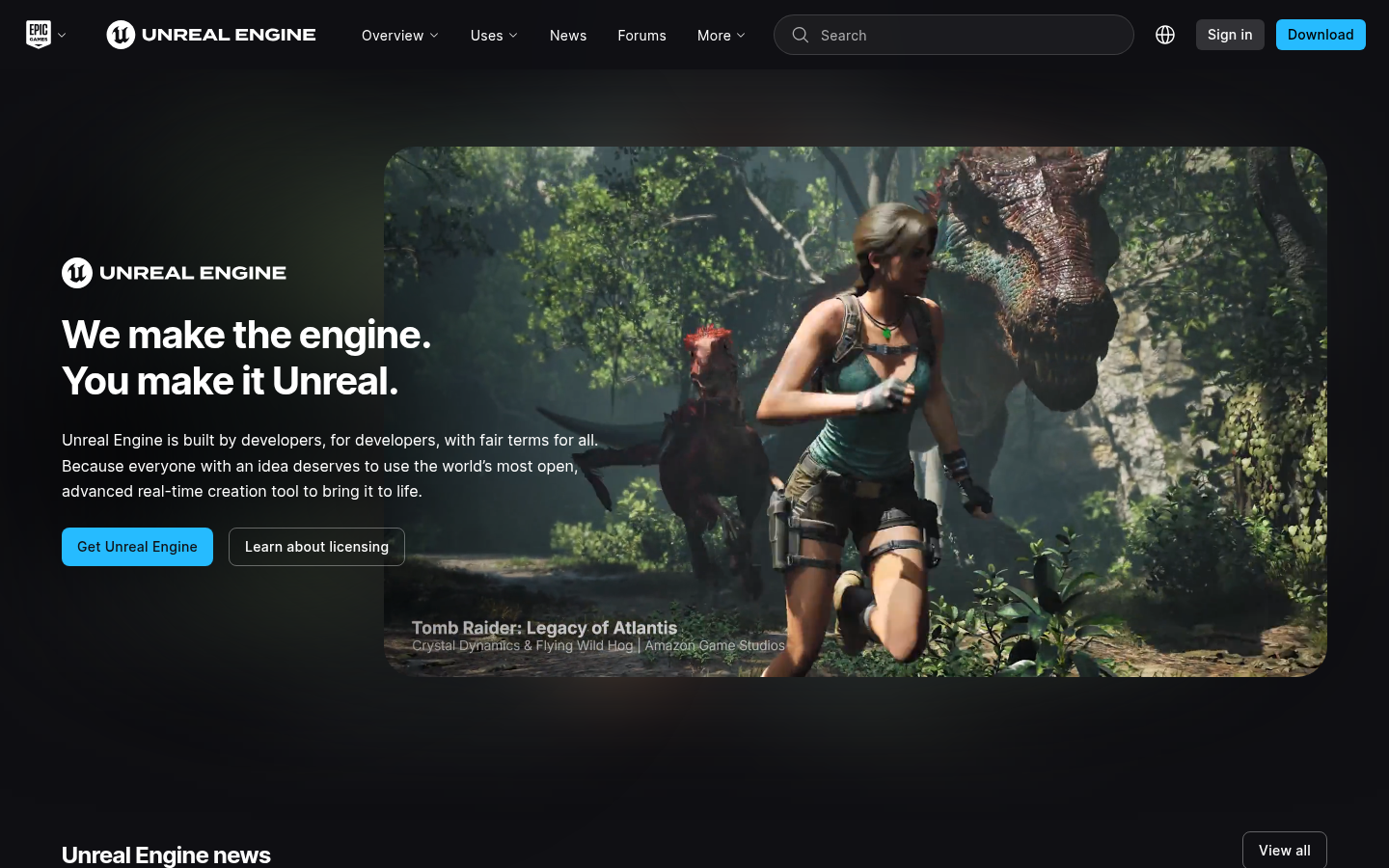
Unreal Engine is the C++ / Blueprint engine you open when the picture has to hold up in a trailer. UE5 is the current line. You download it for $0. The bill, if it comes, is a royalty on the shipped product.
For a Royalty Product (a game or other runtime app licensed to third-party end users) the standard rate is 5% of worldwide gross after the first $1 million lifetime revenue on that product. The first million is waived; they do not claw it back. Launch Everywhere with Epic (ship on the Epic Games Store at the same time as other stores on matching platforms) drops that rate to 3.5% while you qualify. Custom licenses sit outside that addendum. Non-game, non-distributed work has a different seat-subscription path on newer 5.x versions; if you are not shipping a game to players, read that split before you assume “free until $1 million.”
Best for: 3D-first teams that will take a royalty if the title works.
What you get:
- UE5 renderer, World Partition, Blueprints, and a C++ source-available engine.
- Same project to console, PC, and XR. The hard part is the platform cert.
- Fab / Marketplace for content. Budget time as well as dollars.
- Royalty reporting in the Epic Developer Portal instead of a quarterly spreadsheet ritual.
Why we like it: Free until the game actually makes money is the honest indie deal, as long as you can live with 5% on dollar 1,000,001. Teams that pick a seat engine to avoid that royalty and then pay five Pro seats for three years sometimes spend more than the royalty would have.
Limits:
- 5% of gross, with Epic’s exclusions, not net profit. Platform fees do not all come off the top the way people hope.
- Custom licenses are common at real studios and they override the EULA. The public 5% is not what a 200-person team is on.
- Learning curve is real. Blueprints get a prototype up. A shippable third-person game is still an engineering project.
Price: Engine free to download. Royalty is 5% of lifetime gross after $1 million per product, or 3.5% while Launch Everywhere with Epic applies.
Godot
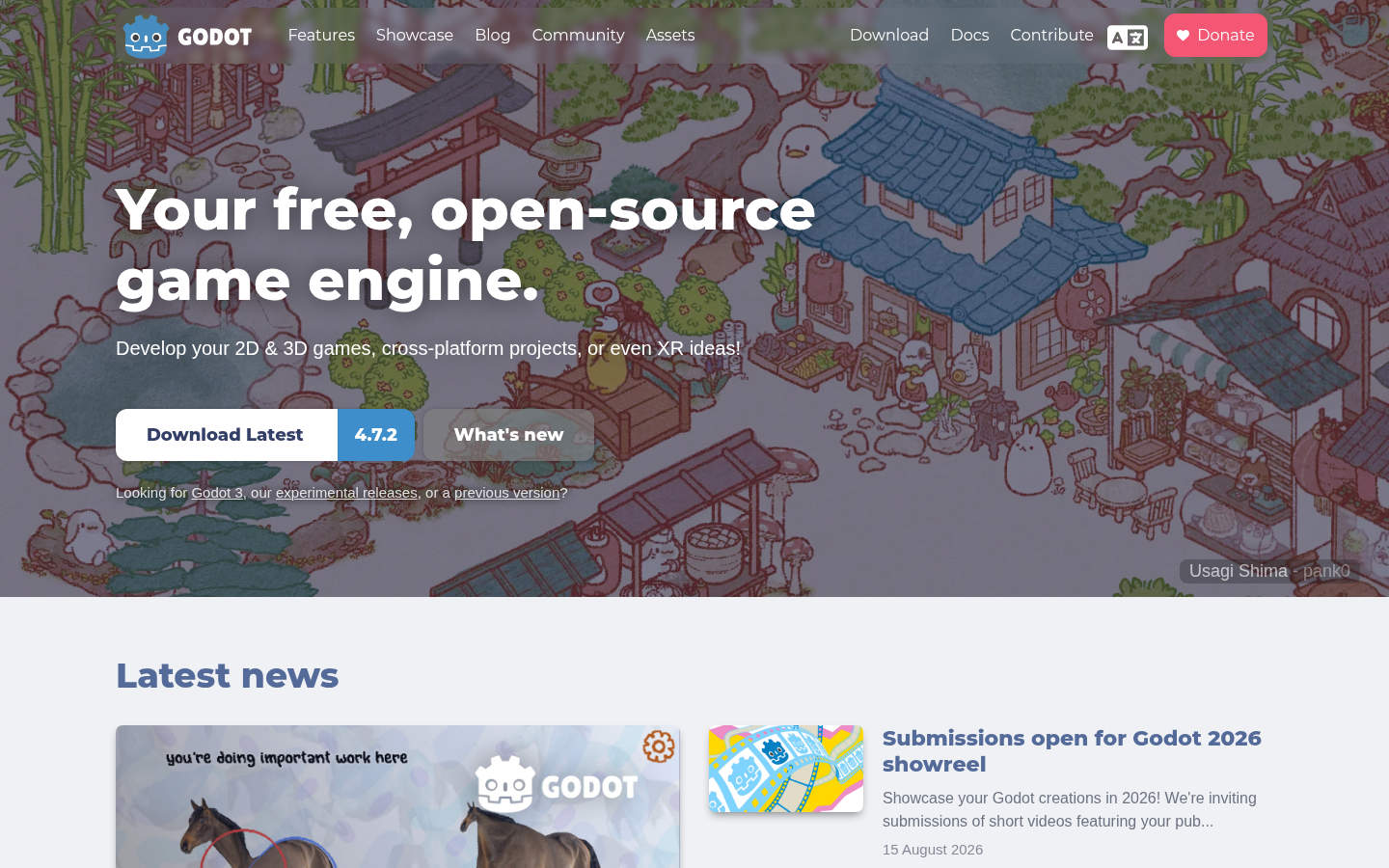
Godot Engine is the MIT-licensed 2D and 3D editor. No seat. No royalty. The Development Fund is how the 4.x line gets paid; it is not a license term.
The current stable track is 4.7. Version 4.7.2 landed 18 August 2026 and is the current 4.7 maintenance build. Jolt is the default physics engine. Export covers desktop, mobile, and web. Consoles exist via third-party porting and official modules as they mature. Do not assume Switch is a button.
Best for: Indies that want an MIT editor, GDScript or C#, and can wait on consoles.
What you get:
- Nodes and scenes, 2D and 3D in one editor, GDScript plus C# (.NET builds are a separate download).
- Export to desktop, mobile, and web. Consoles via a porter or an official module, not a built-in export.
- Jolt as the physics default. Projects that struggled with Godot Physics should run again on Jolt before you call the old quirks gone.
- 4.7.2 on 18 Aug 2026 is a maintenance drop. Take it if you are already on 4.7.
Why we like it: It is the only engine on this shortlist whose honest price is $0 at $10 million revenue. The trade is ecosystem and console path, which is why a C# studio with a console date still starts in Unity, and a trailer-first 3D team still starts in Unreal.
Limits:
- Console shipping is not Unity or Unreal’s “we have the devkits.” Plan a porter or an official module, in writing, before you promise a platform in a pitch deck.
- 3D has come a long way in 4.x and is still not Unreal’s product. If the trailer is the product, start in Unreal.
- Hiring a senior Godot engineer is harder than hiring a Unity engineer. Budget that.
Price: MIT, $0. Optional donations via the Godot Development Fund.
GameMaker
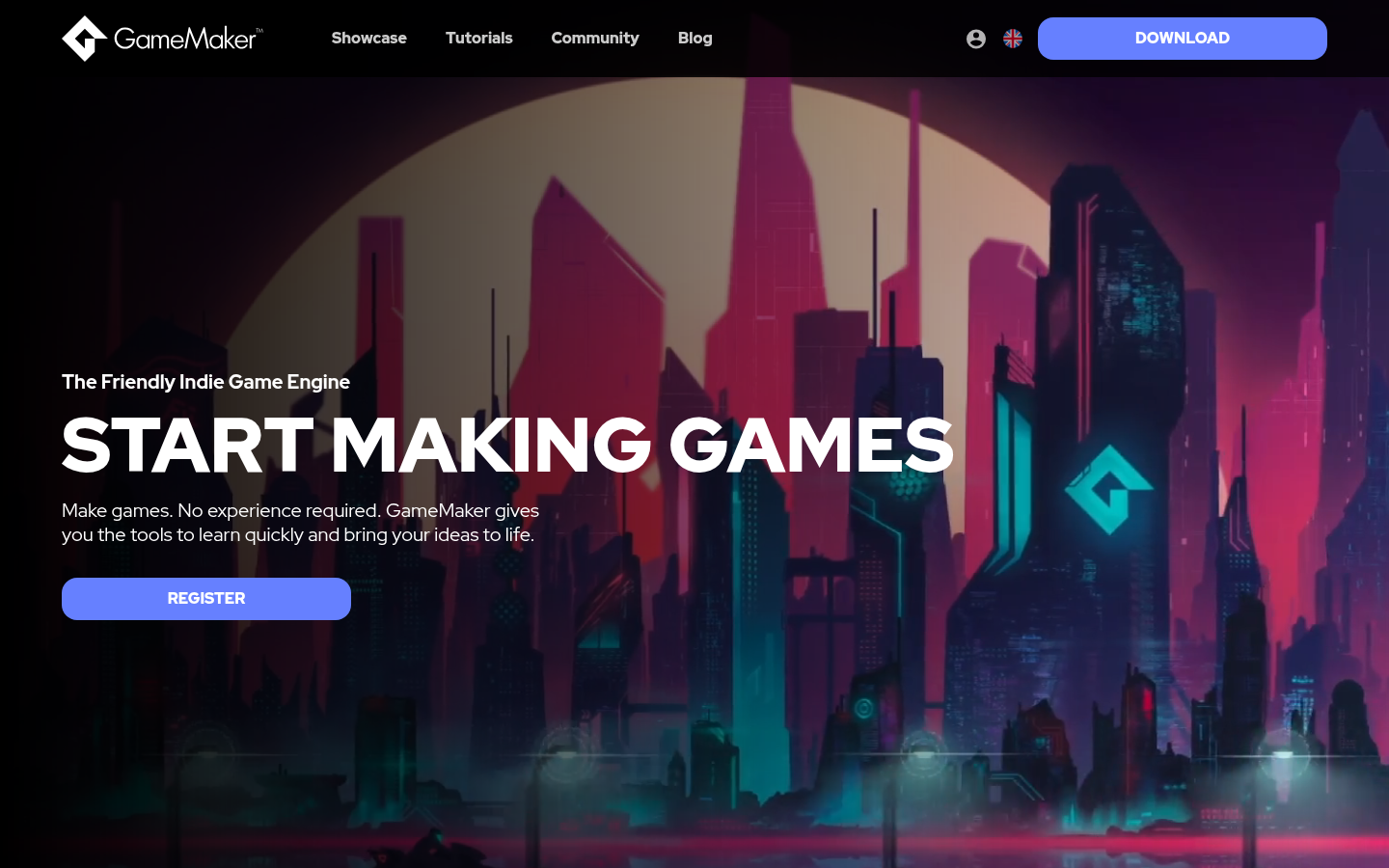
GameMaker is the 2D box: rooms, objects, Drag and Drop or GML. Undertale, Hotline Miami, Pizza Tower. That lineage. It is not a 3D engine with a 2D mode.
Free for non-commercial use, no watermark, with desktop, web, and mobile exports included. To sell the game: Professional, $99.99 one-time (GX, Windows, macOS, Ubuntu, HTML5, Android, iOS, tvOS). Consoles (Xbox, PlayStation, Switch) are Enterprise, from $79.99 per month, and you still need to be a registered platform developer. Old Creator/Indie subscriptions are not renewed; time already paid can discount Professional.
Best for: 2D rooms you intend to sell, with a one-time commercial key.
What you get:
- GML plus Drag and Drop in one IDE. YYC compiles to native for release builds.
- Free tier is the real editor.
- Professional unlocks selling on PC, mobile, and web. Enterprise is the console unlock.
- Asset library is smaller than Unity’s. You will make more of the art.
Why we like it: $99.99 to commercialize is the clearest indie price on this list. Console as a subscription you can turn on for the port months is cheaper than switching engines for a Switch build.
Limits:
- 3D is not the product. If the prototype grows a camera in Z, you are in Godot or Unity.
- GML does not travel. A programmer you hire from a Unity shop will not be productive on day two.
- Enterprise is $79.99 every month you need the console exporters, plus platform fees and kits. A surprise Switch port is not $99.99.
Price: Free for non-commercial use. Professional is $99.99 one-time. Enterprise starts at $79.99 per month.
Construct 3
Construct 3 is a paid 2D event-sheet editor. You build with events rather than a general-purpose 3D renderer. Personal is $15.99 per month or $129.99 per year, with no royalties on the public terms. Construct 2 is retired; new work belongs in Construct 3.
The product is a subscription. You pay while you use the editor, and the public terms do not take a cut of game revenue. That is the split versus Unreal’s royalty, versus GameMaker’s one-time Professional key, and versus GDevelop’s MIT editor (where Pro is required over $50k revenue). It is not an MIT license.
Best for: Event-sheet 2D teams that will pay a subscription and will not take a royalty.
What you get:
- A current Construct 3 event-sheet editor for 2D work.
- Personal subscription with no royalties on the public terms.
- A browser-based editor you pay for while you use it, not a one-time commercial key.
- Construct 2 is retired, so a 2026 project starts here, not on a .capx file.
Why we like it: You get a paid 2D event-sheet editor with no royalties, on a subscription you can budget. GameMaker is the one-time 2D key; GDevelop is the MIT events editor with a $50k Pro rule. Construct 3 is the subscription in the middle.
Limits:
- Personal and Business amounts can change; read the live price when you subscribe.
- Not an MIT editor (that is GDevelop).
- Not a general 3D engine. If the game grows a trailer-first 3D look, you are in Unreal or Unity.
Price: Personal is $15.99 per month or $129.99 per year, with no royalties.
GDevelop
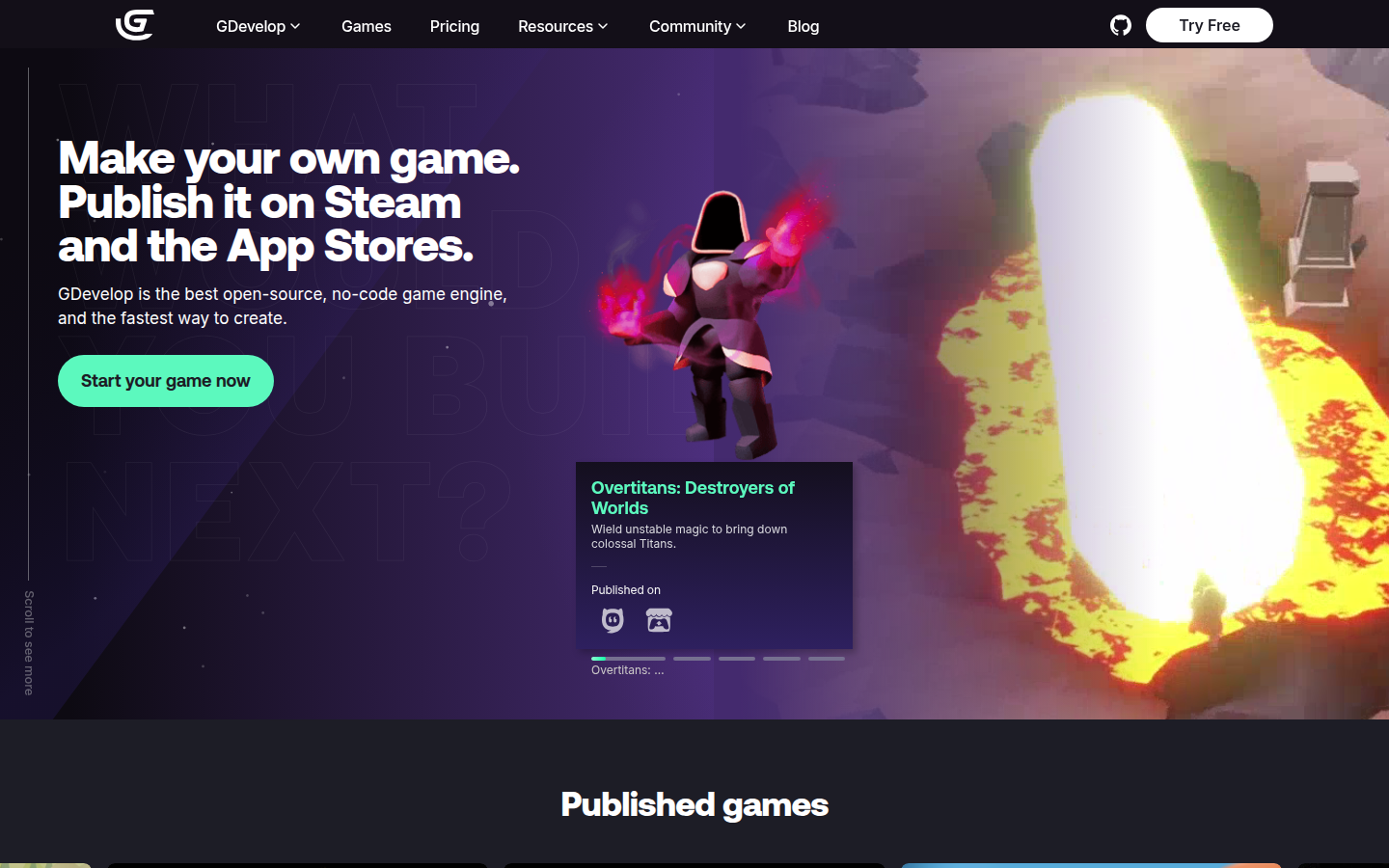
GDevelop is the MIT, events-based editor. The engine is free and open source. Paid cloud Silver, Gold, and Pro seats show at checkout. If your company (or client) is over $50,000 revenue or funds in the prior 12 months, you must use Pro.
You can start at $0 on the MIT editor. The $50k rule is the commercial requirement. That is the split versus Construct 3’s subscription with no royalties, and versus Godot’s MIT editor that uses GDScript or C# instead of events.
Best for: Events-first 2D teams that want MIT and will read the $50k Pro rule.
What you get:
- An MIT events editor for 2D work.
- A free engine, with paid cloud Silver / Gold / Pro seats.
- A rule that over $50k revenue or funds in the prior 12 months must use Pro.
- Event-sheet production without a Construct 3 subscription, as long as you stay under that Pro threshold or pay for Pro.
Why we like it: It is an MIT events editor you can start for $0, with Pro required over $50k revenue. Construct 3 charges a subscription and takes no royalty; GDevelop keeps the editor free until that revenue line, then Pro is mandatory.
Limits:
- Paid cloud amounts show at checkout. Read the live price before you budget a paid seat.
- Over $50k must be Pro.
- Not a general 3D engine, and not Godot’s GDScript/C# workflow.
Price: Engine is free (MIT). Paid Silver / Gold / Pro seats at checkout. Over $50k revenue or funds must use Pro.
Defold
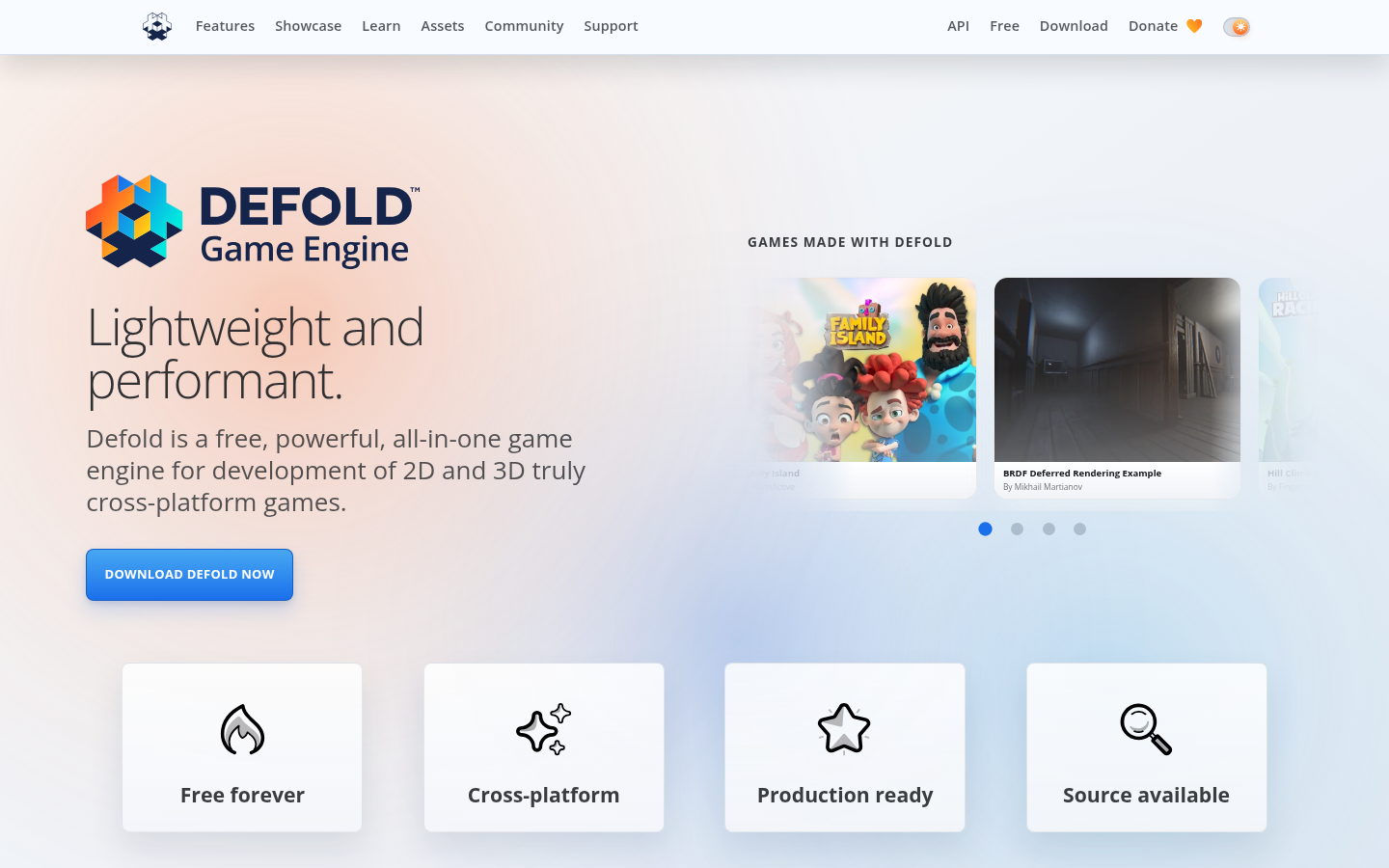
Defold is a Lua engine for 2D and 3D that is free, with no royalties. The vendor names console paths. The license is Apache-derived. There is no seat invoice before you ship.
You still do console certification yourself. This is not a C# Unity project and not a Blueprint Unreal project. Choose it when the team writes Lua, wants a free engine with no royalty if the title succeeds, and needs console paths named by the vendor.
Best for: Lua teams that want a free engine with no royalties and named console paths.
What you get:
- A free engine with no royalties.
- A Lua runtime, with consoles named by the vendor.
- No seat to pay before you ship.
- An Apache-derived license, so success does not turn on a 5% royalty or a $2,310 Pro seat.
Why we like it: You get a free Lua engine with no royalties and consoles named by the vendor. Unreal is free until $1 million, then 5%. Unity is a seat. Defold stays $0 if the game works, as long as the team is actually a Lua team and will own console cert.
Limits:
- Not a C# Unity project and not a Blueprint Unreal project.
- Console certification is still your work.
- The hiring pool is Lua, not the Unity C# market.
Price: Free. No royalties. No paid seat.
RPG Maker MZ
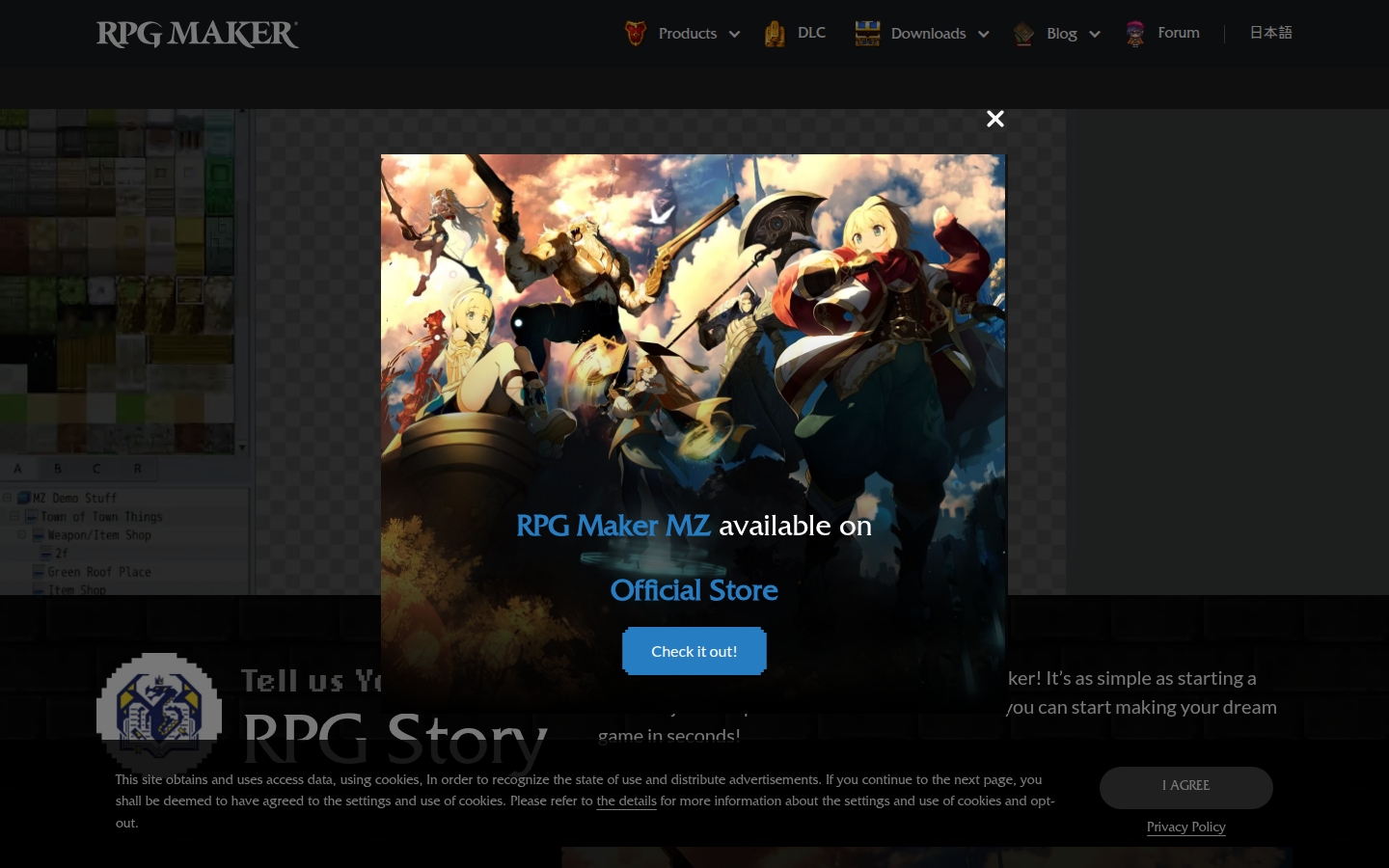
RPG Maker MZ is a 2D RPG editor sold as a perpetual product. MZ is $79.99. That is a genre editor, not a general 3D engine.
Stay inside RPG Maker’s 2D RPG shape. If the game needs a general 3D renderer, Nanite, or C#, this is the wrong editor. The perpetual price is the split versus Construct 3’s subscription and versus Unreal’s royalty.
Best for: 2D RPG teams that want a perpetual editor and will stay inside that genre.
What you get:
- The RPG Maker MZ editor for 2D RPGs.
- A perpetual store product at $79.99.
- A genre editor, not a general 2D or 3D engine.
- A one-time editor purchase, not a seat, royalty, or monthly Construct 3 plan.
Why we like it: You pay about $79.99 once for a 2D RPG editor, not a general 3D engine. That is the honest genre product on this page. GameMaker is the broader 2D commercial key; Unreal and Unity are the general engines you should not stretch an RPG Maker project into.
Limits:
- Wrong if the game is not an RPG Maker-shaped 2D RPG.
- Store prices can move. Read the live store price the day you buy.
- Not a substitute for Unreal, Unity, or Godot if the game leaves that genre.
Price: MZ is $79.99 perpetual.
Do you pay before you ship, and is the game 3D?
This grid plots two questions. Across is when the invoice shows up: a prepaid seat or commercial key on the left, a royalty or MIT license on the right. Up is the picture: high-end 3D at the top, 2D at the bottom.
 5% after $1 million, or free Lua
 $99.99 to sell it
 MIT. GDevelop Pro over $50k
Placement is high-end 3D versus 2D, and a prepaid seat or commercial key versus a royalty or MIT license. Godot can do 3D. It still sits with MIT and 2D-friendly tools because the public license is $0, and high-end 3D on this page is Unreal’s product. Placement only, not review scores.
What you pay when the game ships
| Engine | Published rate | When it bills |
|---|---|---|
| Unity | Personal $0 up to $200,000. Pro $2,310 / seat / year, or $210 / month. Enterprise custom above $25 million | When revenue or funding crosses the cap, not when the game ships. No runtime fee. Egress $0.10 / GB after 100 GB |
| Unreal Engine | 5% of lifetime gross after $1 million per product. 3.5% while Launch Everywhere applies | After the product threshold. The first million is not billed later. A custom license replaces this |
| Godot | MIT, $0 | It does not. Donations are optional and are not a license term |
| GameMaker | Professional $99.99 one-time. Enterprise $79.99 / month or $799.99 / year | When you sell the game (Professional). When consoles enter the build (Enterprise) |
| Construct 3 | Personal $15.99 / month or $129.99 / year | Subscription while you use the editor. No royalties on the public terms |
| GDevelop | Free MIT engine. Paid cloud seats at checkout | Over $50k revenue must use Pro |
| Defold | Free. No royalties | No seat and no royalty |
| RPG Maker MZ | $79.99 perpetual | Pay once for the editor. It is a 2D RPG tool, not a general 3D engine |
Other game development tools worth considering
Neighbors that belong in a different comparison: a discontinued editor, a visual-novel tool, or an art and build app that does not run the game.
- Amazon Lumberyard and Autodesk Stingray - Discontinued. Lumberyard’s continuation is Open 3D Engine if you insist, and it is not this shortlist. Stingray was discontinued in 2018.
- Construct 2 - Retired. Construct 3 is the current subscription product on this list.
- Ren'Py and Twine - Visual novels and hypertext. Real niches. Start with one of the eight above unless you already know you are in that box.
- Blender, Houdini, KeyShot, Character Creator, Incredibuild - Digital content creation and build acceleration. They make the mesh or shorten the compile. They do not run the game.
Questions before you pick an engine license
If a pitch deck cannot answer them, you are still picking an editor screenshot.
- What are you building? 2D or 3D, solo or studio, which language, which platforms, and whether you can hire people who already know the editor. That comes before the invoice.
- How are you billed if the game succeeds? A seat with a revenue-and-funding cap, a royalty after a lifetime threshold, MIT, and a one-time commercial key are different bills. Pick the one you can explain at signing.
- Are consoles a second product? Some seats include console export. Some charge a monthly unlock. Some need a porter. Do not promise a platform the license does not name.
Which game development tool should you pick
C# team that already has project files: Unity, and watch the $200,000 funding cap. 3D that has to look like a trailer: Unreal, and model 5% after $1 million or get a custom license. MIT and a 4.7 editor: Godot. 2D you intend to sell: GameMaker Professional, Enterprise only in the months you actually have console kits. Events on a subscription: Construct 3. MIT events: GDevelop, Pro if you are over $50k. Lua and no royalties: Defold. Genre editor: RPG Maker MZ. Do not start on a discontinued editor.
Frequently asked questions
Is Godot actually free if we raise a seed?
Yes. MIT does not grow a bill at $200,000 or $1 million. Unity Personal does: funding counts, and Pro is required above the published revenue-and-funding cap. Unreal’s royalty is on product revenue, not on the round. GameMaker Professional still bills whether you raised or not. GDevelop requires Pro over its own revenue-or-funds cap.
When does Unreal’s 5% start?
After $1 million lifetime gross on that product, on the revenue Epic counts. The first million is not billed later. Launch Everywhere with Epic is 3.5% while you qualify; the EULA says the rate reverts to 5% going forward when you stop qualifying. Custom licenses replace all of this. Non-game uses can be a seat subscription instead.
Can I still start in Construct 2?
No. Construct 2 is retired. Construct 3 is a subscription. If you want events and an MIT editor, that is GDevelop. If you want a one-time commercial 2D license, that is GameMaker Professional at $99.99. Lumberyard is discontinued. Stingray has been dead since 2018.