

Checking a name against a list and scoring a payment with a model are two different jobs. Anti-money-laundering (AML) screening is the first: a customer, a company, or a payment is matched to watchlists, including politically exposed persons (PEPs). Transaction monitoring is the second: rules and models score the payment itself. Six of these seven are list screening plus a stored reason for the match. One is the bank program that unifies fraud and AML transaction monitoring. Mix those purchases and the morning after a delisting is when you find out.
On 28 May 2026 the Office of Foreign Assets Control (OFAC) took 76 outdated entries off the Specially Designated Nationals (SDN) List: deceased people, scrapped vessels, dead networks, decade-old names without identifiers. That is why re-screening and a stored reason for clearing someone matter more than a list-count slide. On 29 June OFAC also opened an online Reconsideration Portal for delisting petitions. A hit you cannot explain is just another alert.
If you need customer, company, and payment screening with a listed starter, start with ComplyAdvantage. If you are a bank or processor unifying fraud and AML for years, Feedzai. If you want a per-call euro API this week, dilisense. Sanction Scanner, klexta, World-Check, and Bridger Insight XG are quote-led screening: an API and reviewer UI, a shared-subject case platform, the incumbent dataset, or an engine you can point at data you already license. The method is on How we review tools.
What usually goes wrong when choosing AML and sanctions screening
Most bad fits start with treating list screening and transaction monitoring as the same product.
| Problem | Solution |
|---|---|
| A list add or removal never lands in the feed you own | Ask how a list change shows up in your pipeline |
| A delisting has no stored reason | Ask for the field that stores why someone was cleared |
| A KYC verification rate is sitting in a screening budget | Use a public screening rate, or treat it as quote-only |
| A modeling program is sold as a list API | Write whether you are buying a list API or a monitoring program |
How we evaluated AML and sanctions screening
Four checks: how additions and removals land, whether a disposition reason is stored, whether a starting price is public, and whether you can preview alert volume before a threshold goes live. List-count slides did not decide the list. Neighbor products sit under Other AML and sanctions screening tools worth considering.
TL;DR: The 7 Compared
| Platform | Best for | What to check |
|---|---|---|
| ComplyAdvantage | Fintechs that want Mesh screening with a public starter price |
ProductCustomer, company, and payment screening plus monitoring. Cassie and Otto clear assigned low-risk profiles. They do not close the case
PriceFrom $99 / month annual for 100 monitored entities. Enterprise above 2,000 or for transaction screening
Watch-outUnused one-off screens do not roll over. Overages bill at 1.5× the per-unit rate
|
| Feedzai | Banks and processors running a multi-year fraud and AML program |
ProductWatchlist screening on the same stack as transaction monitoring and case management
PriceQuote-only
Watch-outImplementation runs long and needs specialists. Without in-house modeling, a lot of what you pay for sits unused
|
| Sanction Scanner | Teams that need an API for screening plus a reviewer interface |
ProductSanctions, PEP, watchlist, and adverse media, plus real-time alerting and cases
PriceQuote-only
Watch-outThe free no-login web check covers OFAC SDN, the UK sanctions list, and the EU official list. That is a demo of three lists
|
| klexta | Teams that need screening, monitoring, and cases on one subject model |
ProductLens, Trax, and Flow are modular. Trax dry-runs a rule change against history before it touches production
PriceQuote-only. Price the modules you will turn on
Watch-outThe full picture is three lines. Validate throughput on your own peak
|
| LSEG World-Check | Regulated firms that need World-Check data, then a UI or an API |
ProductIncumbent screening data. One is the UI. On Demand is the API. A licensed feed is the contract
PriceQuote-only. Self-serve points for up to 3 users
Watch-out3-user cap on self-serve One. Bank-grade volume is a data contract
|
| LexisNexis Bridger Insight XG | Banks and insurers that want a screening engine on data they already license |
ProductEngine plus WorldCompliance, or bring your own data
PriceQuote-only
Watch-outNot a consumer report under the Fair Credit Reporting Act
|
| dilisense | Builders who want a published per-call sanctions and PEP API |
ProductScreening API
Price100 free calls / month. Starter EUR 0.10 / call. Packs from EUR 150
Watch-outNot a transaction-monitoring case suite
|
ComplyAdvantage
ComplyAdvantage is the strongest fit here for teams that need Mesh screening they can price before a sales call, rather than a multi-year fraud-plus-AML program. Mesh covers customers, companies, and payments against sanctions, PEPs, and adverse media, plus monitoring and cases on one risk-data layer.
Agents Cassie (onboarding) and Otto (ongoing monitoring) can clear assigned low-risk profiles. They do not close the case as a whole. Your team still assigns the work and owns the final judgment. Every action is logged. Above 2,000 monitored entities, or if you need transaction screening, you are on Enterprise.
Best for: Fintechs that want Mesh screening with a public starter price.
What you get:
- Customer, company, and payment screening against sanctions, PEP, and adverse media.
- Ongoing monitoring with configurable risk profiles, and access within 24 hours on weekdays after payment.
- Agentic workflows on Mesh (Cassie and Otto) with a full audit trail.
- An API for straight-through payment screening.
Why we like it: You can price Mesh screening before a sales call, and still get customer, company, and payment checks on one data layer. dilisense is per-call and has no case suite. Feedzai will not give you a listed starter.
Limits:
- Starter agent configs are standardized. Custom agents are an Enterprise conversation.
- Expect tuning work to bring false positives down. Pilot your actual corridors.
- Transaction monitoring at volume is not the starter. Unused one-off screens do not roll over. Overages bill at 1.5 times the per-unit rate.
Price: Essentials starts at $99 per month billed annually for 100 monitored entities. Enterprise is custom above 2,000 entities, or for transaction screening.
Feedzai
Feedzai is the bank program on this list: AML transaction monitoring, watchlist screening, and case management on the same RiskOps stack. Rules plus models prioritize the queue. Feature engineering is aimed at risk teams that employ their own modelers. ComplyAdvantage and Sanction Scanner will not replace that desk.
On 6 March 2026 Novobanco named Feedzai the platform for a multi-year fraud and AML transformation. That is a bank putting fraud and AML on one stack, not a screening API.
Best for: Banks and processors running a multi-year fraud and AML program.
What you get:
- Watchlist, sanctions, PEP, and transaction screening on the same platform as monitoring.
- Rules plus adaptive models, with prioritization so investigators see high-risk first.
- Case manager with documented decisions and exportable audit trails.
- Data orchestration (Demyst / Zonic) for third-party sources in the same workflow. AWS Marketplace is a procurement path.
Why we like it: If fraud and AML have to share a queue, and you have modelers, this is the only program-shaped option here. The others are list screening with a case UI.
Limits:
- Implementation runs long and needs specialists. Budget elapsed time as well as the licence.
- No public list rate. Expect a scoped enterprise engagement.
- Without in-house modeling, a lot of what you pay for sits unused.
Price: Quote-only.
Sanction Scanner
Sanction Scanner is an API-first sanctions, PEP, watchlist, and adverse-media platform with alerting, cases, and audit trails. Feedzai is the modeling suite. This is the path when the constraint is wiring an API and giving a junior analyst a clear review screen.
A free, no-login web check covers OFAC SDN, the UK Office of Financial Sanctions Implementation (OFSI), and the EU official list, and emails a PDF. That free tool is a demo of three lists. Transaction monitoring here is real-time alerting, not an enterprise modeling studio.
Best for: Teams that need an API for screening plus a reviewer interface.
What you get:
- Name and transaction screening against sanctions, PEP, watchlists, and adverse media.
- Real-time transaction monitoring and alerting.
- Built-in case management with audit trails and reporting.
- REST API plus webhooks, 250 ms average response.
Why we like it: You get an API and a reviewer screen a junior analyst can use, without a bank modeling contract. Customization is shallower than Feedzai or klexta Trax.
Limits:
- No public price list.
- Shallower customization than a bank modeling suite. Run a proof of concept on your own lists.
- Monitoring is basic to intermediate. Do not buy this as a modeling-suite substitute.
Price: Quote-only. Free web screening of OFAC, UK, and EU names is a demo.
klexta
klexta is screening, transaction scoring, and casework on one subject model. Lens, Trax, and Flow are modular. If a delisting re-screen has to arrive with history, that shared subject is the difference versus a standalone screening API.
Lens returns sanctions, PEP, adverse media, and watchlist results in one structured, deduplicated response. Trax scores every transaction at submission and shows the rules and signals that contributed. Dry-run replay puts a rule change against historical data before it touches production. Flow turns those alerts into investigation-ready cases with evidence attached. Sentinel is the always-on agent layer inside Flow: it routes the case and stops when policy requires a person.
Best for: Teams that need screening, monitoring, and cases on one subject model.
What you get:
- Lens: one response, deduplicated across overlapping lists.
- Trax: per-transaction scoring, contributing-rule explainability, dry-run replay.
- Flow: cases with owners, stages, exportable audit trail. Trax alerts and Lens hits convert with subject history attached.
- Adopt one product first. APIs and webhooks into onboarding or core banking.
Why we like it: You can replay a threshold against history before it goes live, and the same subject record rides into the case. Nobody else on this list makes that dry-run the point of the product.
Limits:
- Validate throughput on your own peak before you commit the queue.
- Scope the quote. Lens, Trax, and Flow are modular. The full picture is three lines.
- No public list rate.
Price: Quote-only. Price the modules you will turn on.
LSEG World-Check
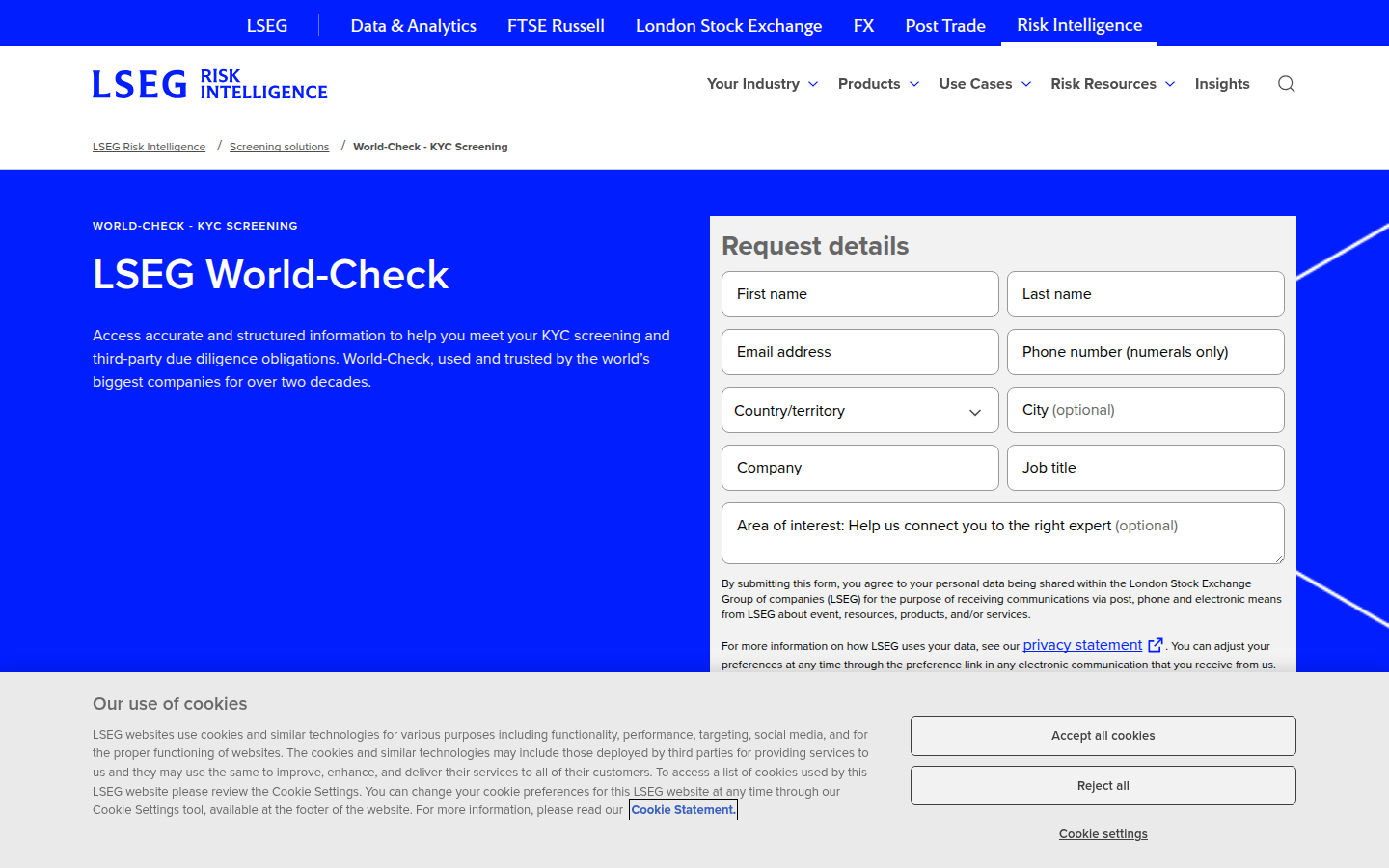
LSEG World-Check is the incumbent risk-intelligence dataset, not a starter API. If an examiner already expects World-Check, you buy that data, then choose the One UI, the On Demand API, or a licensed feed. Bridger is the engine you can point at data you already license.
Coverage includes PEPs, global sanctions, enforcement lists, adverse media, and sanctioned securities. There is also a batch API and a Zero Footprint Screening API when names should not leave the buyer. Self-serve One packages use usage points for up to 3 users, with a 7-day free trial. Bank-grade volume is a data contract, not the 3-user pack.
Best for: Regulated firms that need World-Check data, then a UI or an API.
What you get:
- Incumbent PEP, sanctions, and adverse-media data, plus optional add-on sets.
- World-Check One for data plus a screening UI, On Demand for an API-first feed, or a licensed data contract.
- Online exclusive packages: 7-day free trial, self-serve points, dashboard usage, and quarterly overage invoices.
- Batch API and Zero Footprint Screening API when names should not leave the buyer.
Why we like it: If the examiner already expects World-Check, you are buying the dataset other platforms license. Then you pick the UI, the API, or a feed. A starter API is not the same records.
Limits:
- No public dollar rate. Self-serve One uses usage points.
- Self-serve One packages cap at 3 users. Unused points do not roll after 12 months.
- Bank-grade volume is an incumbent data contract or API license, not the 3-user points pack.
Price: Quote-only. A 7-day free trial on self-serve One. Paid self-serve is usage points for up to 3 users. Bank-grade volume is a quote.
LexisNexis Bridger Insight XG
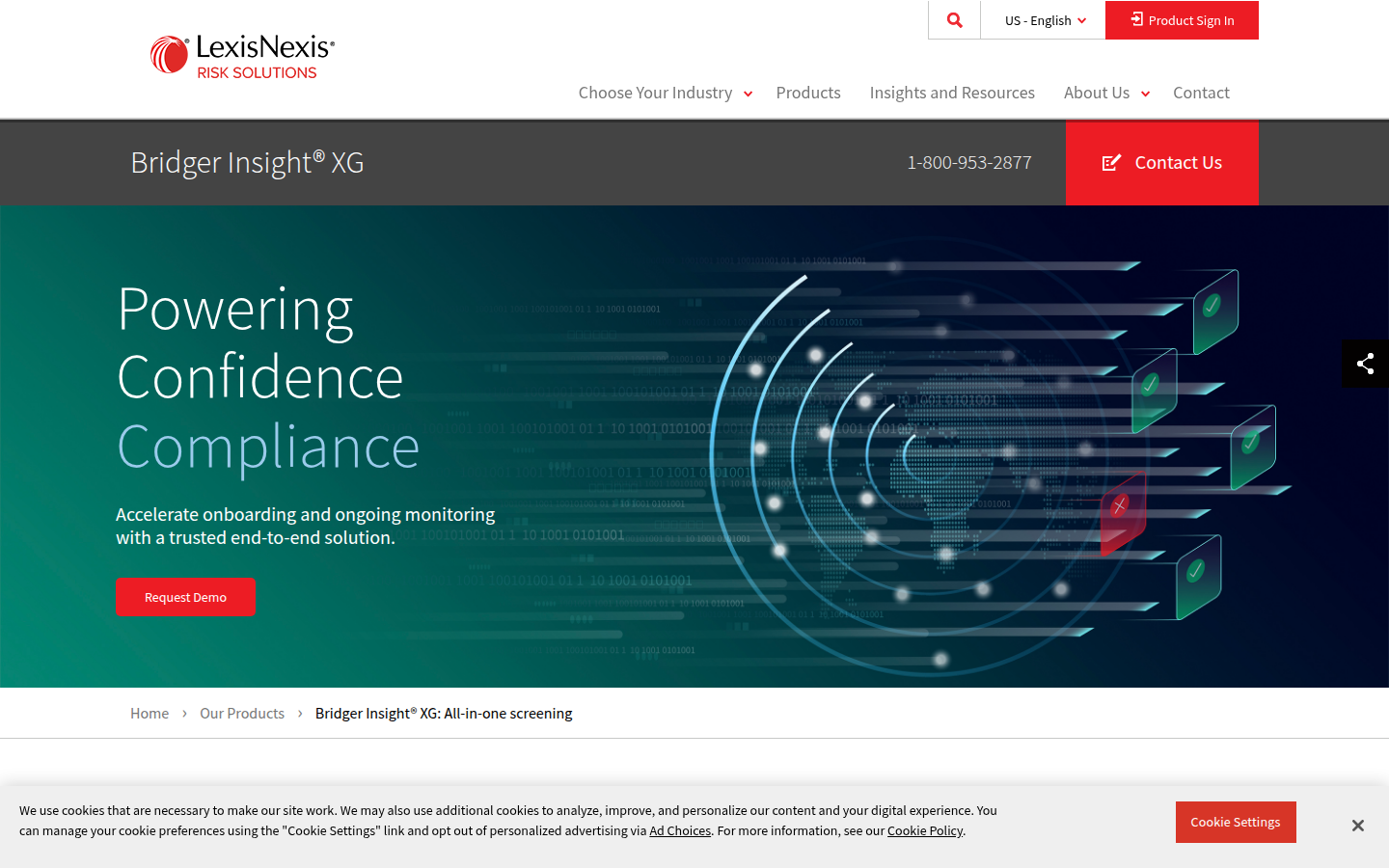
LexisNexis Bridger Insight XG is the screening engine plus workflow, not a data feed you drop into someone else’s UI. End-to-end account and payment screening sit in one product: a UI, batch, and API, on public or private cloud or on-prem. Default data is LexisNexis WorldCompliance. You can also bring a list you already license. World-Check is the dataset. This is the matcher, the thresholds, and the rescreen.
Configurable match thresholds and ongoing rescreen when lists or portfolios change are in the core product. InstantID and enhanced due diligence are optional add-ons. Bridger Insight XG is not a consumer report and must not be used for Fair Credit Reporting Act (FCRA) eligibility decisions.
Best for: Banks and insurers that want a screening engine on data they already license.
What you get:
- Account and payment screening in a UI, plus batch and API (XGServices).
- WorldCompliance as the default dataset, or bring another data provider.
- Configurable match thresholds and ongoing rescreen when lists or portfolios change.
- Public or private cloud, or on-prem, with optional InstantID and enhanced due-diligence add-ons.
Why we like it: You get the matcher and the workflow in one engine. If you already license a list, you can keep it. World-Check is the data. This is the engine you point at data.
Limits:
- No public screening price. Sales quote covers the engine and the data.
- Not a self-serve API. This is an incumbent contract.
- FCRA: not a consumer report, and not for eligibility decisions.
Price: Quote-only.
dilisense
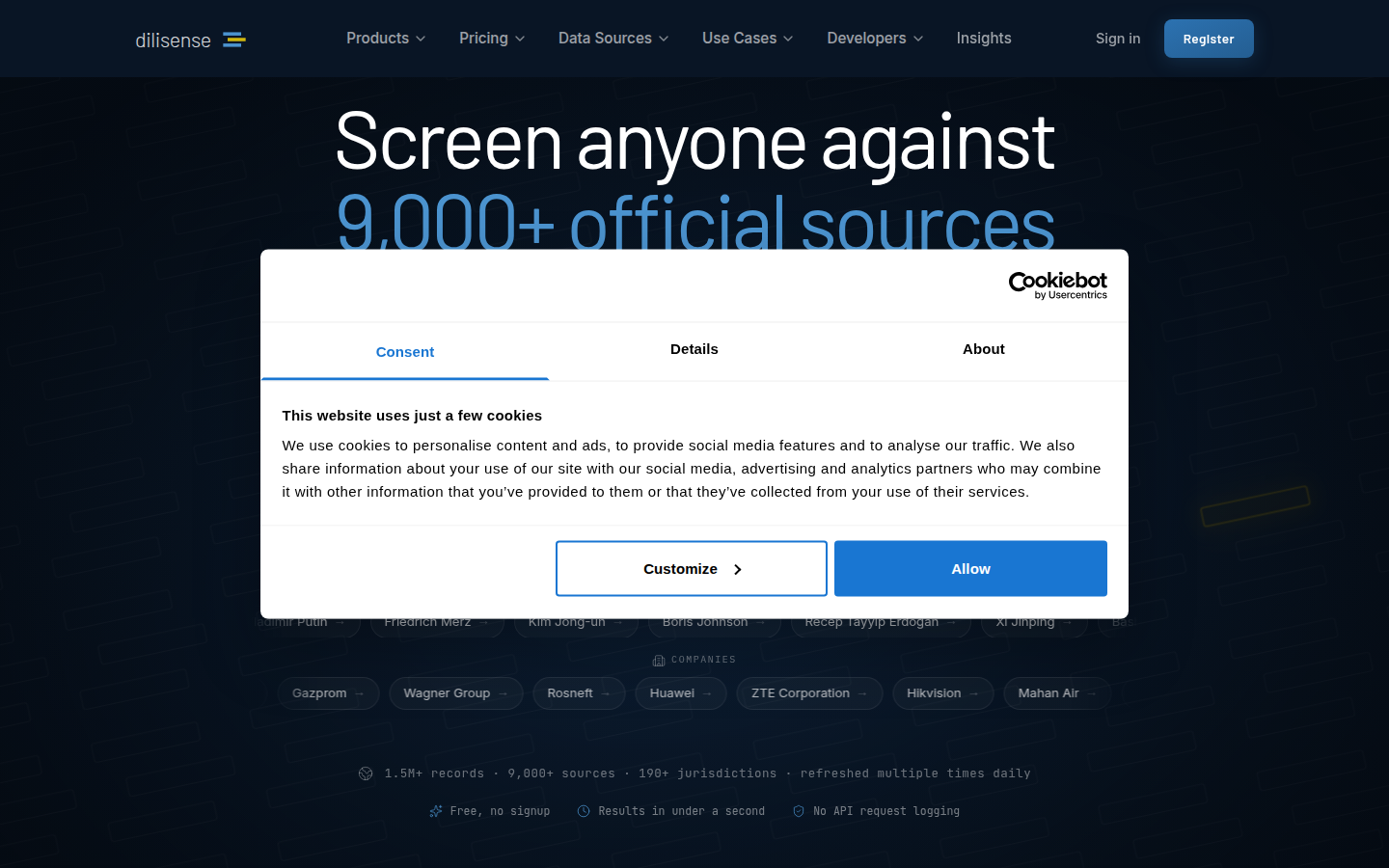
dilisense is a sanctions, PEP, criminal, and regulatory screening API with a listed euro rate, not a case-ops suite. ComplyAdvantage’s starter is a monitored-entity seat. Billing here is per call. World-Check and Bridger stay quote-only.
Lists update hourly, with fuzzy filters on the API. A free, no-login web search covers sanctions, PEP, and criminal names. An on-prem database is a separate quote so customer names never leave the buyer. Request bodies are not logged; billing stores timestamp and count only.
Best for: Builders who want a published per-call sanctions and PEP API.
What you get:
- A screening API against sanctions, PEP, criminal, and regulatory sources, with hourly-updated lists and fuzzy filters.
- Free no-login web search, plus Excel batch screening.
- Optional on-prem AML database so customer names never leave the buyer.
- No request-body logging. Billing stores timestamp and count only.
Why we like it: You can put a per-call euro rate in a budget this week. World-Check and Bridger stay quote-only. ComplyAdvantage’s starter is a monitored-entity seat, not a per-call API.
Limits:
- This is a screening-data API, not a full case-management or transaction-monitoring platform.
- Pay-as-you-go is capped at 10,000 calls per month. Above that you contact sales.
- Adverse media is a lower-price option and is not always in the cheapest plan.
Price: 100 free calls per month. Starter is EUR 0.10 per call. Packs from EUR 150 per month. On-prem database is quote.
Name screening is not entity proof. If the next question is whether the company on the other side of the payment is real, see our related list of KYB business verification platforms.
Is a price listed, and is this a list API or a modeling program?
This grid plots two questions. Across is whether a starting price is listed: a listed price on the left, quote-only on the right. Up is the product: a unified fraud-plus-AML modeling program at the top, list screening and casework at the bottom.
 Listed starter, not volume monitoring
 API or shared subject
Placement is a screening-and-case product versus a unified fraud-plus-AML suite, and a listed starter versus quote-only. Two logos share the listed-price screening square. Placement only, not review scores. The $99 Essentials line is 100 monitored entities, not transaction monitoring at volume.
How a delisting shows up
| Platform | Public rate | What a delisting needs |
|---|---|---|
| ComplyAdvantage | Essentials from $99 / month annual at 100 monitored entities | Re-screen plus a logged agent or analyst action. Agents remediate profiles; they do not close the case |
| Feedzai | Quote-only | Modeling controls can preview volume if you have modelers. Budget elapsed time |
| Sanction Scanner | Quote-only. Free OFAC / UK / EU web check is a three-list demo | Ask for refresh SLA and the field that stores why someone was cleared |
| klexta | Quote-only. Price Lens, Trax, and Flow separately | Trax dry-runs the threshold against history. Subject history rides into the Flow case |
| LSEG World-Check | Quote-only. Self-serve points for up to 3 users | Bank-grade volume is a data contract, not the 3-user pack |
| LexisNexis Bridger Insight XG | Quote-only | Ongoing rescreen when lists or portfolios change. Not a consumer report under FCRA |
| dilisense | 100 free calls / month. Starter EUR 0.10 / call. Packs from EUR 150 / month | Hourly-updated lists. No case suite to store a disposition reason |
Other AML and sanctions screening tools worth considering
These are real products next door. Someone would want them. They are not list-screening versus fraud-plus-AML infrastructure in the sense this page compares.
- Dow Jones Risk & Compliance - Incumbent risk data if the bank already lives there. Useful as a data contract. It is not a starter screening API as compared here.
- Moody’s Grid - Same incumbent-data job.
- NICE Actimize and other transaction-monitoring-only suites - Useful if the gap is payment scoring at a bank. Confirming the legal entity on the other side of the payment is a KYB job, not another sanctions list.
Questions before you change a threshold
If these three stay vague, you are still buying a list-count slide.
- How do additions and removals land? OFAC now prunes as well as designates. Ask for refresh SLA, re-screen behavior, and the field that stores why someone was cleared after a delisting.
- Can you preview alert volume? A dry-run against history is the honest control. If the platform cannot preview, stage the change and keep a rollback.
- Who owns the case at 2 a.m.? Agents can clear assigned profiles. They do not close the case. Write that in the operating model before you staff for 85 percent automation.
Which AML platform should you pick
Listed starter and Mesh screening: ComplyAdvantage, from $99 per month billed annually for 100 monitored entities. Transaction monitoring at volume is a different conversation. Bank program that unifies fraud and AML: Feedzai, quote-only. API and a junior-analyst UI: Sanction Scanner, quote-only. Shared subject plus a dry-run: klexta, and price Lens, Trax, and Flow as three lines. Incumbent dataset: LSEG World-Check, quote-only with a 3-user self-serve path. Engine plus WorldCompliance: Bridger Insight XG, quote-only. Per-call API: dilisense, 100 free calls, then Starter EUR 0.10 per call. Then put the delisting field next to last month’s false-positive rate.
Frequently asked questions
Is a 3,000-list slide the same purchase as a fraud-plus-AML program?
No. List screening returns a name hit and, if you bought it, a disposition reason. A modeling suite scores payments and needs modelers. Mixing those is how a starter list API gets compared to a multi-year bank program.
Which platforms list a public price?
Two do. ComplyAdvantage Essentials starts at $99 per month billed annually for 100 monitored entities. Enterprise is custom above 2,000 entities, or for transaction screening. dilisense lists 100 free calls per month, Starter at EUR 0.10 per call, and packs from EUR 150 per month. Feedzai, Sanction Scanner, klexta, World-Check, and Bridger Insight XG are quote-only.
Can an agent close a case you would show an examiner?
Cassie and Otto remediate assigned profiles. They do not close the case as a whole. Whether that satisfies your examiner’s human-judgment rule is a policy question, not a product toggle. Ask before you staff for 85 percent automation.