

Building with stablecoins can mean very different things. You might want to issue your own branded stablecoin, add USDC wallets to a product, or use stablecoins to move money across borders. Those jobs all get sold as “stablecoin infrastructure,” which is why comparing homepages is confusing.
Those jobs need different infrastructure. If you are issuing a coin, the important questions are who legally issues it, where the reserves sit, and who will redeem it for $1. A bank trust charter is often about holding assets, not a promise that the trust issues the coin. If you are simply adding wallets, pricing, chain support, and developer experience matter more. A public wallet rate helps with that job. It is not an issuance conversation.
Circle and Crossmint are the easiest wallet options here to price before talking to sales. Both publish starting rates, while most issuance platforms require a quote. Bridge, Paxos, Bastion, MoonPay, and Brale become more relevant when issuance is part of the job. The method is on How we review tools.
If you are issuing a coin, a 22 June 2026 proposal from the Financial Crimes Enforcement Network (FinCEN) and the banking agencies would treat permitted payment stablecoin issuers as financial institutions that must run a Customer Identification Program. That is a compliance plan for people who issue a coin. It does not change a wallet-only build.
What usually goes wrong when choosing stablecoin infrastructure
Most bad fits start with treating issuance and wallets as the same product.
| Problem | Solution |
|---|---|
| You bought wallet software when you needed to issue a coin | Write down whether you are issuing a coin or adding wallets |
| Pricing is a partnership slide, not a number | Use a public vendor price, or treat it as quote-only |
| No issuer or regulator is named | Ask for the issuer and the regulator in writing |
| Redemption is missing from the contract | Write how redemption works before you sign |
How we evaluated stablecoin infrastructure
Four checks: whether the product is issuance or wallets, whether a starting price is public, whether an issuer and a regulator are named, and whether redemption is described as a product. Third-party fee rumors did not decide the list. Neighbor products sit under Other stablecoin infrastructure platforms worth considering.
TL;DR: The 7 Compared
| Platform | Best for | What to check |
|---|---|---|
| Circle | USDC wallets and payments with public pricing |
ProductWallets, institutional Mint, cross-chain USDC. Not a white-label coin
PricingFirst 1,000 monthly active wallets free. Signing from $0.038; all-included from $0.050
Watch-outNational trust is custody. USDC still redeems at regulated affiliates. Sponsored gas is extra
|
| Bridge | Branded issuance and payouts in the Stripe orbit |
ProductIssuance, orchestration, cards, wallets
PricingQuote-only
Watch-outReserve yield of 3–4% is theirs. Who redeems a branded coin is not named
|
| Paxos | Institutional mint and redeem, including PayPal-class programs |
ProductUSDP, PYUSD, USDG, PAXG under Paxos Trust Company
PricingQuote-only. Production is an enterprise engagement
Watch-outThe trust is the issuer. BUSD is a legacy asset
|
| Crossmint | Developer wallets and checkout this month |
ProductWallets, ramps, checkout, orchestration. Not an issuer
Pricing1,000 wallets free, then from $0.05. Tokenization from $0.01
Watch-outRamps, checkout, and orchestration are custom. The wallet rate is not the payments bill
|
| Bastion | New York trust-charter issuance plus wallets |
ProductIssuance and custodial wallets
PricingQuote-only
Watch-outThe trust and the wallet company are separate legal entities
|
| MoonPay Enterprise Issue | A branded coin on MoonPay’s licenses |
ProductBusiness issuance: mint, redeem, onboarding
PricingQuote-only
Watch-outNot the consumer MoonPay widget
|
| Brale | Listed issuance prices before a sales call |
ProductIssuance, custody, and payment rails
PricingMini $10 / month. Pro $500. Business is $0 plus usage
Watch-outThe $0 line is not the issuance plan
|
Circle
Circle is the strongest fit here for teams building around USDC rather than launching their own branded stablecoin. Circle Wallets gives developers managed wallet infrastructure, while Mint serves institutional access and a cross-chain transfer product moves USDC between chains.
The important regulatory detail is that Circle’s national trust charter does not itself issue USDC. On 10 July 2026 the Office of the Comptroller of the Currency (OCC) approved Circle National Trust. That entity is primarily custody. USDC continues to be issued and redeemed through regulated Circle affiliates. The distinction matters if compliance needs to know which legal entity stands behind redemption.
Best for: Teams building USDC wallets or payment products that want public pricing and a regulated issuer ecosystem.
What you get:
- USDC as the dollar stablecoin, plus institutional Mint and cross-chain USDC movement.
- Managed wallets with APIs and SDKs, including passkeys, email, social, and PIN sign-in.
- A public pay-as-you-go wallet rate. The first 1,000 monthly active wallets are free.
- Circle National Trust for fiduciary digital-asset custody. Reserve management is a planned capability, not the current product.
Why we like it: You can price wallets before a sales call, and the federal trust approval is a dated public fact. The trust is custody, not the issuer. Nobody else on this list gives you both a listed wallet rate and that kind of group-level charter.
Limits:
- Wallets is still in beta. Mint is not self-serve. Do not staff a launch as if both were a Stripe account.
- The national trust does not issue the coin and does not make every Circle product a bank product.
- Sponsored gas is extra: billed in dollars plus 5 percent. The wallet rate is not the all-in bill.
Price: The first 1,000 monthly active wallets are free. Paid usage starts at $0.038 per wallet for the Signing API or $0.050 for the All-Included plan, with lower rates at higher volumes. Mint and enterprise products are quote-based.
Bridge
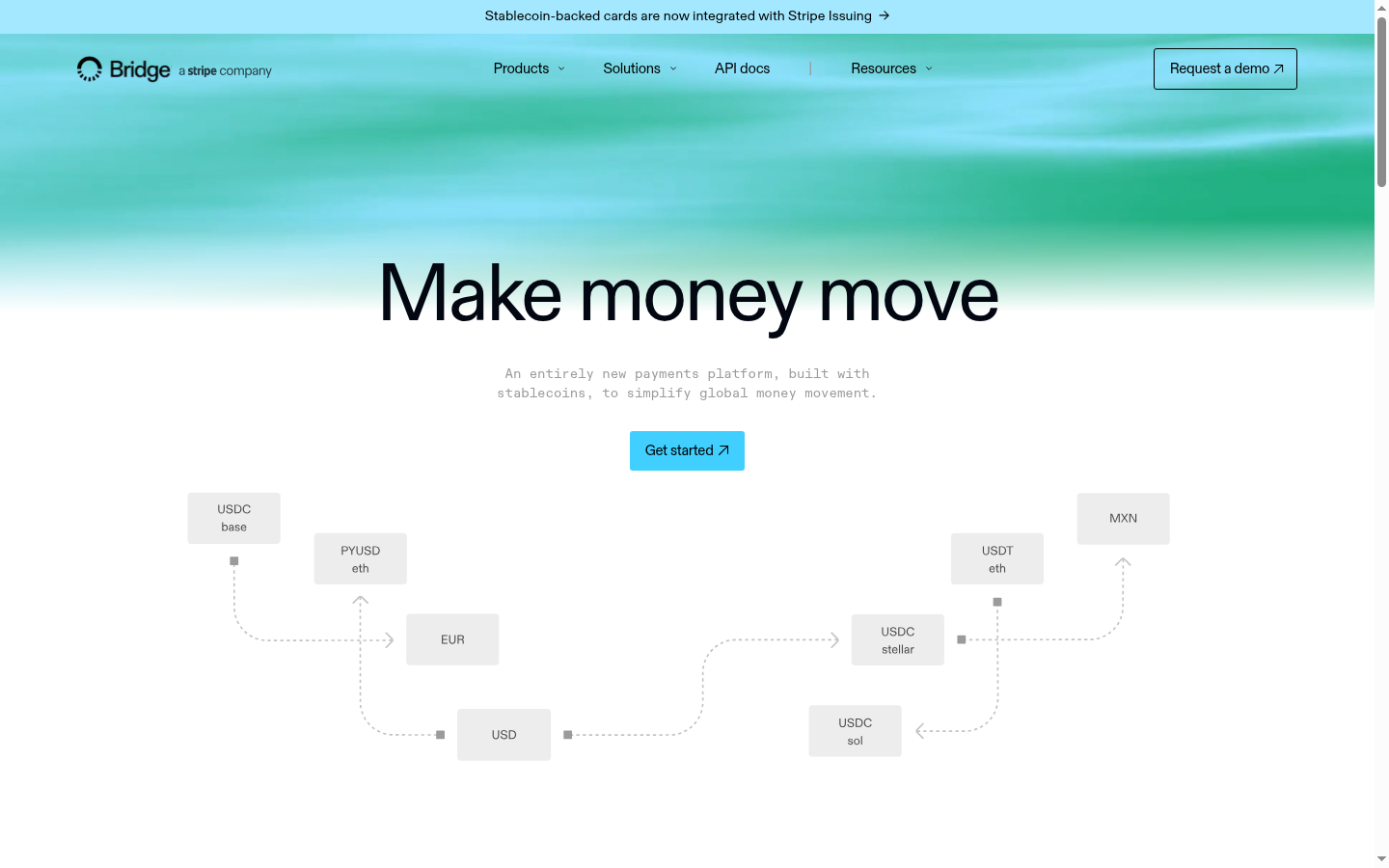
Bridge is the issuance and orchestration path inside Stripe. You can issue a branded coin, move money, and issue cards on Stripe Issuing. Circle will not put your brand on the coin. Paxos will, after a longer compliance process.
Stripe completed the $1.1 billion acquisition on 4 February 2025. Reserve yield of 3–4% on Treasuries is their figure, not a contracted rate. U.S. money transmission sits on Bridge Building Inc (NMLS 2450917). There is no public fee table, and a branded-coin contract still has to name who issues and who redeems.
Best for: Fintechs that want branded issuance and payouts in the Stripe orbit.
What you get:
- One API for receive, store, convert, issue, and spend.
- Optional branded issuance, with convert between the issued coin, USDC, USDT, and fiat.
- Cards on Stripe Issuing, plus wallets with gas handled on Bridge’s side.
- U.S. money-transmitter licenses, plus an EEA entity in Luxembourg.
Why we like it: If the job is to stand up a branded dollar and pay people in corridors Stripe already understands, this is the shortest path. You will take a quote, and you still have to write down who redeems.
Limits:
- No public price table.
- Stripe ownership is a feature and a concentration risk. Put continuity and data-handling language in the contract.
- White-label issuance does not, by itself, name the legal issuer, the redeeming entity, or who runs identity checks.
Price: Quote-only. Do not budget from a blog’s fee percentage.
Paxos
Paxos is the issuer you pick when a committee needs a named trust company to mint and redeem on your behalf. It already issues PayPal USD, plus Pax Dollar, Global Dollar, and Pax Gold. Production is an enterprise engagement, not a self-serve API key.
Unlike Circle’s national trust, Paxos Trust Company is the issuer. It sits under OCC national oversight, with New York Department of Financial Services (NYDFS) heritage behind it. That is why institutions shortlist Paxos. Speed to a first key is not the reason.
Best for: Institutions that need a regulated issuer for mint and redeem, including PayPal-class programs.
What you get:
- Issuance and mint/redeem under a named national trust.
- Named issued assets: USDP, PYUSD, USDG, and PAXG, with 1:1 backing language.
- Stablecoin payments and payouts, plus brokerage with qualified custody.
- A testnet path for developers. Production waits on approval.
Why we like it: When a committee asks who already issues PayPal’s dollar, the answer is Paxos. Circle will not put your brand on the coin. Bridge will, with less of that institutional paper trail.
Limits:
- No public fee table. Everything that matters is a sales conversation.
- Onboarding is approval-gated. If you needed an API key this afternoon, you wanted Crossmint or Circle Wallets.
- BUSD is history. Do not staff a 2026 program around it.
Price: Quote-only.
Crossmint
Crossmint is not an issuer. It is the developer wallet, checkout, and orchestration layer you can start this month. Circle is the other wallet option with public pricing. Crossmint is the one that also bundles ramps and checkout in the same console.
It has powered consumer apps, including MoneyGram’s stablecoin cross-border product, often without the Crossmint name on the surface. Advanced screening, travel-rule tools, and 24/7 support are paid add-ons. If you need New York or federal issuance, this is the orchestration layer on someone else’s coin.
Best for: Fintech and marketplace teams that need wallets and checkout this month.
What you get:
- Smart wallets, treasury wallets, mobile SDKs, and webhooks, with optional gas sponsorship.
- On-ramps, off-ramps, and checkout across cards, wallets, and bank rails.
- Stablecoin orchestration for treasury and payouts.
- A free wallet tier, then a listed per-wallet rate. Enterprise chain work is custom.
Why we like it: You can start on a free wallet tier this week without hiring a chain team. Issuance-grade regulation is not the product. Wallets and rails are.
Limits:
- Ramps, checkout, and orchestration are custom. The per-wallet rate is not your all-in payments cost.
- Onboarding quality is mixed in public reviews. Do your own due diligence.
- This will not give you a New York trust or a national-bank issuer.
Price: The first 1,000 monthly active wallets are free. Paid wallets start at $0.05. Tokenization starts at $0.01 per action. Ramps, checkout, and orchestration are custom.
Bastion
Bastion is enterprise issuance plus wallets under named U.S. licenses, in one vendor instead of two. If you need a listed issuance price this week, Brale is the closer comparison. Bastion is the quote-led path when the licenses are the reason you are looking.
Issuance sits on Bastion Platforms Trust Company, an NYDFS limited-purpose trust. Wallets sit on Bastion Platforms US, a money-services business (NMLS 2523302). Those are not the same legal person, so the contract has to say which one you are signing. There is no public mint or redeem fee.
Best for: Enterprises that want New York trust-charter issuance plus wallets.
What you get:
- Issuance and custodial wallets under named licenses.
- A New York limited-purpose trust on the issuance side.
- Money-services wallets on a separate U.S. entity.
- Quote-only access. No published mint or redeem fees.
Why we like it: You get issuance and wallets under named New York trust and federal money-services licenses, instead of stitching those jobs across two vendors. You will have to take a quote.
Limits:
- No public price table, and no published mint or redeem fees.
- Availability depends on licenses and partner paths.
- The trust and the wallet company are separate entities. Name which one you are contracting with.
Price: Quote-only.
MoonPay Enterprise Issue
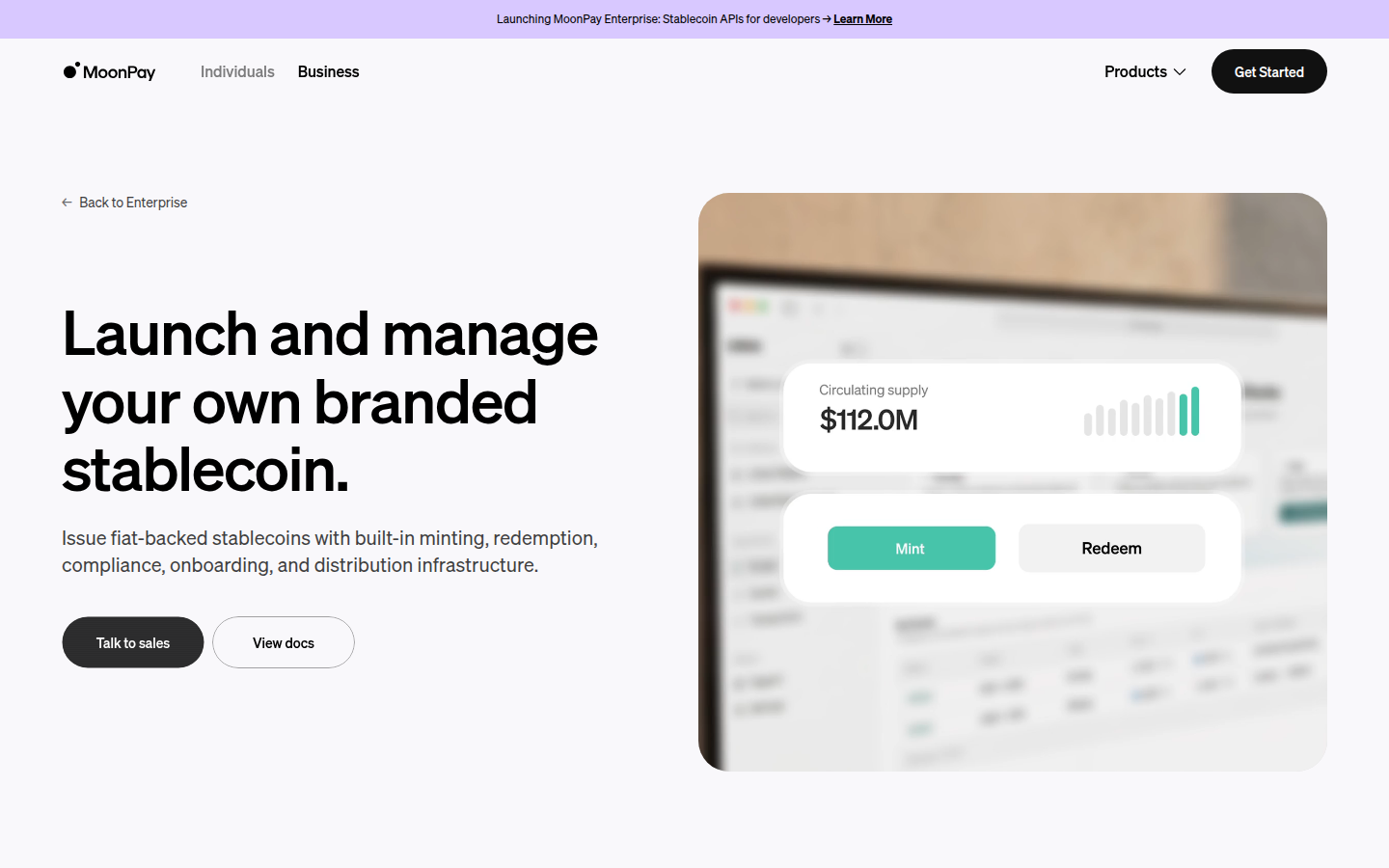
MoonPay Enterprise Issue is branded issuance for businesses: mint and redeem, hosted onboarding, sanctions monitoring, and an API. It is not the consumer MoonPay widget. If the team only needs wallets and checkout, Crossmint or Circle is the closer product.
Issue runs on MoonPay’s U.S. money-transmitter licenses, a New York BitLicense, and the EU’s Markets in Crypto-Assets (MiCA) regime. There is no public mint price. Availability varies by jurisdiction.
Best for: Fintechs that want a branded coin on MoonPay’s licenses.
What you get:
- Branded fiat-backed issuance with mint and redeem.
- Hosted onboarding plus sanctions monitoring.
- An Issue API, webhooks, and a dashboard.
- Business-only access. Quote-only pricing.
Why we like it: You can issue a branded coin with mint, redeem, onboarding, and sanctions monitoring in the same Issue product, on licenses that already cover the U.S. and the EU. Circle will not put your brand on the coin.
Limits:
- No public mint or fee table.
- Availability varies by jurisdiction.
- Issue is business-only. Do not treat the consumer widget as this product.
Price: Quote-only.
Brale
Brale is the issuance option you can price before a sales call. Circle and Paxos issuance are custom contracts. Brale is the path with list prices, plus custody and payment rails on the same vendor.
It is a FinCEN money-services business (NMLS 2376957). Business at $0 plus usage is not the issuance plan, so do not model a branded coin on the free line. An EU application is in progress, not live.
Best for: Teams that want listed issuance prices before talking to sales.
What you get:
- Issuance, custody, and payment rails with listed monthly plans.
- A $0 usage-based line that is not Mini issuance, plus Mini and Pro.
- Bank rails and USDT conversion as separate usage lines.
- A public FinCEN and NMLS number you can take to compliance.
Why we like it: You can read issuance pricing before a sales call. That combination of a public starting rate and a public money-services number is rare among issuance options here.
Limits:
- Business at $0 does not include Mini issuance.
- An EU application is in progress, not live.
- Rail and conversion fees are separate from the monthly plan.
Price: Mini is $10 a month. Pro is $500. Business is $0 plus usage and does not include issuance.
Issuance programs still need screening. If the next question is name-and-payment checks, see our related list of AML and sanctions screening platforms.
Are you issuing a coin, and is any price public?
This grid plots two questions. Across is whether a starting price is listed: quote-only on the left, a listed price on the right. Up is the product: issuance at the top, wallets and rails at the bottom.

 Branded coin, or PYUSD-class
Placement is issuance versus wallets, and a listed price versus quote-only. Circle issues USDC through regulated affiliates; on this page the product most teams actually buy from Circle is wallets, so it sits on the wallets side. Placement only, not review scores.
Who redeems the coin for $1
| Platform | Published rate | Redemption / issuer language |
|---|---|---|
| Circle | 1,000 wallets free. Signing from $0.038; all-included from $0.050. Sponsored gas: dollars plus 5% | USDC redeems at regulated affiliates. Circle National Trust is custody, approved 10 Jul 2026 |
| Bridge | None. Quote-only | Who redeems a branded coin is not named. U.S. money transmitter: NMLS 2450917 |
| Paxos | None. Quote-only | Paxos Trust Company issues USDP, PYUSD, USDG, PAXG. 1:1 backing language |
| Crossmint | 1,000 wallets free, then from $0.05. Tokenization from $0.01 | Not an issuer. Orchestration sits on someone else’s coin |
| Bastion | Quote-only | Named New York trust for issuance; NMLS 2523302 for wallets. Separate entities |
| MoonPay Enterprise Issue | Quote-only | Business issuance. Not the consumer ramp |
| Brale | Mini $10 / month. Pro $500. Business $0 plus usage is not issuance. ACH $0.25 | FinCEN money-services business (NMLS 2376957). Confirm who redeems a branded coin |
Other stablecoin infrastructure platforms worth considering
These are real products next door. Someone would want them. They are not issuance-or-wallet infrastructure in the sense this page compares.
- Fireblocks - Custody and multi-party computation for keys. Useful if the problem is key management. It is not issuance or wallet-as-a-service as compared here.
- Chainstack - Node RPC. You would want it to talk to a chain. It is not stablecoin infrastructure.
- Estable.io - An all-in-one deck without a regulatory story you can compare to these seven.
Questions before you sign
If redemption, issuer, and pricing stay vague, you are still looking at a logo.
- Are we issuing a coin, or using someone else’s? A USDC wallet price is not a white-label coin. Issuance and wallets are different jobs. Mixing them in one request is how you buy the wrong product.
- Who will redeem it for $1? Name the redeeming entity, not the homepage brand. A trust charter is often custody. The June 2026 customer-identification proposal belongs on an issuance plan, not a wallet-only build.
- Is there a listed wallet or issuance price? Two wallet products here list the first 1,000 monthly active wallets free. Gas, ramps, and checkout are other lines. Quote-only issuance has no public fee percentage you should put in a seed-stage budget.
Which stablecoin platform should you pick
USDC wallets you can price this week: Circle. Branded issuance plus Stripe distribution: Bridge. Institutional issuer, including PayPal-class programs: Paxos. Wallets and checkout this month: Crossmint. New York trust issuance: Bastion. A branded coin on MoonPay’s licenses: Enterprise Issue. Listed issuance prices: Brale. If a pitch cannot name the issuer, the regulator, and who redeems for $1, keep looking.
Frequently asked questions
Does Circle’s national trust mean Circle is a bank that issues USDC?
No. Circle National Trust received final approval on 10 July 2026 for fiduciary custody. The trust does not take deposits, does not lend, and does not issue USDC. USDC is still issued by regulated affiliates. Those affiliates are still who redeem it for $1.
Can we launch on Crossmint’s free tier and add Paxos later?
Wallets, yes. Issuance, no. Crossmint lists 1,000 free monthly active wallets, then from $0.05. That path does not include a regulated coin. Paxos is a new vendor, a new legal-entity problem, and a new reserve story.
Which platforms list a public price?
Circle and Crossmint publish wallet rates. Brale publishes issuance rates. Bridge, Paxos, Bastion, and MoonPay Enterprise Issue are quote-only. The starting numbers sit in each Price section.