
Most teams discover traceability gaps during a customs hold or surprise audit, not from their annual sustainability report. From our experience in the startup ecosystem, the biggest wins come from early choices like capturing EPCIS event data at PO level, binding items to QR or NFC identities for digital product passports, and adding geospatial checks for EUDR-sensitive commodities. You think you know your supply base until a tier-3 subcontractor triggers a red flag. McKinsey's recent surveys show that deep-tier visibility is still limited, with the majority of companies understanding their supply chain risks only up to tier one, and visibility capabilities have yet to return to 2022 levels, which stalls response time when disruptions hit McKinsey research.
The ESG software market reached about 1.44 billion dollars in 2026 and continues to grow rapidly, a signal that boards are funding audit-ready data and automation rather than spreadsheets, per Grand View Research. Below, we cover where each tool fits, what it really takes to deploy, current pricing realities, and the tradeoffs teams run into in year one.
TrusTrace
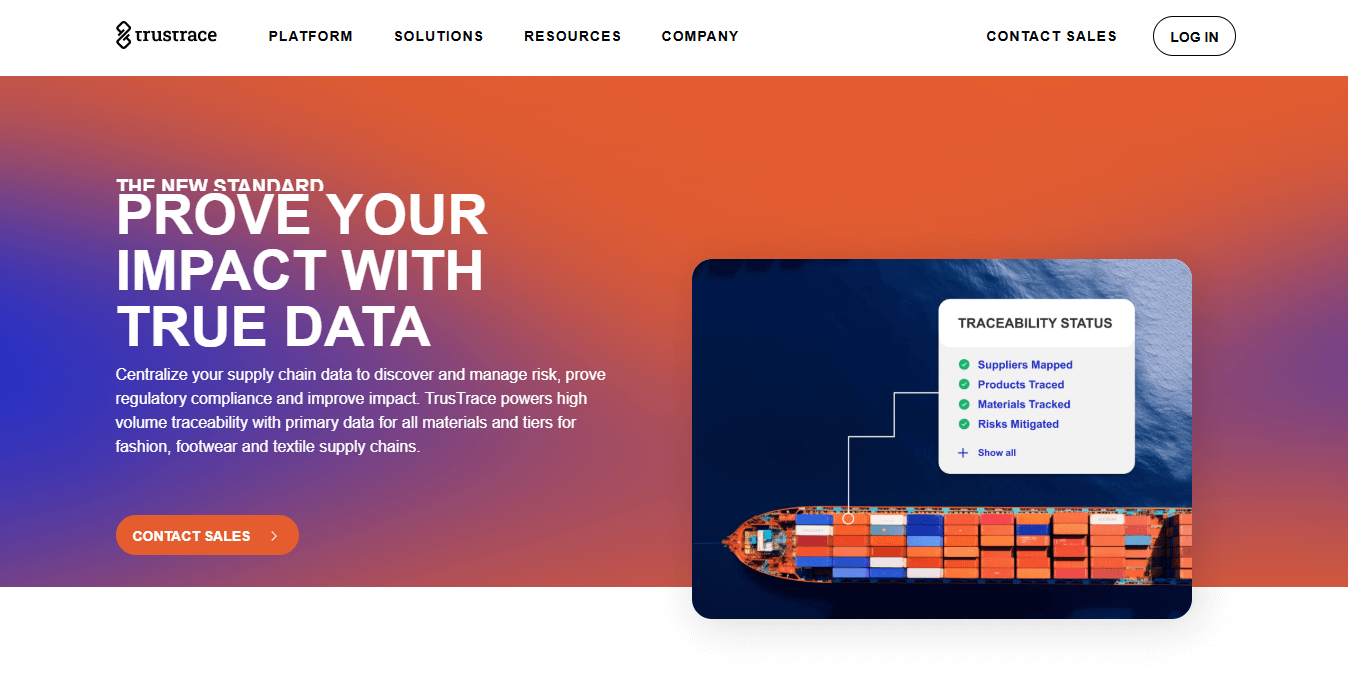
AI-driven traceability and compliance platform focused on fashion and textiles. Strong execution on material, product, and shipment-level evidence collection for regulations such as EUDR, UFLPA, and emerging DPP use cases.
Best for: Fashion and footwear brands that need PO, material, and farm or plot-level documentation to satisfy due diligence and deforestation rules.
Key Features:
- Shipment-level EUDR deforestation compliance with geospatial risk checks and automated due-diligence statements, validated publicly when the solution was announced and profiled by industry press FashionUnited coverage.
- Forced Labor Prevention workflows used by brands to collect chain-of-custody evidence for UFLPA, as described in independent press releases PR Newswire report.
- Documented adoption across leading brands and playbooks guiding Digital Product Passport programs in fashion, covered by Vogue Business analysis.
Why we like it: For apparel, TrusTrace has a pragmatic blend of supplier onboarding, PO-linked primary data, and targeted automation around EUDR and UFLPA that reduces scramble time during audits, confirmed by multiple third-party write-ups and brand case references in the trade press.
Notable Limitations:
- Public end-user reviews are still sparse, which makes benchmark comparisons tricky, as seen on Gartner Peer Insights.
- Industry reporting highlights ongoing challenges with harmonizing supplier data requests, which can slow onboarding without a strong internal program Vogue Business on supplier data burden.
Pricing: Pricing not publicly available. Contact TrusTrace for a custom quote. If you require third-party validation before engaging sales, note that broad, published pricing has not been listed on neutral marketplaces as of February 9, 2026.
Optchain by OPTEL
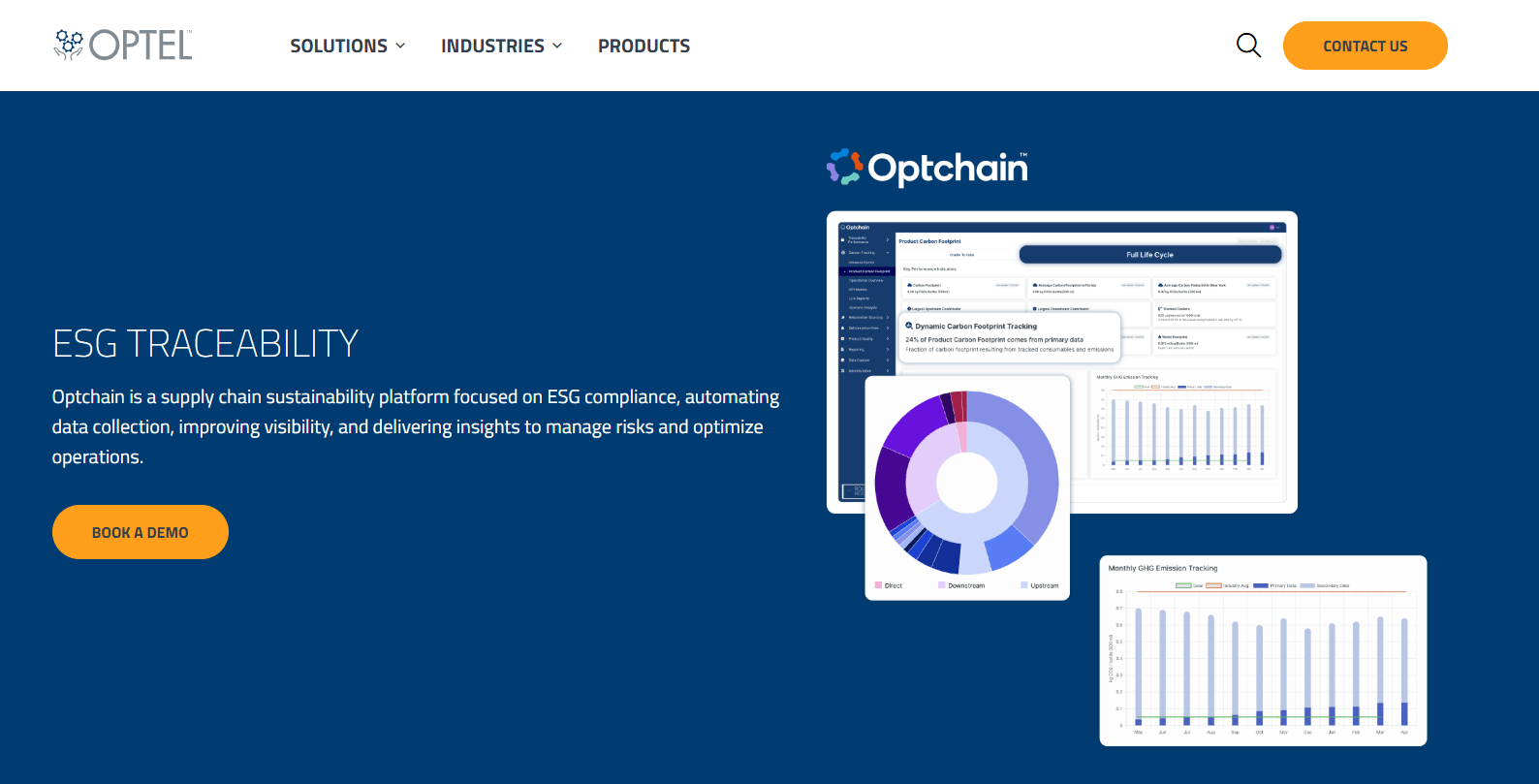
A sustainability and traceability platform from OPTEL, known for pharma serialization, now applied to EUDR, carbon tracking, and DPP use cases. Often paired with consulting partners for regulatory programs.
Best for: Manufacturers and CPGs that want multi-tier mapping plus compliance modules for EUDR and emissions reporting, and that value partner ecosystems.
Key Features:
- Partnerships with ERM and BSI to accelerate EUDR, CSRD, and CBAM programs, documented in third-party announcements ERM and OPTEL partnership, BSI and OPTEL partnership with EUDR dates and penalties.
- Proven serialization and traceability heritage in regulated industries, with public expert interviews about implementation scope and complexity for line-level systems Healthcare Packaging interview.
- Vendor materials describe carbon tracking and DPP modules, plus supplier onboarding and risk assessment; confirm fit with your compliance scope during evaluation.
Why we like it: If your task list spans EUDR due diligence and product carbon accounting, Optchain's compliance framing, plus access to ERM and BSI assurance, shortens the path from pilot to audit-ready outputs, and the pharma lineage is a plus in high-control environments.
Notable Limitations:
- Implementation timelines of three to nine months are typical in complex environments per OPTEL's published FAQs for regulated deployments, which means teams must budget program management accordingly OPTEL FAQ timelines.
- Serialization and traceability projects are organization-wide and can require label, packaging, and IT changes that slow rollout without cross-functional alignment, as experts have cautioned publicly.
Pricing: Pricing not publicly available. Contact OPTEL for a custom quote. BSI's advisory content confirms EUDR timing and potential penalties, which helps size the risk-avoidance value case during pricing discussions.
TraceID.io
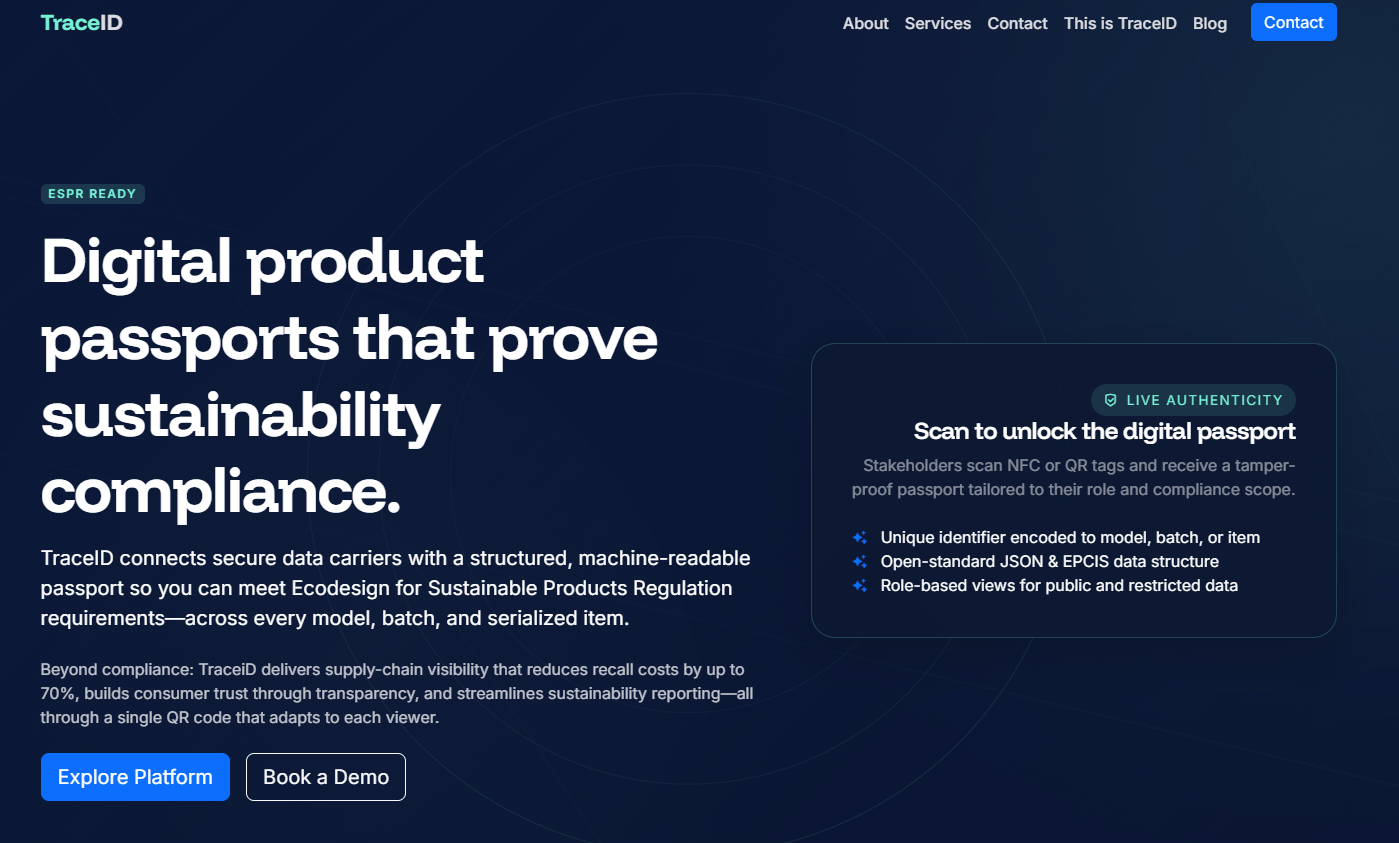
Digital Product Passport platform that assigns a verifiable identity to products, components, and suppliers, typically via QR or NFC, and structures data using open standards for ESG and compliance use cases.
Best for: Manufacturers preparing for ESPR Digital Product Passport requirements who want item, batch, or model passports tied to open schemas and role-based access.
Key Features:
- Digital identities on QR or NFC that link to machine-readable passports, with alignment to open standards, per vendor documentation.
- Evidence capture for materials, substances of concern, repairability, and end-of-life guidance intended to support DPP and due-diligence workflows, per vendor documentation.
- Role-based passport views for authorities, partners, and consumers to separate sensitive and public data, per vendor documentation.
Why we like it: For companies that need to move fast on DPP without replacing ERP or PLM, TraceID's device-agnostic identity approach and standards emphasis fit sprint timelines while building toward compliance.
Notable Limitations:
- Limited third-party reviews in the public domain as of February 9, 2026, which can make external benchmarking and ROI validation harder before pilots.
- DPP programs introduce organization-wide change, and industry reporting highlights data alignment, interoperability, and supplier participation as top hurdles, not just software selection Vogue Business on DPP readiness, European Parliament ecodesign overview.
Pricing: Pricing not publicly available. Contact TraceID.io for a custom quote. Given evolving EU timelines, verify your product category's DPP delegated acts window on the Commission and Parliament portals before scoping investment.
Semantic Visions svEye

OSINT-based risk intelligence that scans media in multiple languages to surface supply-chain, ESG, geopolitical, and operational events with alerts, dashboards, and API export.
Best for: Procurement, risk, and ESG teams that need real-time early-warning signals on suppliers and regions, plus historical context to validate trends.
Key Features:
- Real-time adverse media and event monitoring across 12 languages with supply-chain mapping and API export, documented in neutral overviews and directories Wikipedia profile.
- Company, commodity, and event watchlists with historical screening for trend analysis per third-party summaries and listings.
- Published user feedback cites comprehensive data and decision support, with some notes on performance and integration limits on independent review sites G2 reviews summary.
Why we like it: Traceability programs benefit when OSINT detects a factory fire, labor action, or sanctions risk before suppliers disclose it. svEye's alerts complement system-of-record traceability by shrinking the time to act, validated by third-party review excerpts.
Notable Limitations:
- Reviewers mention occasional slow performance on very large entity graphs and limited customization or integration friction in some cases.
- OSINT signals are media-derived, so you still need internal validation and supplier follow-up to avoid overreacting to noisy events, a limitation common to all media-based tools.
Pricing: Published monthly plans appear on independent marketplaces and review sites, including Free, 499 dollars Pro, and 1,950 dollars Enterprise per month G2 pricing page. Confirm specific SLAs, data export quotas, and add-ons with sales.
Supply Chain Traceability & ESG Provenance Tools Comparison: Quick Overview
| Tool | Best For | Pricing Model | Highlights |
|---|---|---|---|
| TrusTrace | Fashion, footwear, textiles | Custom quote | EUDR shipment-level workflows, UFLPA evidence collection, brand adoption covered by trade press |
| Optchain | Manufacturers, CPG, regulated industries | Custom quote | Compliance focus with EUDR and advisory partners |
| TraceID.io | DPP pilots and rollouts across manufacturing | Custom quote | Standards-aligned DPP and role-based passports, useful where QR or NFC tagging is feasible |
| Semantic Visions svEye | Supply risk, ESG events, geopolitics monitoring | Published tiers (Free tier noted on reviews) | Real-time OSINT alerts and historical screening, with published pricing and user feedback |
Supply Chain Traceability & ESG Provenance Platform Comparison: Key Features at a Glance
| Tool | Deep-tier Mapping | Regulatory Workflows | Risk Signals |
|---|---|---|---|
| TrusTrace | Yes, PO and material level in fashion press coverage | EUDR, UFLPA noted in independent coverage | Optional integrations, OSINT not core |
| Optchain | Yes | EUDR, CSRD context with partner validation | Third-party risk modules, depends on deployment |
| TraceID.io | Yes, product, batch, serialized | DPP, due diligence evidence, per vendor documentation | Not a signals tool |
| svEye | N-tier supplier discovery and mapping on OSINT layer | Not a forms workflow tool | Real-time ESG and supply events with alerts |
Supply Chain Traceability & ESG Provenance Deployment Options
| Tool | Cloud API | On-Premise | Integration Complexity |
|---|---|---|---|
| TrusTrace | Yes | Not publicly documented | Medium, depends on ERP and PLM scope; plan supplier onboarding early |
| Optchain | Yes | Often available in regulated contexts via related OPTEL deployments, confirm for Optchain scope | Medium to high where serialization or L4/L5 integrations are in play |
| TraceID.io | Yes | Not publicly documented | Medium, requires identity tagging and BOM data harmonization |
| svEye | Yes | No, browser-based SaaS per public listings | Low to medium, API export to ERP or risk systems with some user-reported constraints |
Supply Chain Traceability & ESG Provenance Strategic Decision Framework
| Critical Question | Why It Matters | What to Evaluate |
|---|---|---|
| Which regulation is driving the deadline, and for which products or materials | Scope, timing, and penalties differ by rule | Map to EUDR shipment scope (enforcement now December 30, 2026 for large/medium operators), ESPR DPP category timelines, and UFLPA exposure |
| Do we need real-time risk signals in addition to a system of record | Events often precede supplier disclosures | OSINT event coverage, alert latency, API quality |
| How far down the tiers must we collect primary data | Deep-tier risk is where most disruptions start | Supplier readiness, data model, EPCIS mapping |
| What does onboarding look like for suppliers | Onboarding friction drives cost and timeline | Training, templates, playbooks, language support |
Supply Chain Traceability & ESG Provenance Solutions Comparison: Pricing & Capabilities Overview
| Organization Size | Recommended Setup | Monthly Cost | Annual Investment |
|---|---|---|---|
| Mid-market fashion brand | TrusTrace for PO and material traceability, plus svEye for event alerts | Pricing not publicly available for TrusTrace, svEye Pro listed at 499 dollars | TrusTrace: Contact vendor, svEye Pro: 5,400 dollars published annually |
| Global manufacturer with EUDR exposure | Optchain with advisory support from ERM or BSI, plus svEye for OSINT alerts | Optchain pricing not publicly available, svEye Enterprise 1,950 dollars monthly | Optchain: Contact vendor, svEye Enterprise: 19,800 dollars annually |
| DPP pilot across SKUs | TraceID.io for DPP plus targeted OSINT on suppliers | Pricing not publicly available for TraceID.io | Contact vendor for a custom quote |
Problems & Solutions
-
Problem: EUDR enforcement will require shipment-level due diligence, plot or farm coordinates, and can trigger penalties up to 4 percent of EU turnover for noncompliance. Enforcement is now set for December 30, 2026 for large and medium operators, and June 30, 2027 for small and micro operators, following the EU Parliament and Council-backed one-year delay.
- TrusTrace: Offers shipment-level collection, geospatial checks, and automated due-diligence statements, profiled by industry outlets ahead of enforcement.
- Optchain: Backed by BSI and ERM partnerships for EUDR, with public briefings that outline dates, penalties, and compliance mechanics to frame programs.
- TraceID.io: Focuses on standards-based identities and item or batch lineage that help assemble evidence packages for due diligence alongside DPP, with program drivers described by the European Parliament.
- svEye: Provides early warning on deforestation controversies, land-use disputes, or enforcement trends in media, helping teams triage suppliers before filings are due.
-
Problem: UFLPA detentions require fast, verifiable chain-of-custody for cotton and other sensitive inputs.
- TrusTrace: Public case references show brands collecting product-level evidence for UFLPA with the platform.
- Optchain and TraceID.io: Strengthen documentation by linking identities and supplier attestations to shipments; confirm specific UFLPA modules during evaluation.
- svEye: Surfaces NGO, media, or regulatory allegations tied to suppliers, supporting faster internal reviews before CBP interactions.
-
Problem: ESPR Digital Product Passports will phase in, and teams need interoperable, machine-readable product data rather than PDFs.
- TraceID.io: Built around QR or NFC identities and structured schemas to produce role-based DPPs aligned to the EU approach described by Parliament.
- Optchain: Positions DPP for certain categories and pairs with advisory partners for data readiness.
- TrusTrace: Trade-press playbooks document steps and gaps brands encounter in DPP pilots.
- svEye: Not a DPP tool, but helps track regulatory changes and peer actions so teams time pilots against policy shifts.
-
Problem: Deep-tier visibility remains elusive, slowing incident response by weeks on average.
- TrusTrace: Material-level mapping in fashion is well documented in trade coverage, improving readiness for audits.
- Optchain: Multi-tier mapping plus risk and supplier onboarding supported by partner ecosystems.
- TraceID.io: Creates a direct link between the physical product and a live record, which shortens data hunts during escalations, with the policy driver detailed on EU portals.
- svEye: Alerts on strikes, fires, fraud, and sanctions risk so teams can pivot sourcing before downstream impacts.
The Bottom Line: Pick, Pilot, Prove
The fastest wins come from pairing a system of record with a risk-signal layer, then piloting on a high-exposure product line. If EUDR is your trigger, start with shipment-level evidence and plot data; note that enforcement for large and medium operators is now December 30, 2026 following the EU-backed one-year delay, with partners and press detailing timing and penalties. If DPP is your driver, plan for open standards and supplier change management, which trade reporting calls out repeatedly. And remember, deep-tier blind spots are still common, as independent research continues to show, so budget time for supplier enablement and data quality gates.
The CSDDD timeline has also shifted - transposition into national law is now due by July 26, 2027, with the first application phase for the largest companies pushed to July 2028 under the EU Omnibus simplification package adopted in December 2025. Teams should track both EUDR and CSDDD timelines in parallel when scoping platform investments.
All pricing and capabilities referenced above are based on public third-party sources as of February 9, 2026. Where pricing is not publicly available, request a formal quote and attach regulatory timelines from official EU pages to frame urgency and ROI during procurement.