A startup's first SOC 2 request usually arrives inside a security questionnaire, a few weeks before the enterprise deal it blocks is meant to close. A Type 1 report shows your controls exist on a single date, while a Type 2 shows they operated across an observation window, often three to twelve months, so the clock on the report your buyer really wants starts long before an auditor signs anything. That gap is when founders stop reading about GRC in general and start pricing a platform that can get one report out the door without hiring a compliance team.
Buyers have a concrete reason to ask early. Verizon's 2026 Data Breach Investigations Report found a third party involved in 48% of breaches, so a vendor without a SOC 2 report reads as an open risk on the procurement checklist. For a startup, the cheapest platform quote is rarely the cheapest first year once the auditor, a penetration test and your engineers' hours sit on the same sheet.
Below are seven platforms built for that first report, compared on who does the work, who signs the report and what the first year costs.
SOC 2 Compliance Platforms at a Glance
| Platform | Best for | Pricing model | Standout |
|---|---|---|---|
| Thoropass | Founders who want the platform and the SOC 2 audit on one contract | Quote; AWS Marketplace from $8,700/yr for the platform plus $5,800/yr for a SOC 2 audit | In-house CPA auditors review evidence inside the platform |
| Comp AI | Developer-led startups that want to read or self-host the code | Quote on a 20-minute call; open-source core free to self-host | AGPLv3 core, AI agents and an hourly device agent |
| Oneleet | Startups whose buyers want real security testing behind the report | Quote; one flat fee covers platform, pentest and audit support | Manual pentests by OSCE-certified testers plus a dedicated vCISO |
| Scytale | Teams with no compliance owner who want an expert doing part of the work | Quote; AWS Marketplace lists the platform with one framework from $7,500/yr | Dedicated GRC consultant on the DFY and Stronger bundles |
| Iru | Small IT teams buying device management and SSO alongside SOC 2 | Quote by products chosen, on annual contracts | SOC 2 evidence pulled natively from Iru's MDM, EDR and identity products |
| Strike Graph | Self-run teams that want to start free and budget against printed prices | Free Launch tier; Scale from $21,500/yr | Verify AI checks evidence before the auditor sees it |
| Scrut Automation | Startups with ISO 27001, HIPAA or GDPR planned after SOC 2 | Quote; AWS Marketplace lists $15,000/yr for up to 20 employees | 70+ frameworks with a risk register and vendor reviews built in |
The bigger decision is how much of the work you want done for you. Comp AI, Strike Graph and Scrut Automation suit a technical founder or a first security hire who will own the controls, at very different price floors. Scytale attaches a GRC consultant and Oneleet a vCISO who also runs the pentest, which matters when nobody on the team has been through an audit. Iru folds the evidence into the device and identity tools a small IT team buys anyway, and Thoropass goes furthest by selling the software and the audit together.
How We Evaluated These Tools
We compared each platform against its own product pages, pricing pages, documentation and official marketplace listings, checked in October 2026, using six criteria that matter to a company under 50 people in its first SOC 2 year:
- Time to a Type 1 report: how fast controls, policies and evidence reach audit-ready, and what the platform keeps doing during the Type 2 window.
- Evidence from a startup stack: how much evidence flows from AWS or GCP, GitHub, Google Workspace, an identity provider and HR software without screenshots.
- Audit path: whether the auditor is included, picked from a partner list or entirely yours to find.
- Expert help: whether a named person does part of the work or you get a support queue.
- Price under 50 employees: published starting prices where they exist, and which extras (audit, pentest, second framework) sit outside them.
- Room for a second framework: how much SOC 2 work carries into ISO 27001, HIPAA or GDPR.
The 7 Best SOC 2 Compliance Platforms for Startups
1. Thoropass
Thoropass sells the SOC 2 audit and the platform you prepare in as one purchase. Audits come from Thoropass Assurance, a licensed CPA firm registered with the AICPA, and its auditors review evidence inside the same workspace where your team collects it, so requests, samples and findings never move into email or a second portal. Audit leadership comes from KPMG, EY and Coalfire, and AI in the platform maps controls, flags gaps and organizes evidence before a human auditor looks at it. By the company's own account, its CPA firm holds the highest AICPA peer review rating, and many customers finish readiness and audit in weeks to a few months, with ISO 27001, HIPAA, PCI DSS and HITRUST available as the next framework on the same evidence.
The bundle raises a fair independence question. Thoropass runs the audit through its own CPA practice, a separate legal entity from the software business, so get in writing how the people who prepare you are kept apart from the people who test your controls.
Best for: Founders selling into healthcare, fintech or enterprise SaaS who want one vendor accountable from readiness to the signed report.
Key features:
- In-house auditors working in the platform from kickoff to final report
- AI that maps controls, identifies gaps and organizes evidence during readiness
- Multi-framework audits that reuse SOC 2 evidence for ISO 27001, HIPAA and HITRUST
- CREST-accredited penetration testing and vulnerability scanning from the same vendor
Why we like it: Thoropass shows auditor requests as tasks next to the evidence they need, which removes the duplicate-upload loop that slows most first audits.
Notable limitations:
- The model assumes Thoropass Assurance performs the audit, so ask how evidence exports if you later move to another firm
- An affiliated audit firm is a harder sell to buyers who expect a report from a firm they already know
- No integration count or price list on its own site, so check your exact stack and scope on the call
Pricing: On AWS Marketplace, the Compliance Platform starts at $8,700 per 12 months with the first framework included, and the SOC 2 Audit Subscription starts at $5,800 per 12 months (checked October 2026). Direct quotes vary by frameworks, audit scope, company size and services.
2. Comp AI
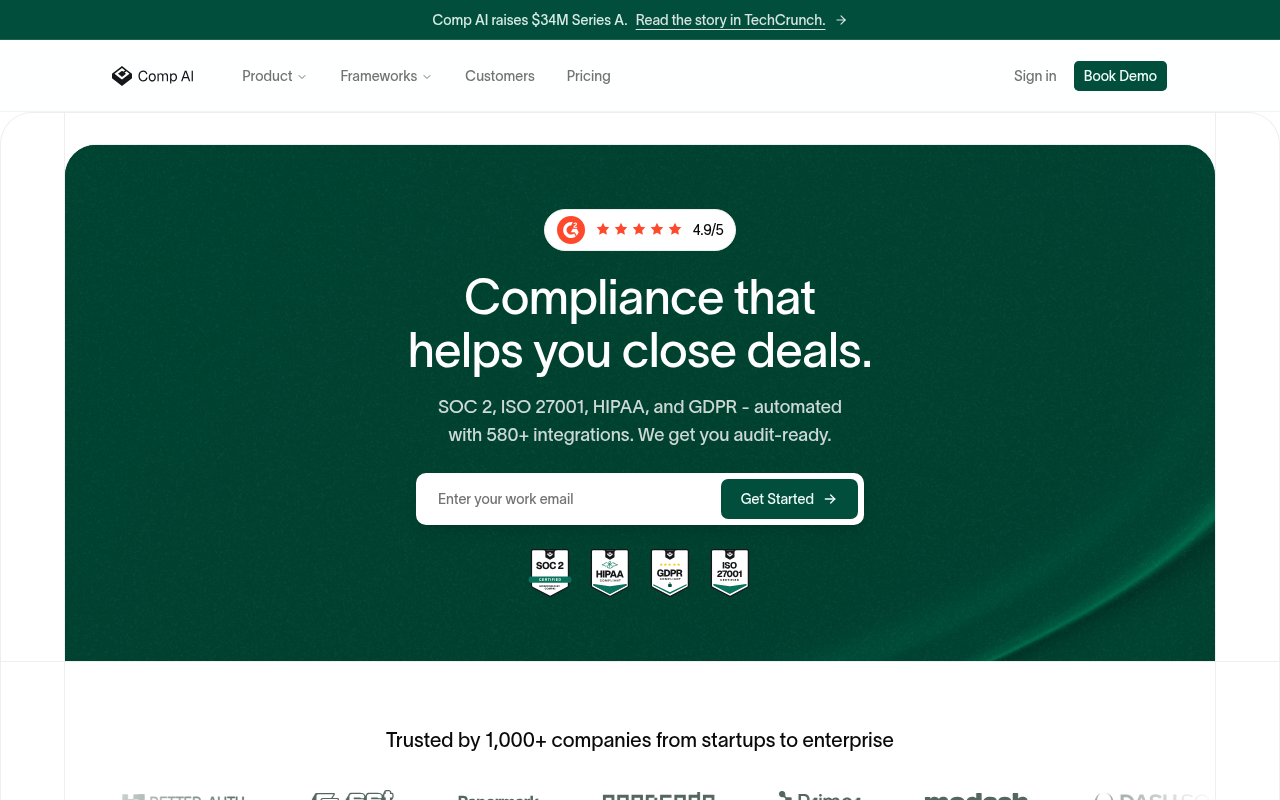
Comp AI is the open-source pick. Its core is published under AGPLv3, with a small Enterprise Edition directory under a commercial license, and the repository ships a self-hosting guide and a Docker Compose file, so a team that wants compliance data inside its own infrastructure can run the platform and read the logic behind every check. The hosted product adds AI agents that draft policies from your stack and processes, collect evidence, watch controls and run vendor reviews, while in-house compliance experts answer in a shared Slack channel. A device agent checks every employee laptop each hour for disk encryption, antivirus, password policy and screen lock on macOS, Windows and Linux, and a live Trust Center drops a control the moment it fails. Comp AI was founded in 2025, raised a $34 million Series A led by Roo Capital and Grand Ventures in September 2026, and says more than 1,000 companies use it.
Agent-driven setup shortens the preparation, not the calendar. Audit-ready in days is realistic for a small, cloud-only company and is enough for a Type 1, but a Type 2 still needs the observation window your auditor sets.
Best for: Developer-led startups chasing SOC 2 or ISO 27001 that want to inspect, extend or self-host the compliance platform.
Key features:
- AGPLv3 open core with a self-hosting guide and Docker Compose file
- AI agents for policy drafting, evidence collection, control monitoring and vendor reviews
- Hourly device agent checks on macOS, Windows and Linux laptops
- Agent-run penetration testing of code, APIs and infrastructure
Why we like it: With Comp AI, you can read the code that marks a control as passing, which gives you a real answer when an auditor asks how an automated result was produced.
Notable limitations:
- Self-hosting means you own the database, upgrades and integration credentials, and the README still lists some deployment steps as coming soon
- AGPLv3 obligations apply if you modify the code and serve it to users, so have counsel read the license before you fork
- Founded in 2025, so ask for customer references at your size and in your industry
Pricing: No price list. Comp AI quotes on a 20-minute call based on frameworks, headcount, timeline and whether the audit, penetration testing or a trust center is included, and the hosted plan carries a money-back guarantee (checked October 2026). The open-source code is free to self-host.
3. Oneleet
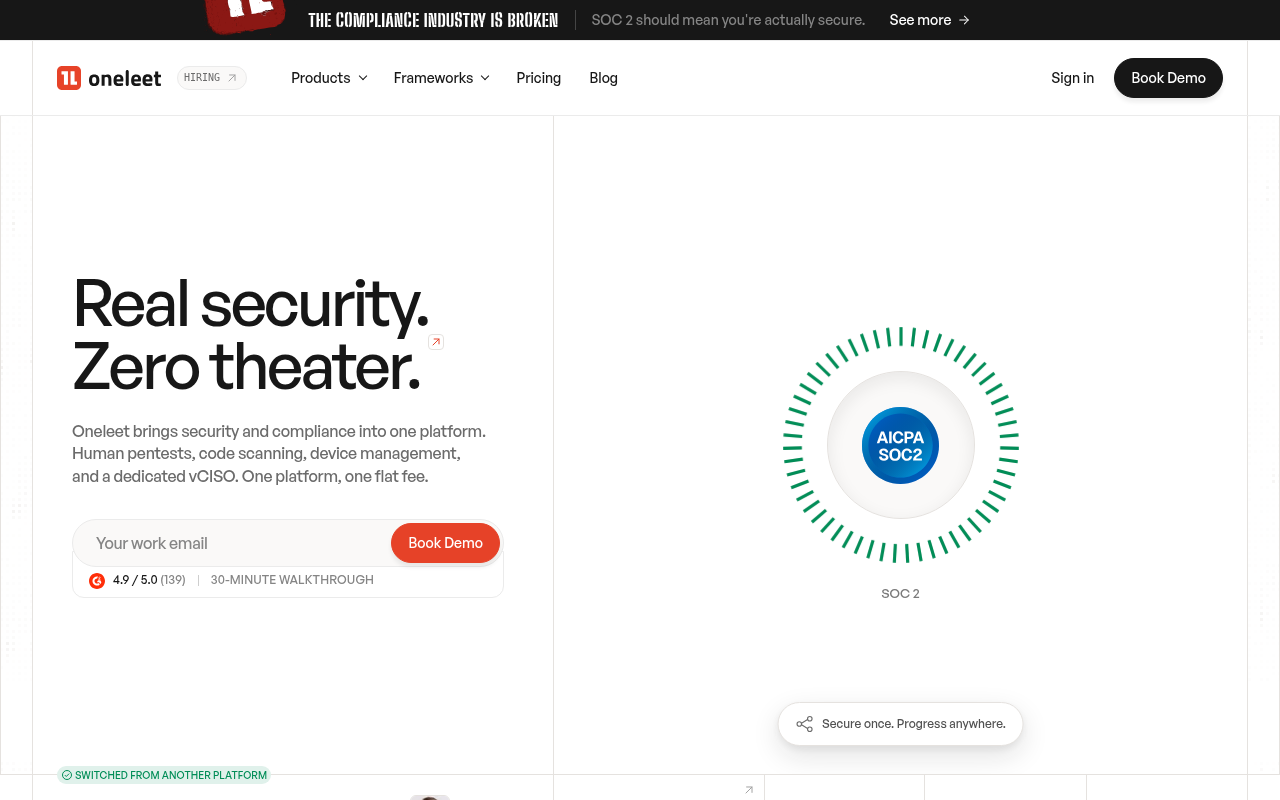
Oneleet builds the security work into the compliance program instead of selling it through a separate vendor. Manual penetration tests by OSCE-certified testers, code and dependency scanning, DAST, attack surface monitoring, cloud posture checks for AWS, GCP and Azure, device management and phishing campaigns all run in the same platform that tracks your SOC 2 controls. Every customer gets a dedicated vCISO in Slack, drawn from former auditors and security engineers, and an independent auditor signs the report. Oneleet is a Y Combinator company founded in 2022, raised a $33 million Series A led by Dawn Capital in October 2025, and covers SOC 2, ISO 27001, HIPAA, PCI DSS, GDPR and ISO 42001.
Best for: Startups selling to security-conscious buyers who will ask for a pentest report and managed laptops alongside SOC 2.
Key features:
- Manual pentests by OSCE-certified testers plus continuous attack surface monitoring
- Code, dependency and DAST scanning, with cloud posture checks for AWS, GCP and Azure
- Built-in device management for encrypted, patched laptops, plus phishing campaigns
- Dedicated vCISO in Slack for remediation and audit questions
Why we like it: Oneleet puts the pentest, the scanners and the vCISO on one contract with SOC 2, so a buyer's security review and the auditor's request list are answered from the same platform.
Notable limitations:
- No published prices, so the flat fee becomes a number only after a demo
- The auditor's fee is a third-party cost on top, though Oneleet quotes it before you sign
- If you already pay for a scanner or an MDM your team likes, part of the bundle overlaps
Pricing: Custom quote. Oneleet charges one flat fee that covers the platform, the pentest and audit support, and quotes third-party fees such as the auditor before you sign (checked October 2026).
4. Scytale
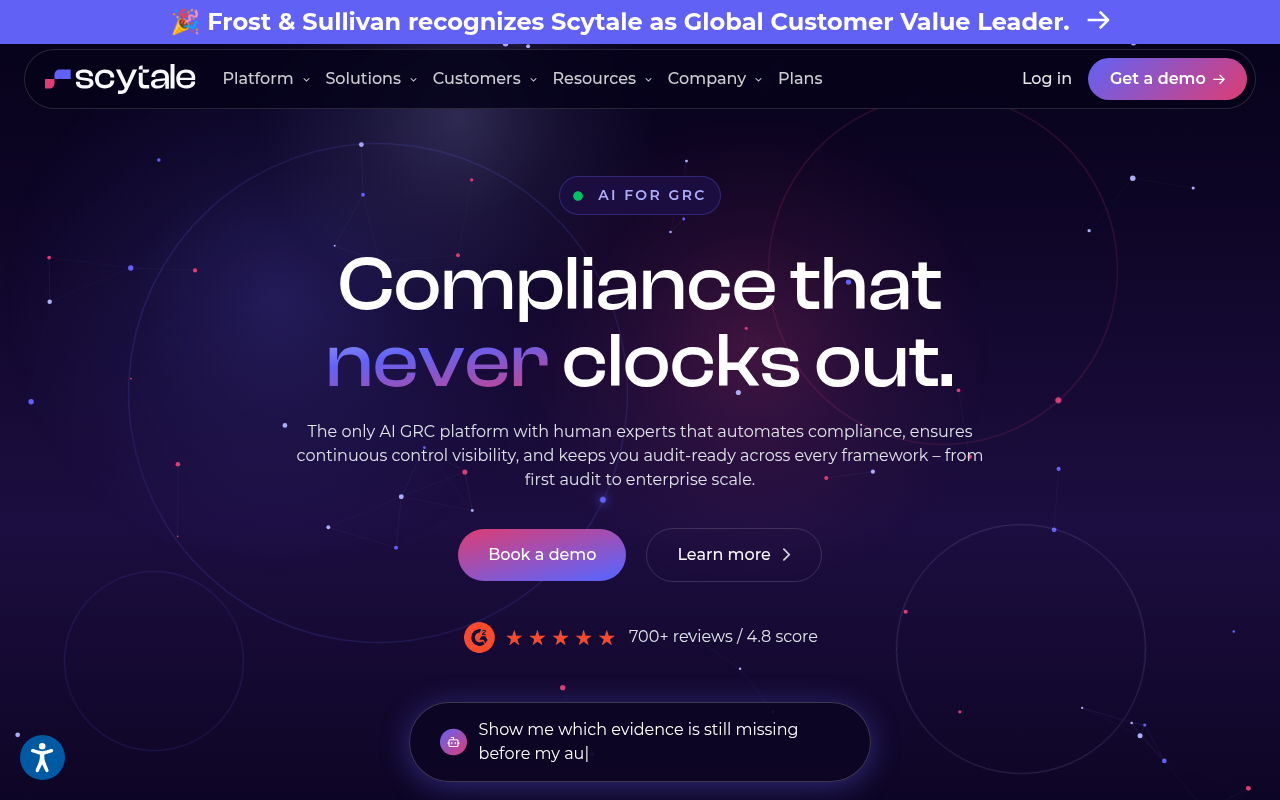
Scytale pairs its platform with a dedicated in-house GRC expert who guides scoping, policies, evidence and the conversation with your auditor. The startup bundles show how much help you get: Build Starter is the platform with one framework, Build DFY adds the LaunchReady consulting plan (a dedicated consultant for up to six months, until the audit completes) and a black box web app pentest, and Build Stronger swaps in the twelve-month StayReady plan and a gray box test. Underneath sits a platform covering more than 60 security and privacy frameworks, with 150+ integrations, user access reviews, AI security questionnaire answers and a Trust Center, and Scytale's AWS Marketplace listing cites more than 500 automated compliance tests running daily.
Best for: Seed and Series A teams with no compliance owner who want a person steering the first audit.
Key features:
- Dedicated GRC consultant on the DFY and Stronger bundles
- 60+ frameworks with control cross-mapping
- User access reviews and AI-assisted security questionnaires
- Third-party audit and pentest available as packages
Why we like it: The consultant at Scytale works from the same evidence and controls you see, so advice turns into specific tasks instead of a slide deck.
Notable limitations:
- Build Starter has no consultant, which removes the main reason to pick Scytale
- LaunchReady support ends when the audit completes, so keeping a consultant through the Type 2 window means the twelve-month StayReady plan
- Consulting, pentest, extra frameworks and the audit are separate lines that add up quickly
Pricing: Scytale's plans page lists what each bundle contains but no figures. Its AWS Marketplace listing gives starting prices for 12-month contracts that rise with company size: the platform with one framework from $7,500, each extra framework from $2,100, consulting from $4,000, a pentest from $4,500 and a third-party audit from $4,200 (checked October 2026).
5. Iru
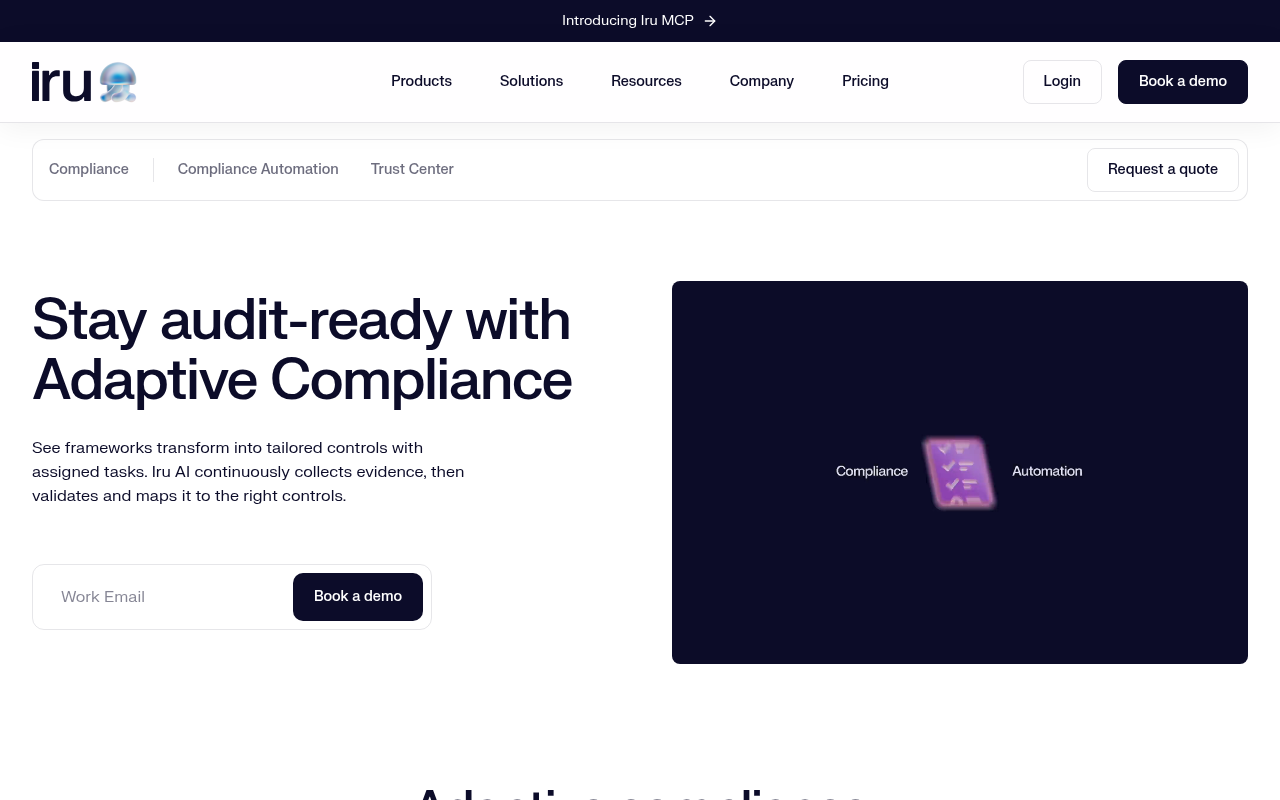
Iru is the company formerly called Kandji. It rebranded in October 2025 and grew from Apple device management into a set of products: Workforce Identity, Endpoint Management for Apple, Windows and Android devices, Endpoint Detection and Response, Vulnerability Management, Compliance Automation and a Trust Center. When the laptops, the sign-in layer and the compliance program run on one platform, evidence for criteria such as CC6.1 and CC6.7 comes from Iru's endpoint data and CC6.2 and CC6.3 from its identity product, not from a third-party integration. Iru AI generates controls from your company context and audit details, assigns owners and due dates, and checks your sources for changes, suggesting control updates, often within 24 hours, that apply only after you approve them.
Best for: Startups with a small IT team that need device management and SSO anyway and would rather not run a separate compliance platform beside them.
Key features:
- Device, EDR, vulnerability and identity evidence collected natively and mapped to SOC 2 criteria
- AI-generated controls with suggested owners, due dates and logged change approvals
- Policy distribution with tracked employee acknowledgements
- Trust Center with NDA-gated documents
Why we like it: At Iru, the platform that enforces disk encryption is the one that proves it, so a laptop that falls out of policy shows up as a compliance gap without waiting on a sync.
Notable limitations:
- The native-evidence advantage shrinks if you keep a different MDM or identity provider
- No pentest or dedicated compliance consultant in the published product set
- Iru partners with auditors but does not name them publicly, so ask your rep
Pricing: Quote only, based on the products you choose, on annual contracts billed annually. Identity and endpoint products have a 14-day free trial, while Compliance Automation and Trust Center are shown through a personalized demo (checked October 2026).
6. Strike Graph
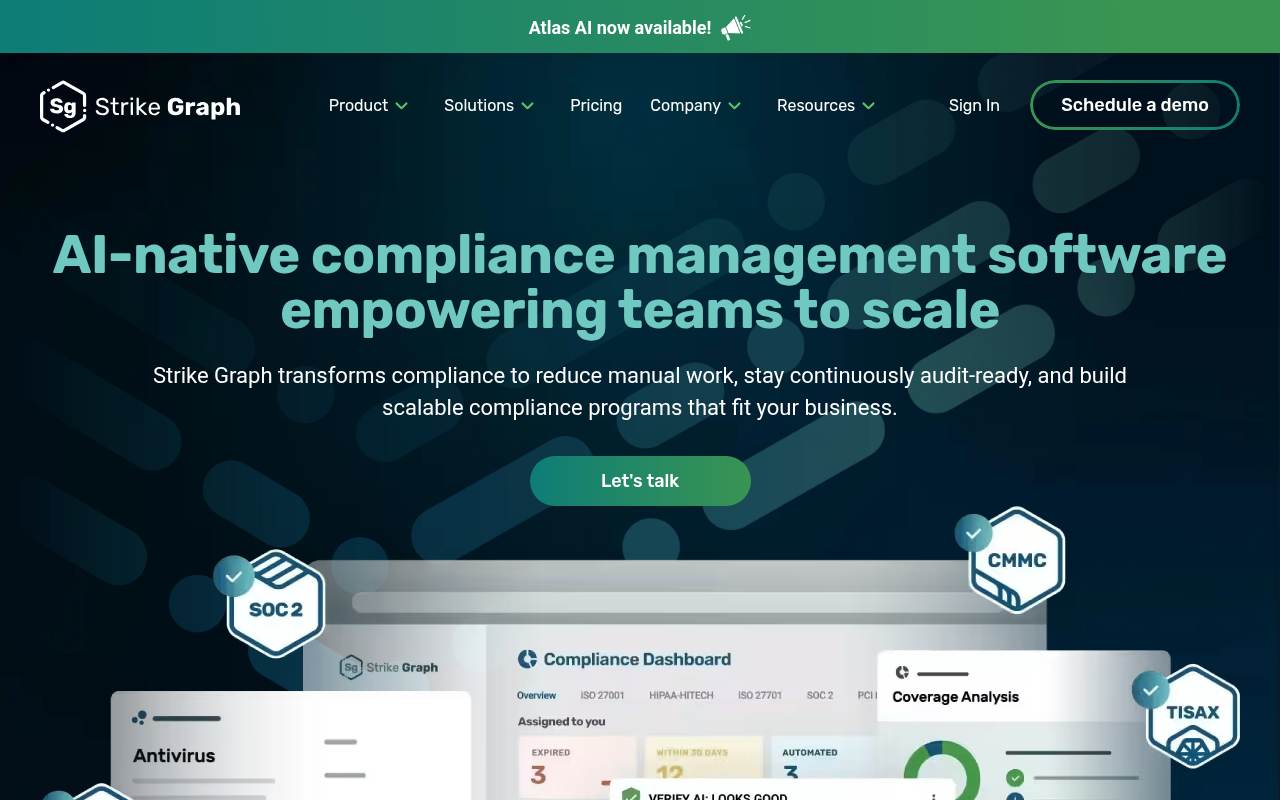
Strike Graph lets a self-run team start free and see real prices before talking to sales. The free Launch tier covers the SOC 2 Security criterion with limited policy templates, one manager, a Google Drive or Microsoft 365 connection and a 30-minute audit advisor call. Certify seeds one Tier 1 framework such as SOC 2 or HIPAA with unlimited risks, controls and evidence, 50+ cloud integrations, cross-framework mappings, the AI Security Assistant and a full audit workbook export. On Scale, Verify AI checks each piece of evidence before the auditor does, and Atlas, launched in August 2026, proposes a prioritized fix list that runs only after a person approves it. Any auditor can work in the platform, or you can pick one from Strike Graph's partner network.
Best for: Technical founders and first security hires who will run SOC 2 themselves and want printed prices to budget against.
Key features:
- Free Launch tier for the SOC 2 Security criterion
- AI Security Assistant for gap analysis, integration code and questionnaire drafts
- Verify AI evidence checks and Atlas remediation plans on Scale
- Unlimited users with no per-seat fee
Why we like it: Strike Graph flags weak evidence while there is still time to fix it, which turns the pre-audit scramble into a short list with owners.
Notable limitations:
- Certify has no printed price, and the next published step, Scale at $21,500 a year, is steep for a seed-stage budget
- Verify AI and Atlas are add-ons on Certify, so the AI features that matter most during a Type 2 window cost extra below Scale
- Adding ISO 27001 as a second framework costs $5,000 a year on Certify ($3,000 on Scale), and a penetration test starts at $10,000
Pricing: Launch is free. Scale starts at $21,500 a year and Enterprise at $35,000 a year, with no per-seat fee for general users and AI credit packs from $4,250 a year (checked October 2026).
7. Scrut Automation
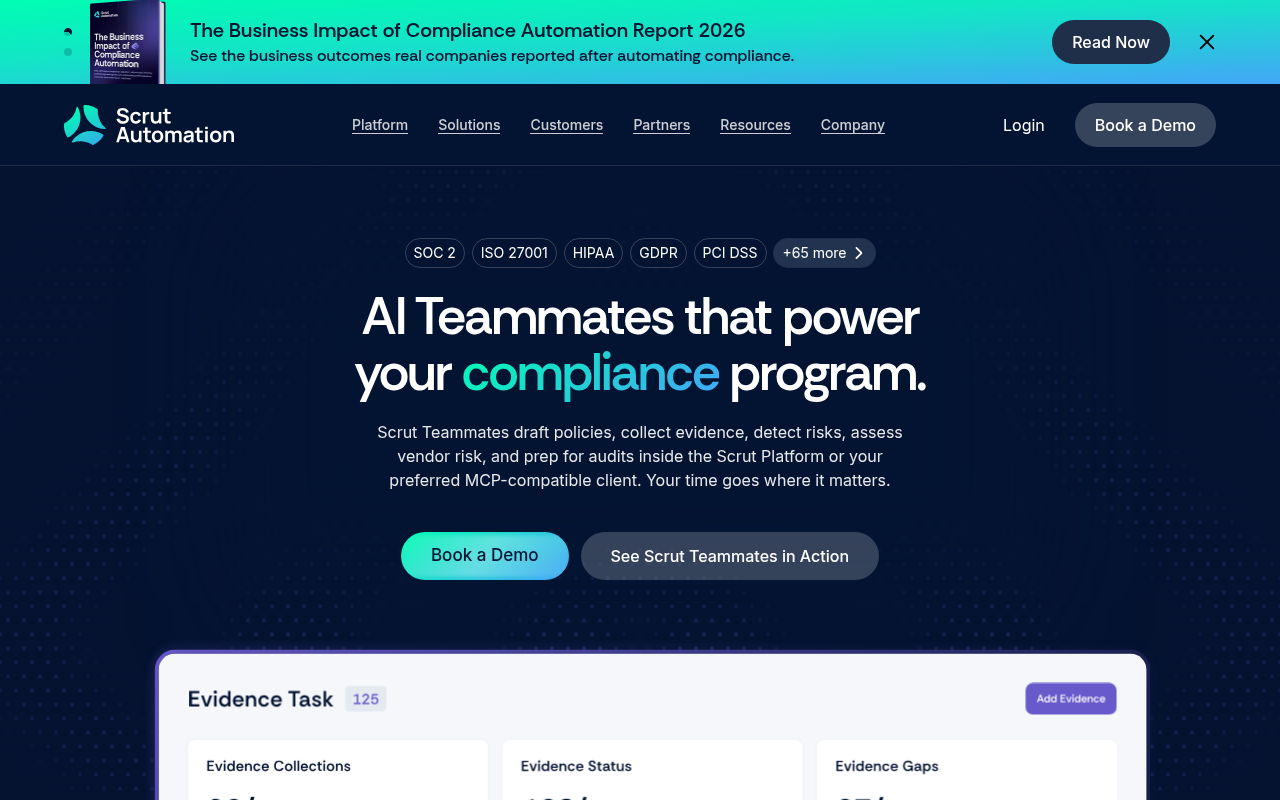
Scrut Automation is built for the startup that already knows SOC 2 is the first framework, not the last. It supports 70+ frameworks out of the box, connects to 150+ tools, and runs continuous tests with drift detection that feed a live risk register next to policies, vendor reviews and access reviews, which is the structure ISO 27001, HIPAA and GDPR ask for later. By Scrut's own figure, an existing SOC 2 program covers up to 80% of the controls ISO 27001 needs. Scrut Teammates, a set of AI agents, draft policies, collect evidence, run readiness assessments and pre-fill security questionnaires, and the Scrut MCP Server lets you query controls from Claude or Cursor. Implementation and InfoSec managers help during onboarding, and CREST-accredited pentesting is available from the same vendor.
Best for: Startups with ISO 27001, HIPAA or GDPR on next year's plan that want the risk register and vendor reviews in place from the first SOC 2.
Key features:
- 70+ frameworks on a unified control framework, plus custom frameworks
- 150+ integrations with continuous tests and drift detection
- Scrut Teammates agents and an MCP server
- Implementation and InfoSec managers during onboarding
Why we like it: Scrut Automation ties a cloud misconfiguration to both the control and the risk it affects, so the risk register stays current without a separate review cycle.
Notable limitations:
- No pricing page, so the only public figure is an AWS Marketplace listing for teams of up to 20
- Audit fees sit outside the platform contract, with your firm working in Scrut's Audit Center
- The risk register and vendor modules are more program than a five-person team uses in year one
Pricing: Quote-based. AWS Marketplace lists the Compliance Automation module at $15,000 for a 12-month contract covering organizations of up to 20 employees (checked October 2026).
Audit Path and Support Compared
Start with the audit column: it tells you who signs your report and how much of the path from Type 1 to Type 2 you manage yourself.
| Platform | Who signs the report | Expert help | Pentest |
|---|---|---|---|
| Thoropass | Thoropass Assurance, its affiliated CPA firm | Auditors working inside the platform | CREST-accredited, sold alongside the audit |
| Comp AI | Can be scoped into the quote; confirm which firm signs | In-house compliance experts in Slack | Agent-run tests of code, APIs and infrastructure |
| Oneleet | An independent auditor, with the fee quoted before you sign | Dedicated vCISO in Slack | Included, manual tests by OSCE-certified testers |
| Scytale | Your firm, or its third-party audit package | Dedicated GRC consultant on DFY and Stronger | Bundled in DFY and Stronger, add-on otherwise |
| Iru | Your firm, or a partner auditor through your rep | No compliance consultant in the published product set | Not offered |
| Strike Graph | Any auditor, or one from its partner network | 30-minute audit advisor call on the free tier | Add-on from $10,000 |
| Scrut Automation | Your firm, working in Scrut's Audit Center | Implementation and InfoSec managers | CREST-accredited, offered by Scrut |
Automation and Stack Compared
Integration counts are each vendor's own figure, so the device column says more if your team works on laptops nobody manages yet.
| Platform | Integrations | Monitoring and trust center | Device checks |
|---|---|---|---|
| Thoropass | Cloud, identity, HR and ticketing connectors, with no count published | Real-time monitoring and alerts | Not listed |
| Comp AI | 580+ advertised | Daily cloud scans and a live Trust Center | Device agent with hourly checks |
| Oneleet | No count published | Attack surface monitoring and cloud posture checks | Built-in device management |
| Scytale | 150+ | 500+ daily automated tests and a Trust Center | Via EDR integrations |
| Iru | Native device and identity data plus supported integrations | AI change checks and a Trust Center | Native, as the MDM and EDR |
| Strike Graph | 50+ cloud integrations from Certify up | Control monitoring, Verify AI and Atlas, and a Trust Center | Not listed |
| Scrut Automation | 150+ | Continuous tests, drift detection and a Trust Center | Device monitoring module |
Strategic Decision Framework
| Critical question | Why it matters | What to evaluate | Red flags |
|---|---|---|---|
| Who signs the report, and will your buyer accept the firm? | Your buyer reads the auditor's name on the report, and a firm they distrust can cost the deal the report was for | The CPA firm's name, how its testers are kept apart from readiness staff, and whether your largest prospect accepts its reports | The vendor arranges the audit but can't say who signs or how independence is kept |
| Is the evidence work your team really does? | Auditors sample across the observation window, and policies nobody follows can pass a Type 1 and still fail the Type 2 | Which evidence comes from integrations with timestamps, and which policies your team edited, approved and actually runs | Templated policies approved in bulk so the dashboard turns green |
| What happens between the Type 1 and the Type 2? | Many enterprise buyers accept a Type 1 once and then ask for the Type 2 | The observation window your auditor proposes, what the platform monitors during it, and whether support continues past the first audit | A "SOC 2 in days" promise that never mentions the observation period |
| Who does the work if nobody owns compliance? | A self-run platform with no owner stalls, and the customer deadline doesn't move | Named consultant or vCISO hours, what they do versus review, and when the engagement ends | Support that ends at the Type 1, with the Type 2 left to a shared inbox |
| What does year two cost with a second framework? | Most startups add ISO 27001 or HIPAA within a year or two, and the first quote rarely shows that line | Price per added framework, auditor fees, pentest renewals and renewal caps | Per-framework add-ons that double the renewal when ISO 27001 arrives |
Problems & Solutions
- Problem: You bought enterprise GRC before the first report, and the implementation is still running when the customer deadline arrives. Solution: Pick a platform scoped for a first SOC 2, such as Comp AI, Strike Graph or Scrut Automation, and move to broader GRC once a risk committee and several entities need one register.
- Problem: You bought the cheapest self-run platform, and nobody on the team has time to run it. Solution: Budget for help instead; Scytale's DFY and Stronger bundles, Oneleet's vCISO and Thoropass's bundled auditors all put a named person on the work.
- Problem: The Type 1 passed, but monitoring lapsed and the Type 2 sample turned up gaps. Solution: Start the observation window the day the Type 1 closes, route failed checks to a named owner, and use evidence checks such as Strike Graph's Verify AI to catch weak samples before the auditor does.
- Problem: A prospect asked for a pentest report and you are booking one two weeks before the deadline. Solution: Price the pentest in the first quote; Oneleet includes one, Scytale bundles it on DFY and Stronger, and Thoropass and Scrut Automation sell CREST-accredited testing alongside the platform.
- Problem: Laptops are unmanaged, so device evidence is a screenshot from each employee. Solution: Use Iru or Oneleet's built-in device management, or Comp AI's device agent, so encryption and screen lock are checked automatically.
The Bottom Line
If one contract and one timeline matter most, start with Thoropass, provided your largest prospect accepts an affiliated audit firm. If nobody on the team has run an audit, Scytale's consultant bundles and Oneleet's vCISO take on the most work for you, and Oneleet is the stronger choice when customers also want a real pentest.
If a technical founder will own the program, Comp AI gives you code you can read and self-host, and Strike Graph lets you start free on the Security criterion and grow into printed tiers.
If the company is about to buy device management and SSO anyway, Iru turns that purchase into SOC 2 evidence. If ISO 27001, HIPAA or GDPR is already on next year's plan, Scrut Automation sets up the risk register and vendor reviews those frameworks will ask for.