
You can buy the Israeli-founder story and miss the company a buyer can still run. A passport, a Rothschild desk, and a product with a confirmable Israel headquarters are not the same watch. The first two show up on every country list. The third is the one you can still study as a small team in 2026.
This page is four smaller companies still operating from Israel: a context warehouse for enterprise agents, autonomous financial-crime investigations, behavioral governance of the agents already inside the company, and a Tel Aviv lab racing to a million qubits. A sales desk on Rothschild does not count.
The headquarters had to be confirmable as Israel, not “founded by Israelis.” The last public headcount signal had to sit under 50. The last raise could not be a rumor. The method is on How we review tools. If you are watching New York or the Peninsula, the New York startups and San Francisco startups pages are different shortlists.
Modus
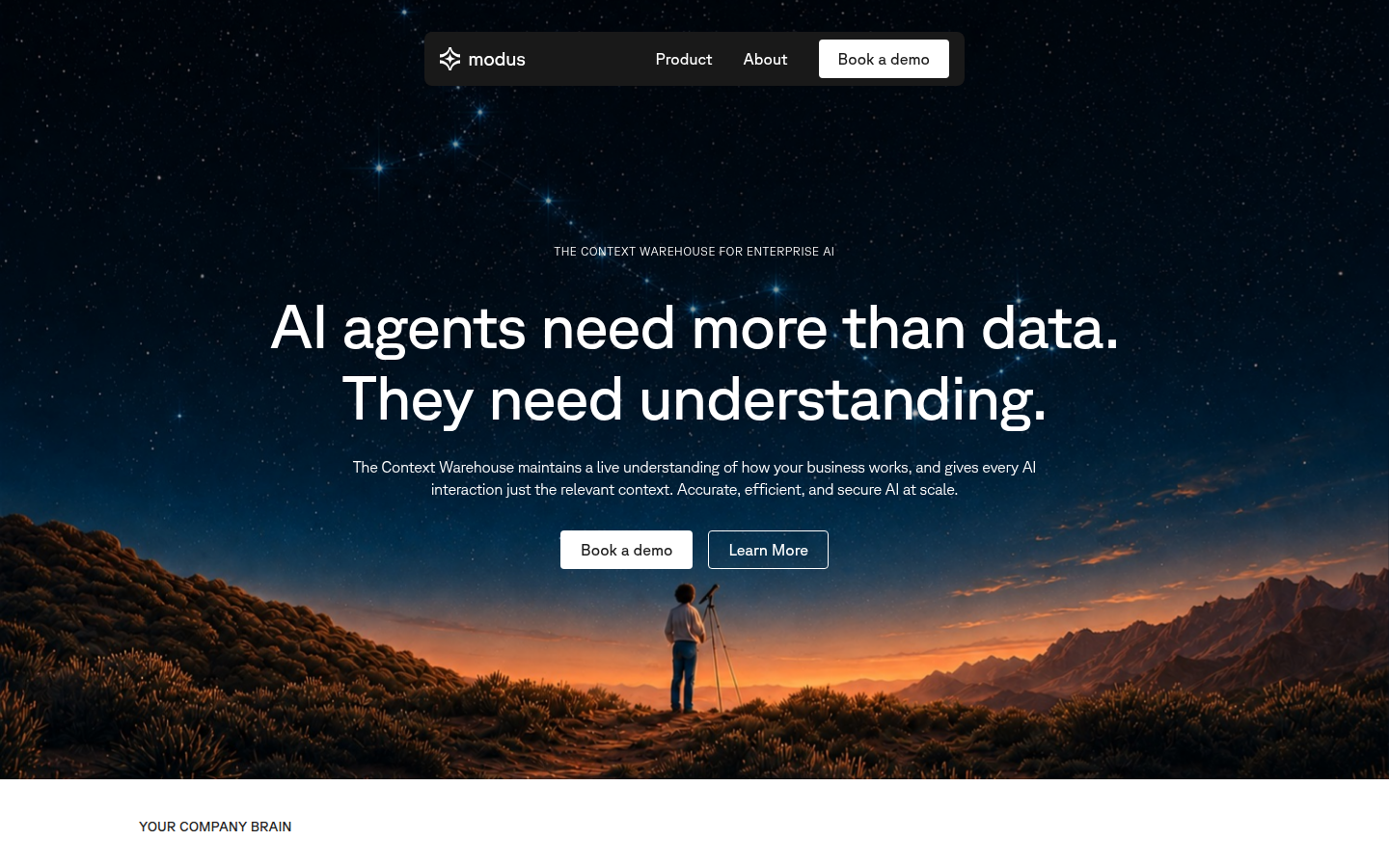
Modus is the context warehouse. Agents already have access to warehouses, tickets, and chat. They still miss how the business actually works. The product learns definitions and metrics from the work already happening, then serves each agent only the slice it is allowed to see, over MCP or API. The homepage job is understanding, not another pile of raw tables.
The about page names Daniel Shimoni as co-founder and CEO and Tomer Mesika as co-founder and CTO. Both LinkedIn links are on that page. The legal name in the site schema is Modus Artificial Intelligence Ltd. No public street address. A Ctech interview with Shimoni put the team at 12, all in Israel. Confirm the contracting entity on the order form if jurisdiction matters.
Best for: Operators whose agents already have access and still answer like tourists, and who will take an Israel Ltd. that is selling the layer under the agent instead of another chat window.
What they sell:
- Connectors into data warehouses, BI, dbt, pipelines, code, docs, and collaboration systems. The site says metadata-first, so raw customer data is not supposed to move.
- A live map of trusted definitions and how metrics actually get calculated.
- Scopes that set what each agent, team, or workflow can see, enforced before anything reaches a model.
- Composed context over MCP or API for agents you already run, or agents and workflows you build on Modus. The company lists SOC 2 Type II, ISO 27001, GDPR, HIPAA, and CCPA.
Why we like it: Most agent decks sell more access. Modus is selling less junk in the prompt. That packaging is the watch. Both founders and Insight Partners are named by the company, not left to a rumor mill.
Notable limitations:
- The “up to 10x fewer tokens” line is a company claim. We did not audit a production token bill.
- The $10 million figure is from the Ctech interview that named Insight. The product homepage does not list the amount.
- SOC 2 Type II and the other badges are homepage marks. We did not read the reports.
- This is context infrastructure, not a self-serve chat you turn on after lunch. Confirm the integration path with the team that already owns the warehouse.
Last raise or stage: $10 million seed, late July 2026, led by Insight Partners, with Soma Capital and named angels including Eyal Kishon, Nadav Abrahami of Wix and Dazl, Cyera founders, and Epsagon founders. That is the Ctech interview with Shimoni. The about page names Insight on the cap table and does not list the amount.
Company LinkedIn: Modus
Tangos
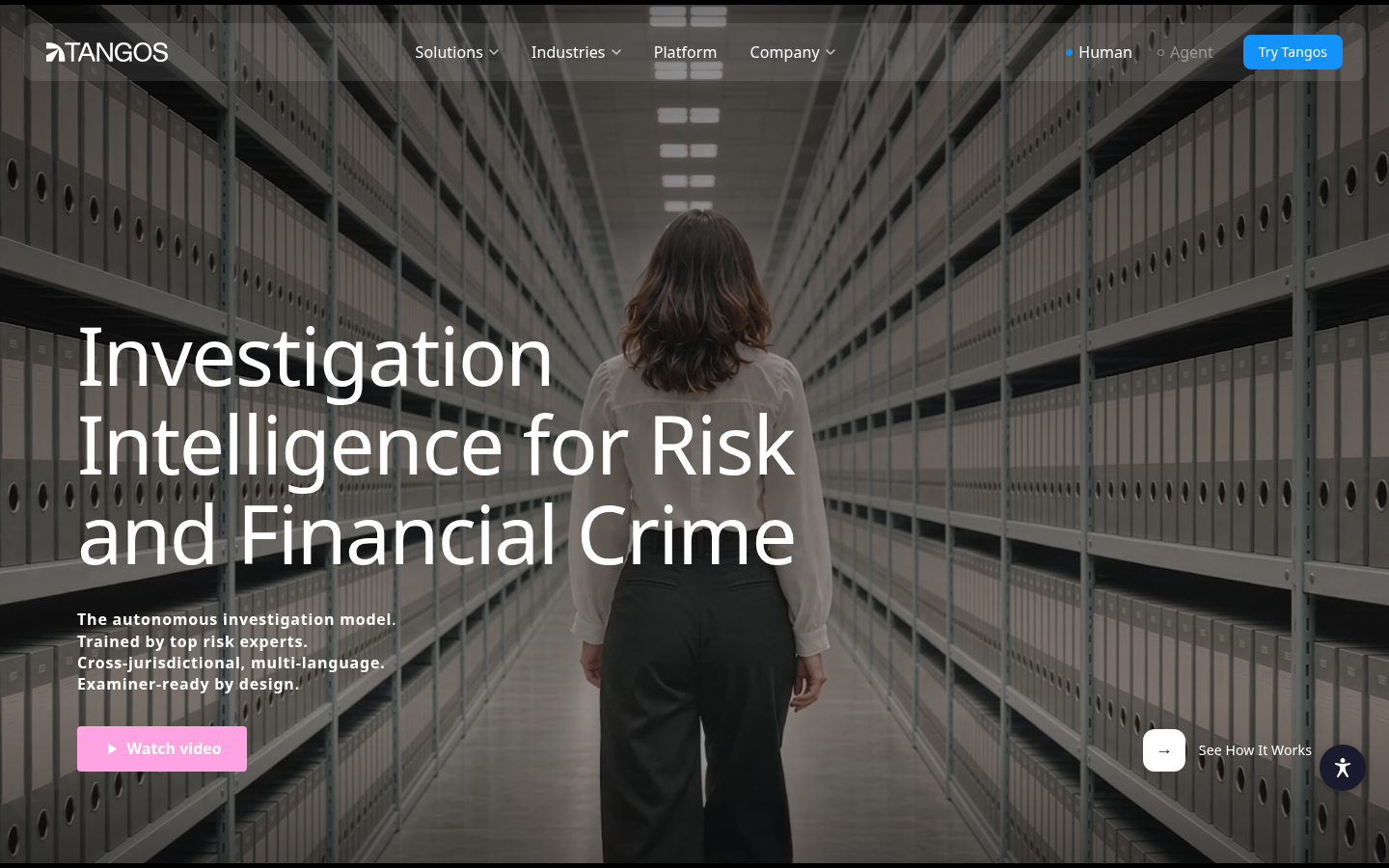
Tangos is the investigation, not the alert. The homepage calls the job investigation intelligence for risk and financial crime. Banks already buy detection. The bottleneck is the pile that still needs a human to gather evidence, test a hypothesis, and file something a regulator will read. The company press note says the platform investigates suspicious activity, sanctions, AML, and fraud, maps ownership and counterparties, and writes a regulator-ready case file with an audit trail. Investigators still review and approve.
That press note is datelined Tel Aviv. It names Eyal Azoulay as founder and CEO. We did not add a second C-suite name from a directory. A Ctech interview put about 20 people in Israel plus a Washington, D.C. team. The company says it serves financial institutions, government, and intelligence organizations in the United States and internationally.
Best for: Compliance and investigations leads whose detection stack is fine and whose case queue is not, and who will take a Tel Aviv company that is selling the file, not another alert.
What they sell:
- End-to-end investigations on suspicious-activity and compliance alerts.
- Sanctions, anti-money-laundering, and fraud analysis, including beneficial ownership and hidden relationships.
- Network maps of entities, accounts, and counterparties, with evidence checked across sources.
- Regulator-ready reports with a complete audit trail. The press note is explicit that people still review, approve, and act.
Why we like it: A decade of regtech went after detection. Tangos is selling the unglamorous case. That is the packaging to study. The raise is on the company press page, not only in a reporter's notebook.
Notable limitations:
- “Already supporting major financial institutions and intelligence organizations” is company language. Named customer logos are not on the company press note.
- This is not a lights-out book. The company's own copy keeps a human on review and approval.
- Headcount is from the Ctech interview, not the press note. Confirm the current team if size is the diligence item.
Last raise or stage: $20 million seed, published 2 July 2026 on the company press page, led by Red Dot Capital Partners, with Leaders Fund, Clarim Ventures, VentureIsrael, Signal Fire, Clutch Capital, Selah Ventures, and a strategic check from Bright Data. Some coverage used a later week. The company press date is 2 July 2026.
Company LinkedIn: Tangos
Arrakis Security
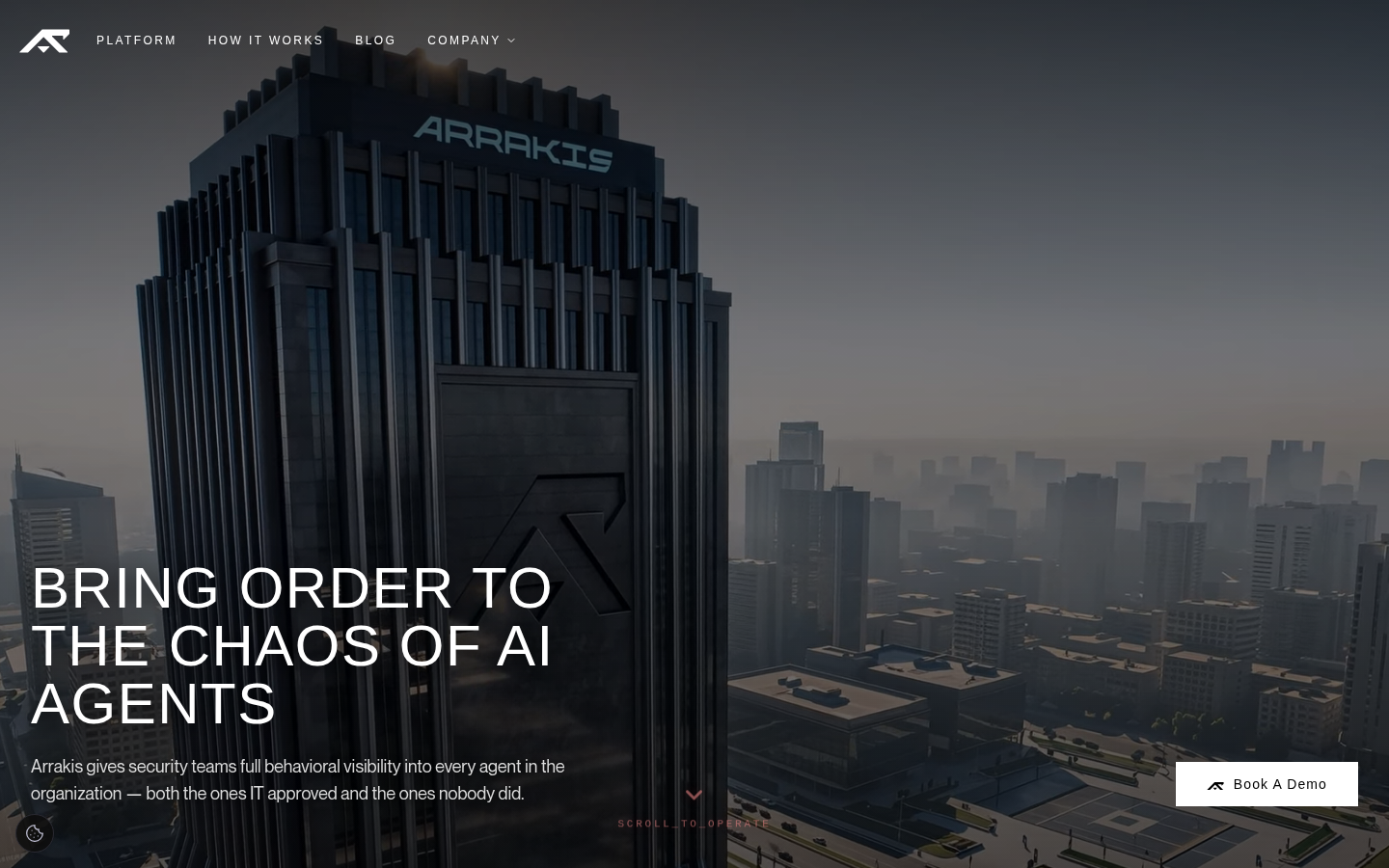
Arrakis Security is watching what agents do after they are already inside. The product site splits the mess into coding agents, assistance agents, and autonomous workflow agents. Discovery, a behavioral profile, real-time monitoring, and a kill switch sit on top. The launch blog calls the gap a visibility illusion: you know the agent exists and still cannot say what it just did.
That launch blog names Omer Efrat and Ron Shani as co-founders and says the company is a team of 20, expanding research and product in Israel. It is written in the first person. A Ctech interview names Tal Baron as co-founder and CEO and quotes him on the same line. The CEO name follows that interview. No public street address.
Best for: Security leads who already approved Copilot or an n8n fleet and still cannot explain the last action, and who will take an Israel R&D shop selling behavior instead of another identity connector.
What they sell:
- Automatic discovery of SaaS, cloud, and endpoint agents, including the ones nobody requested.
- Behavioral profiles for non-human agents, then continuous comparison against policy.
- A three-stage architecture on the homepage: observability, pre-execution AISPM (including an MCP gateway), and AIDR with kill switches.
- Arrakis Labs, a research arm the launch post says feeds agent-specific detections back into the product.
Why we like it: Most agent-security decks still sell access. Arrakis is selling the runtime. That is the watch. The raise and the Israel hiring plan are on the company blog, not only in a funding database.
Notable limitations:
- “World’s first Behavioral Governance platform” is company language. Treat it as a category claim, not a fact we audited.
- Block, revoke, and kill-switch language is the company claim. Confirm what it can actually stop in your stack.
- The CEO name is from the Ctech interview, not a byline on the blog. The blog names the other two co-founders.
Last raise or stage: $8 million seed, announced 2 August 2026, led by Hetz Ventures, with Mati Staniszewski, Ofer Smadari, Amitai Ratzzon, and unnamed Palantir executives. The company blog names the amount, the lead, and those angels. Ctech printed the calendar day.
Company LinkedIn: Arrakis Security
Q-Factor
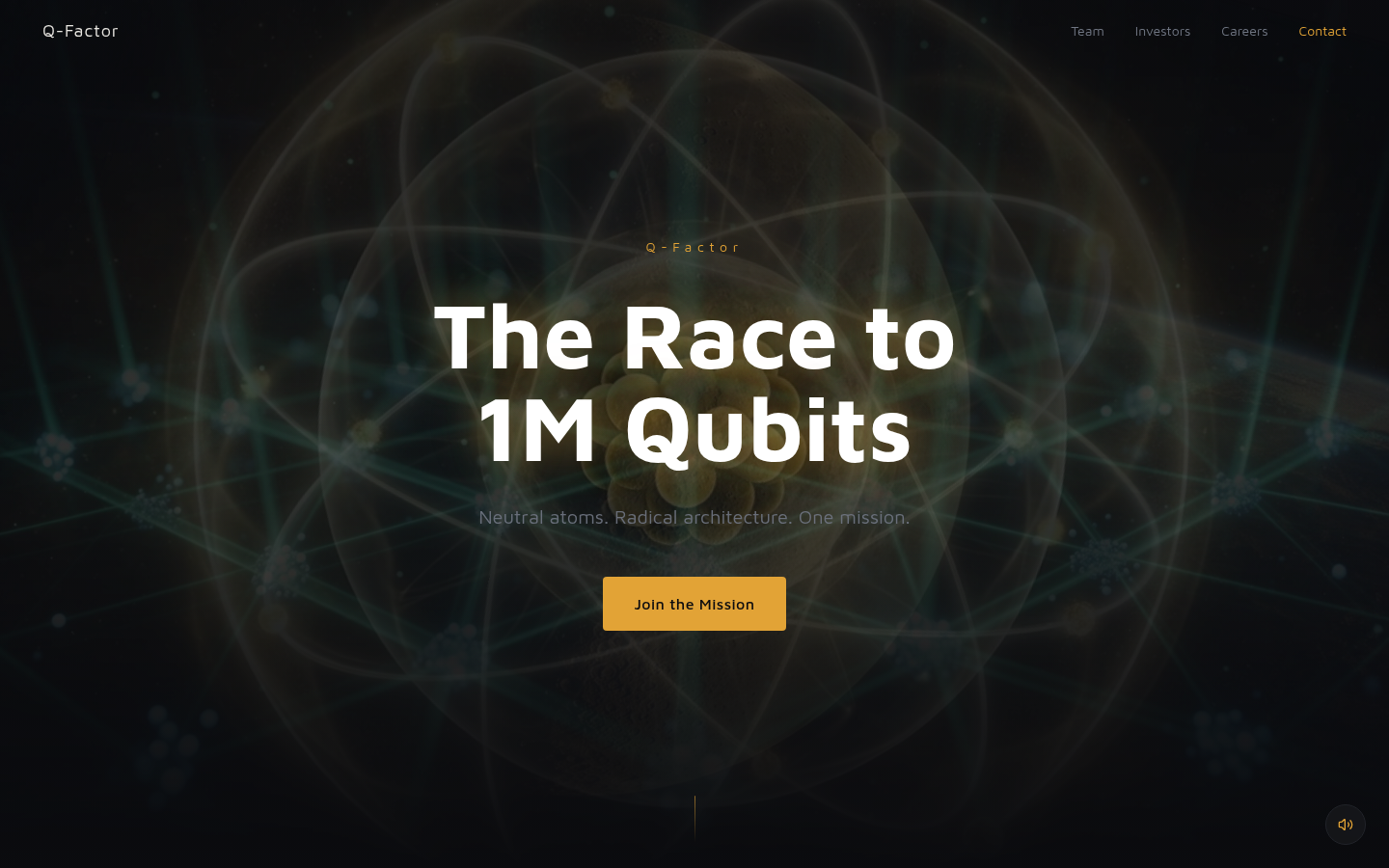
Q-Factor is the hardware bet. Neutral atoms, a race to a million qubits, and a Tel Aviv lab. The homepage does not sell a SaaS seat. It sells an architecture the team says can scale past the few-thousand-qubit ceiling. Careers copy is blunt: based in Tel Aviv, Israel, building for the world.
The company team page names Dr. Guy Raz as co-founder, CEO, and CTO, Prof. Yoav Sagi as CSO, Prof. Nir Davidson as scientific strategist, and Prof. Ofer Firstenberg as chief scientist. Those LinkedIn links are on the company site. The same page lists about a dozen named builders plus open roles. Investor logos on the site include NFX, TPY Capital, Intel Capital, Korea Investment Partners, Deep33, Matias Ventures, and the Israel Innovation Authority.
Best for: Deep-tech operators and corporate innovation teams who want an Israel-HQ quantum lab they can still call small, and who know they are watching a race, not buying software this quarter.
What they sell:
- A neutral-atom architecture aimed at continuous scale, not a one-shot jump.
- Work on control, connectivity, and error correction, which the site calls the bottlenecks between today's arrays and useful machines.
- A Tel Aviv team drawn from Weizmann and Technion labs, named on the company page.
- Open physicist and engineer roles on-site in Tel Aviv. This is a lab, not a remote chat tool.
Why we like it: Israel lists that only recite cyber miss the hardware still being built in the city. Q-Factor names the team, the city, and the investors. The million-qubit line is a mission. That honesty is useful even if you never write a purchase order.
Notable limitations:
- A million qubits is a race the company named, not a machine you can book. Do not read the homepage as a shipped system.
- The $24 million figure is on the company PR Newswire note. The site shows investor logos, not the dollar amount.
- This will not teach you a packaging trick you can ship next week. It is a lab watch: still small, still Israel-HQ, still a 2026 story.
Last raise or stage: $24 million seed, announced 8 April 2026, led by NFX and TPY Capital, with Intel Capital, Korea Investment Partners, Deep33, the Matias family, and a grant from the Israel Innovation Authority. Technion and Weizmann (through Yeda) are shareholders. That is the company PR Newswire note, SOURCE Q-Factor. One Israeli business daily used 6 April. This page uses the company wire date.
Company LinkedIn: Q-Factor
Other Israeli startups worth considering
Wiz, Monday.com, and Cyera are the names everyone already recites. They are Israeli stories and they matter. They are also well past a 50-person shop. This page is who to watch in 2026. It is not a unicorn roll call.
Sentra led the 2024 directory on this slug at 51–100 people. That breaks the filter for 2026. Island is the same class of household cyber.
Brandlight is a real 2026 raise story. The company Series A note is datelined New York, so it stays off an Israel headquarters list. Xpander announced a seed from San Francisco and says it is headquartered there. Engineering jobs still list Tel Aviv. That is a US HQ with an Israel team, which is a different watch than the four above.
If you want a city list with a different job mix, start with New York, San Francisco, or France. Those pages use the same filter. They are not the same companies with a new flag.
FAQs
Does a Ctech interview count as the Israel headquarters?
No. The filter is a confirmable Israel headquarters, a company legal name, or a 2026 raise note datelined Israel. Ctech is the headcount and raise source on some rows. It is not the HQ proof by itself.
Why aren't Wiz and Monday.com on this list?
They are Israeli stories and they matter. They are also names everyone already knows, and they are well past a 50-person shop. This page is who to watch in 2026. It is not a unicorn roll call.
Is a Rothschild desk enough to call a company an Israeli startup?
No. A confirmable Israel headquarters, a company legal name, or a 2026 raise note datelined Israel. A sales office in Tel Aviv does not make a San Francisco stack an Israeli startup.
Can I buy Q-Factor as software this quarter?
No. It is a lab race to a million qubits, not a SaaS seat. The homepage does not sell software you turn on after lunch.
Which raise figure should I trust?
Use the company announcement when a reporter's figure disagrees. Amounts on this page follow the company note.
Bottom line
Start with the job you actually need this year, then check that the company still prints an Israel headquarters you can find and a team that is still small. Context for agents, a financial-crime file, agent behavior, and a quantum lab are four different watches. A household name with a Tel Aviv office can still be a smart buy. It is just a different list.