

An AI sales development representative (SDR) can automate outreach, but it will not fix an unclear target-account list or decide which sales activities you should delegate. Before choosing an agentic go-to-market (GTM) platform, you need to identify the work slowing your team down: researching accounts, acting on buying signals, following up with website visitors, or running outbound campaigns. That choice determines whether you need configurable agents inside your existing systems or a packaged AI sales worker.
The distinction matters as agents gain more control over sales workflows. In August 2026, Clay introduced Account Agents in Workflows in open beta, allowing agents to use account history to choose among actions your team defines. At the other end of the spectrum, 11x describes Alice as an outbound digital worker that handles prospecting from research through outreach, while Julian handles inbound leads. The buying decision is how much of that work to delegate and where your team should retain approval.
We compare seven agentic GTM platforms for account research, signal-driven outreach, inbound conversion, and AI sales development, with pricing and tradeoffs for each approach.
Agentic GTM Platforms at a Glance
| Tool | Best for | Pricing model | Standout |
|---|---|---|---|
| Clay | RevOps teams that build their own plays with Claygent | Launch from $185/mo. Growth from $495/mo. Enterprise quote | Claygent research agents in tables. Account Agents (beta) on paid tiers. Credit plus action meters |
| Unify | Self-serve outbound. Signal-triggered research, qualify, sequence | Free, then $20/seat/mo Base. Pro $60/seat/mo. Business quote | Chat-to-pipeline agent. 40-plus data sources. Managed deliverability on Business |
| Common Room | Product, community, and web signals routed into outreach | Essential $2,500/mo billed annually. Advanced and Enterprise quote | RoomieAI Capture, Activate, Orchestrate, Spark Brief. First-party buyer graph |
| Warmly | Inbound teams that need visitor identification and live chat | Visitor ID from $10,000/year. Inbound Autopilot $30,000/year | Person-level ID, Inbound Agent chat and booking, TAM Agent for off-site follow-up |
| 11x | Managed outbound prospecting with an AI SDR | Alice Growth from $3,750/mo billed annually. Julian priced separately | Alice for outbound. Julian for inbound voice and chat. Managed mailboxes included on Alice |
| Artisan | Packaged AI BDR (Ava) with bundled contact data for a defined ICP | Startups Intern from $250/mo billed annually. Team, Scale, and Enterprise quote | Ava finds, enriches, sequences, handles replies, and books. Bundled contacts claimed |
| Landbase | Agent-run audience build: target, qualify, enrich, keep lists live | 1,000 free credits, then from $499/mo for 15,000 credits | Natural-language search. AI qualification. Verified email and mobile enrichment |
How We Evaluated These Tools
We compared published product documentation and pricing, checked on October 15, 2026, against five buying criteria:
- Work the agent performs: Account research, qualification, outreach, inbound conversations, and meeting booking, including which steps require another tool.
- Control and oversight: Who defines targeting, reviews messages, approves record updates, and handles conversations that need a person.
- Data and integrations: The first-party signals, contact data, and CRM connections available, with attention to plan restrictions and write-back permissions.
- Operating requirements: The setup and ongoing work your team owns, including workflow design, sending infrastructure, and visitor tracking.
- Pricing and commitment: Published entry prices, credit or prospect allowances, separately billed products, and monthly versus annual terms.
The 7 Best Agentic GTM Platforms
1. Clay
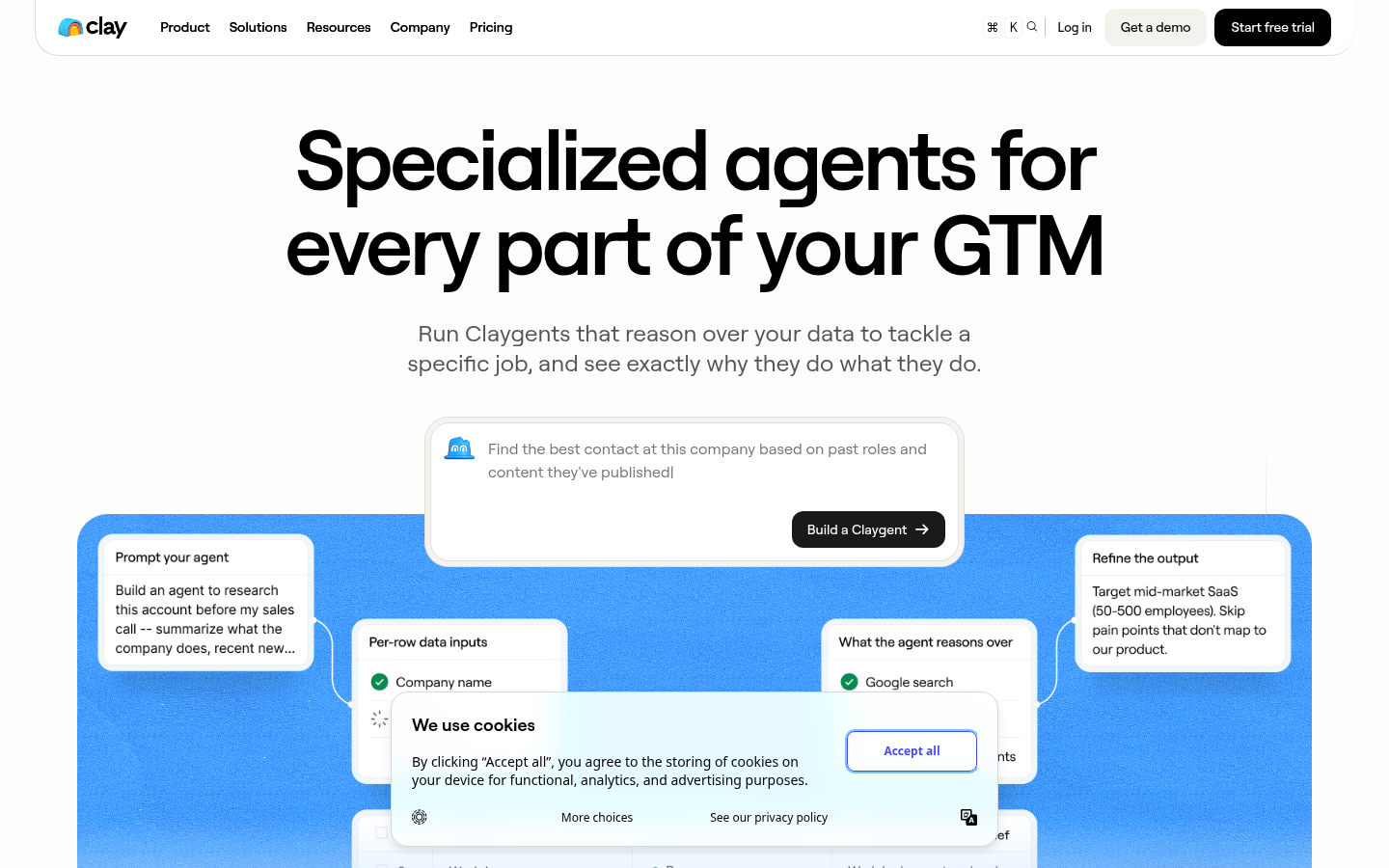
Clay is the RevOps orchestration pick. Claygent is the research agent inside Clay tables and workflows: it takes a prompt, hits the web and your configured sources, and writes a structured cell. Account Agents (beta on Launch, Growth, and Enterprise) run across every account in a segment, with persistent memory and optional human-approved CRM or warehouse writes. You still design the waterfall, the sequencer, and the CRM push. Account Agents can also choose actions inside Workflows, but your team defines the available paths and connects the data sources.
Best for: RevOps and growth teams that want to build their own GTM plays, and will operate tables, credits, and prompts.
Key features:
- Claygent for last-mile web research, scoring, and custom data points. "Use AI" in a table is for copy, not live research
- Account Agents in Audiences and Workflows, with account context carried between runs
- 150-plus data providers, native sequencer on paid plans, CRM auto-sync on Growth
Why we like it: With Clay, you can turn a research question specific to your market into a reusable data field and use it to trigger a sales workflow. That flexibility is useful when standard contact databases do not capture the qualification criteria you need.
Notable limitations:
- Clay requires you to configure the research, workflow logic, and downstream actions before an agent can run a useful sales process
- AI spend is Actions plus Data Credits (fixed or variable by model). Account Agents bill per record processed
- CRM auto-sync is a Growth feature, not Free
Pricing: Launch starts at $185/mo on Clay's pricing FAQ (2,500 Data Credits and 15,000 Actions). Growth starts at $495/mo. Enterprise is quote with an annual commitment. Claygent sits on all tiers. Confirm the live card, because pack sizes change the monthly figure. Source: Clay pricing page and FAQ; checked October 15, 2026.
2. Unify
Unify is signal-triggered outbound for sellers who do not want to live in a spreadsheet. One agent prospects, researches, and sequences from chat. Plays can trigger on intent, hiring, funding, or web visits, then qualify and enroll. Contact data is bundled (Unify cites 1.1 billion people and 65 million companies) with a multi-vendor email and phone waterfall. Managed Gmail and Outlook mailboxes, write-back CRM sync, and website intent sit on Business, not on the Base card.
Best for: Teams that want a self-serve agentic outbound console, with a path from a personal card to a workspace.
Key features:
- Chat agent with native skills for list build, research, and multi-channel sequences
- Signal-triggered plays. Email, call, and social tasks in one sequence
- Hard credit cap: actions pause when the seat and pool are empty, rather than surprise overage
Why we like it: Unify connects list building, research, and sequencing in one workflow, while its credit cap gives you a clear limit on usage-based spend.
Notable limitations:
- HubSpot and Salesforce write-back, managed mailboxes, and signal automations are Business (annual, custom credits)
- Deep agentic workflows consume credits fast. Budget the research depth, not only the seat
- This is outbound. It is not Warmly-style on-site chat
Pricing: Free forever (limited credits, up to 3 seats). Base is $20/seat/mo with 800 credits. Pro is $60/seat/mo with 2,400 credits and a 14-day trial. Extra mailboxes are $25/mo on the pricing FAQ. Business is quote, billed annually. Source: Unify pricing page; checked October 15, 2026.
3. Common Room
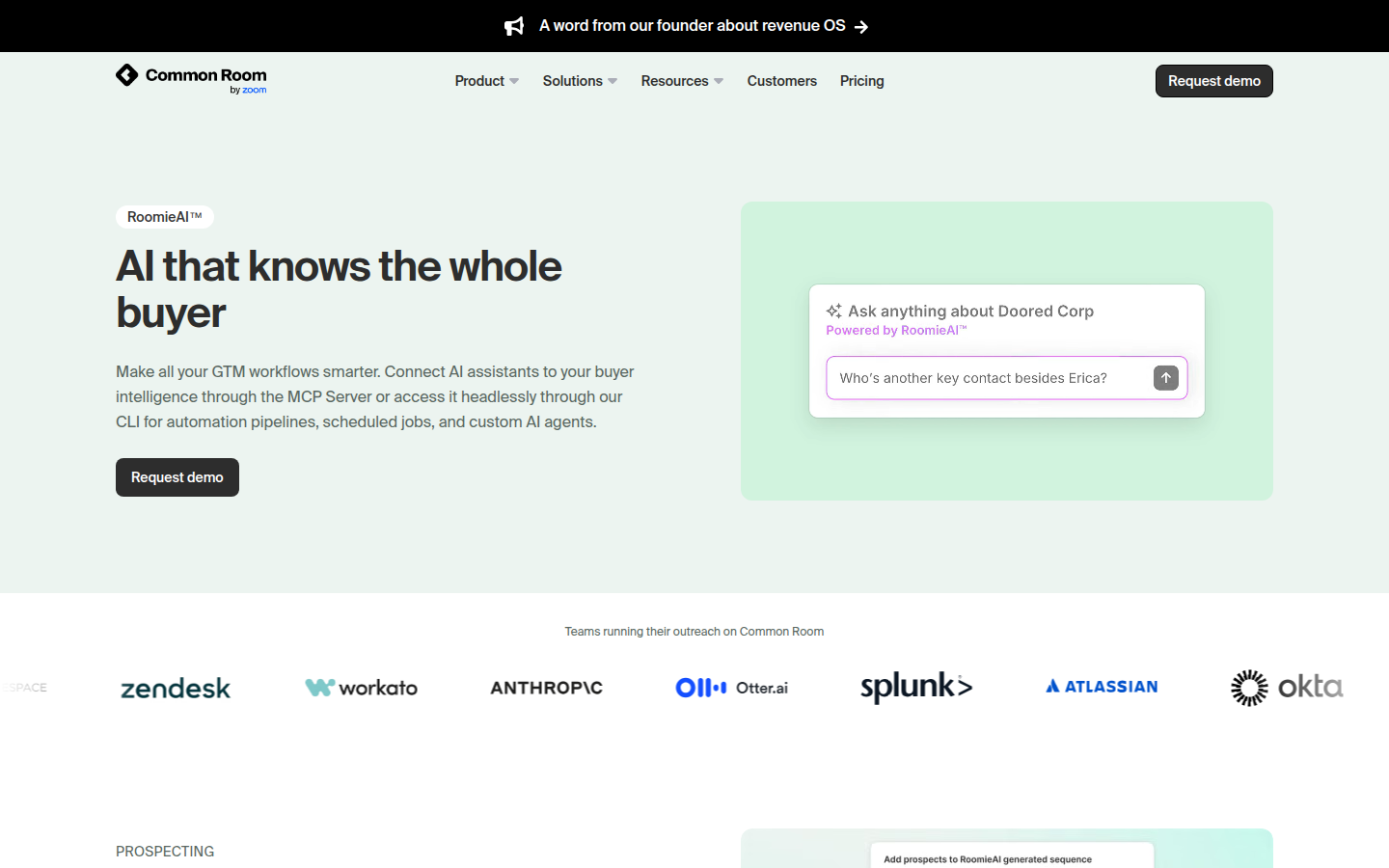
Common Room combines product, community, web, and CRM signals with RoomieAI agents to help your reps prioritize accounts and prepare outreach. Zoom acquired Common Room on July 17, 2026, according to its August 2026 Form 10-Q. RoomieAI is Capture (bespoke signal hunt), Orchestrate and Spark Brief (who is ready and why), Activate (drafted outbound from those signals), and Ask CR Anything. Pricing still meters RoomieAI research credits. Common Room's own FAQ says RoomieAI supports human-led revenue and is not a replacement for sellers. Drafts stay in a review loop.
Best for: Teams whose buying signals already live in product, community, and web, and who want agents to route that context into outreach, now with Zoom in the picture.
Key features:
- RoomieAI Capture, Activate, Orchestrate, Spark Brief, Ask CR Anything
- Person360 waterfall enrichment and buying-committee mapping
- CRM, SEP, and Slack out of the box. MCP server on every plan
Why we like it: Common Room turns scattered product and community activity into account context your reps can use to prioritize outreach and write a relevant first message.
Notable limitations:
- You are buying into Zoom's revenue platform. Confirm what stays on commonroom.io vs what moves into Zoom Revenue Accelerator
- Essential is annual. RoomieAI research and Prospector credits are separate meters
- Not a packaged AI SDR. Reps still send, call, and judge
Pricing: Essential is $2,500/mo billed annually (5 seats, 100k contacts, 5k RoomieAI research credits, 2.5k Prospector credits). Advanced and Enterprise are quote. Product signals and extra Prospector credits are add-ons. Source: Common Room pricing page; checked October 15, 2026.
4. Warmly
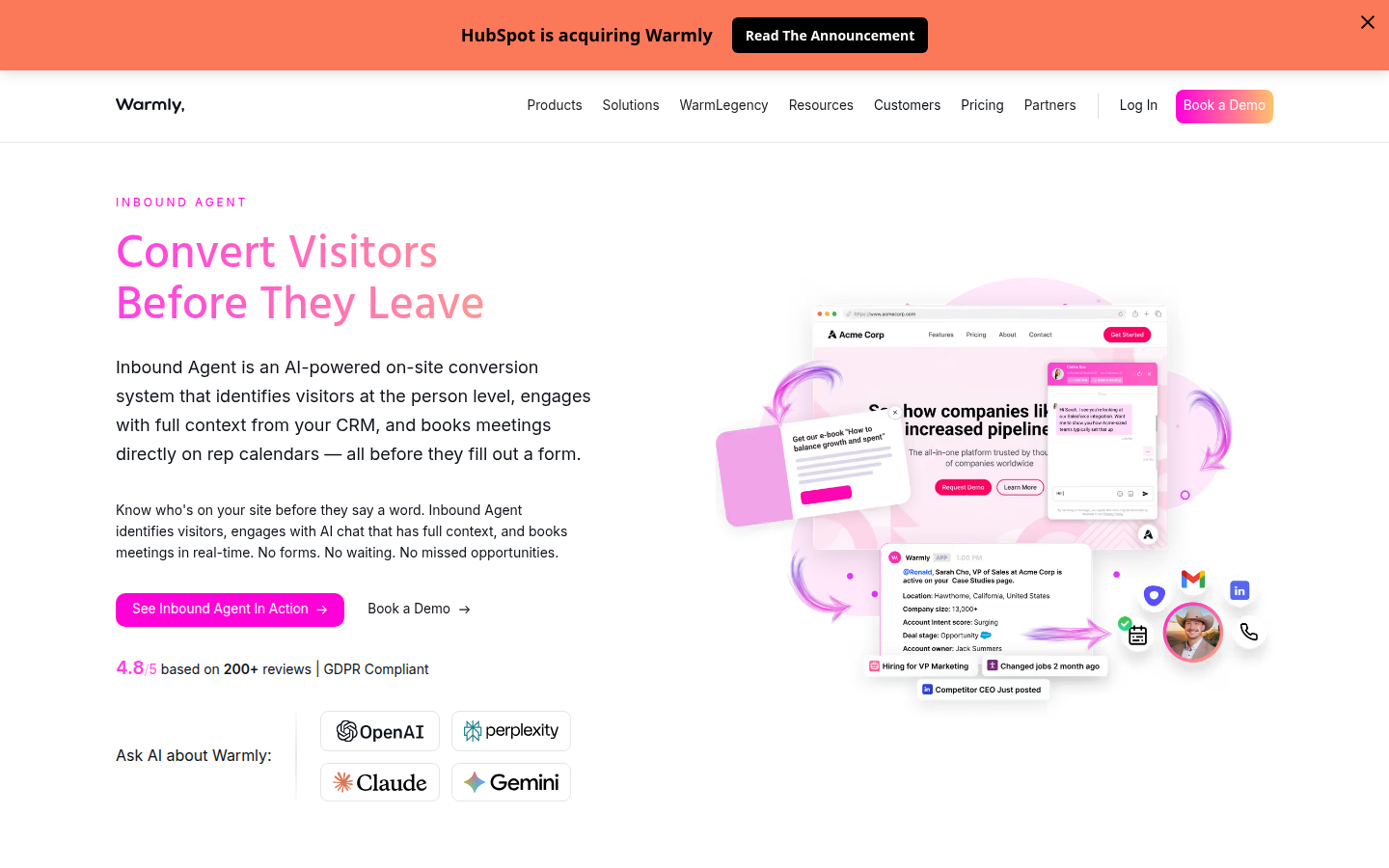
Warmly is the inbound-first pick: person-level website visitor ID, then agents that chat and follow up while the visitor is still on the page. HubSpot signed an agreement to acquire Warmly (announced 30 Jun 2026). The June 30 announcement said existing contracts, pricing, account teams, product experience, and integrations would stay unchanged at that time. Inbound Agent pulls CRM context, books calendars, routes by territory, and alerts Slack. Warmly cites roughly 15% of traffic identified at the person level on matched profiles. TAM Agent is the off-site counterpart (outbound orchestration and buying-committee work). Visitor ID alone does not include AI chat. Chat starts on Inbound Chat. Autopilot is the unlimited-agent tier.
Best for: B2B sites that already buy traffic and lose it to forms, and want ID plus a chat agent in one motion.
Key features:
- Person-level and company-level de-anonymization, with CRM sync and Slack alerts
- Inbound Agent: context-aware chat, direct booking, routing, retargeting
- TAM Agent for off-site follow-up. Context Graph as the shared account record
Why we like it: Warmly combines visitor context with chat and meeting routing, so you can respond to interest while someone is still on your site.
Notable limitations:
- Person-level match is a minority of traffic. Plan for company-level as the default
- AI chat is not in the visitor-ID SKU
- Annual (or quarterly) packaging. Confirm cancellation on the order form, and what stays on warmly.ai vs HubSpot after close
Pricing: AI Web-Deanonymization starts at $10,000/year. Inbound Chat starts at $20,000/year. AI Inbound Autopilot is $30,000/year. Quarterly cards exist if you want to try before annual. GTM Signals and Warm Experiences are $10,000/year add-ons. Source: Warmly pricing page; checked October 15, 2026.
5. 11x
11x is a packaged AI SDR / digital worker, not an orchestration layer. You are buying Alice (outbound prospecting, personalized multi-channel outreach, meeting booking) and, separately, Julian (inbound qualification on voice, chat, SMS, and WhatsApp). 11x prices Alice per new prospect, not per send, and bundles managed Gmail mailboxes, warmup, rotation, and bi-directional CRM sync. Annual billing is the default. You still set the ideal customer profile (ICP), review campaign performance, and decide when a person should take over.
Best for: Teams that want to delegate repetitive SDR work and have 11x manage the sending infrastructure.
Key features:
- Alice: outbound sequences, enrichment, signal triggers, meeting scheduling
- Julian: inbound voice and chat, live transfer, CRM logging (priced on its own page)
- Managed mailboxes and deliverability on Alice Growth and up
Why we like it: 11x prices Alice by new prospects rather than individual messages and includes managed mailboxes, which makes it easier to scope the cost of an outbound program.
Notable limitations:
- You do not design every waterfall. Playbooks are 11x's, with your ICP and CRM as inputs
- Annual contract by default. Docs cite 30-day written non-renewal notice and capped renewal increases. Confirm the paper
- Julian is a second SKU. Do not assume voice is in Alice
Pricing: Alice Growth starts at $3,750/mo billed annually (up to 5 end users, 2,000 new prospects/mo). Pro and Enterprise are quote. Julian Growth starts at $5,333/mo for voice and $2,417/mo for chat, billed annually, on 11x's Julian pricing page. Source: 11x Alice and Julian pricing pages; checked October 15, 2026.
6. Artisan
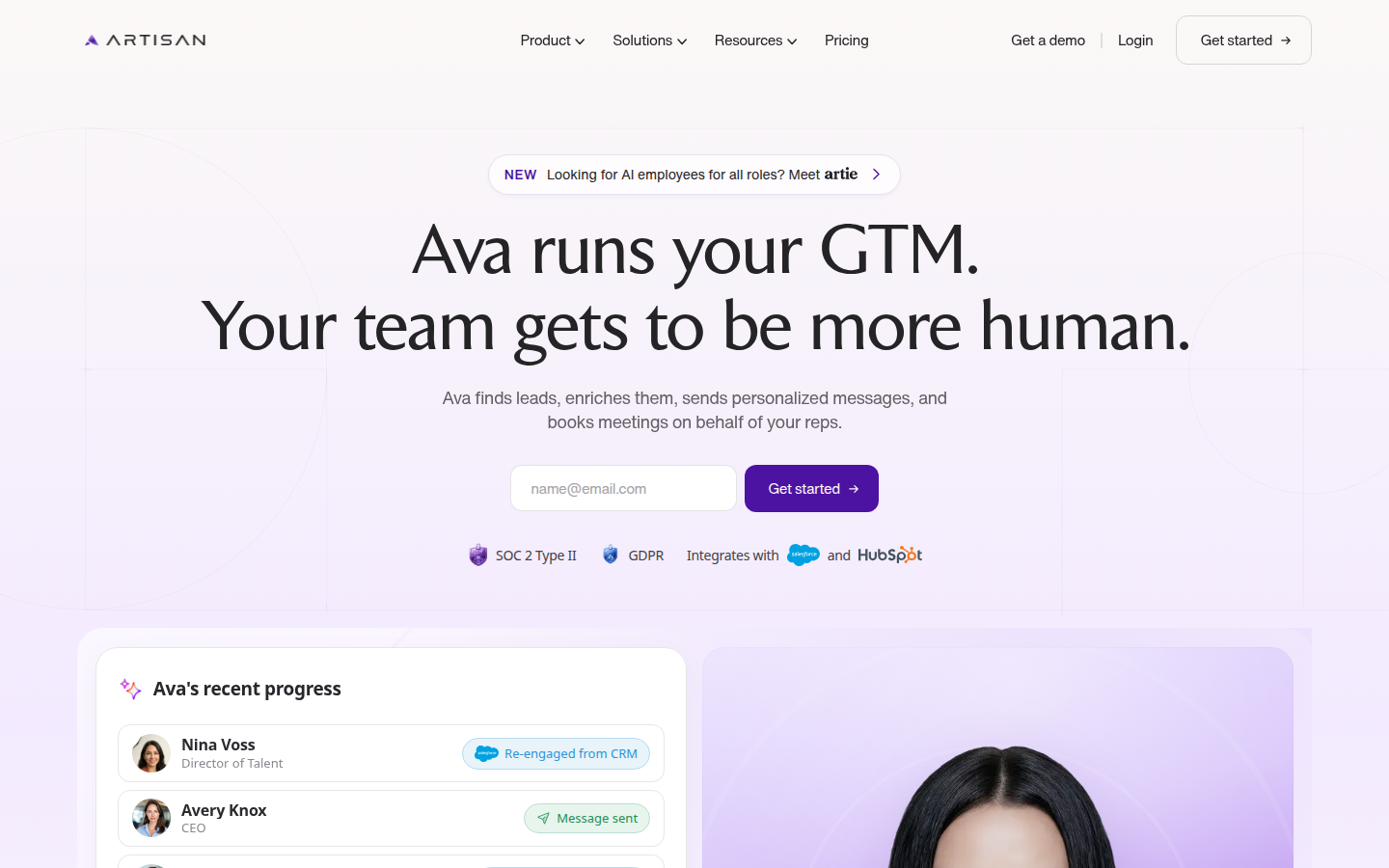
Artisan is a packaged AI BDR, not an orchestration layer. Ava finds and enriches leads from Artisan's claimed 250M-plus verified contacts, runs email and social campaigns, handles replies, and books meetings. The pricing page has two audiences. Startups is self-serve (Intern and Employee cards). Businesses lists Team (~2,500 leads contacted/mo), Scale (~6,000), and Enterprise as quote. Mailboxes and a human power dialer are separate from Ava's campaign credits.
Best for: Teams that want one AI BDR with bundled data for a defined ICP, and will let Ava run the outbound motion.
Key features:
- Ava: lead find, enrich, sequence, reply handling, meeting booking
- Bundled B2B contacts, Salesforce and HubSpot sync on the Team card
- Campaign types for cold outbound, signals, CRM reactivation, and expansion
Why we like it: Artisan combines contact discovery, campaign execution, and reply handling, reducing the number of separate systems you need to connect for outbound prospecting.
Notable limitations:
- The Startups comparison still marks full self-driving Ava as coming soon; assess the campaign and reply automation available today
- Businesses Team/Scale/Enterprise are quote. Startups dollars are annual, credit-metered, and do not include sending infrastructure
- Deliverability still depends on domains and warmup Artisan sizes to your motion. Ask how sending infrastructure is billed
Pricing: Startups Intern is $250/mo billed annually (10K credits, about 500 leads contacted/mo). Employee is $600/mo billed annually (25K credits). Businesses Team, Scale, and Enterprise are quote. Credits, mailboxes, and the human power dialer are separate lines on the order. Source: Artisan pricing page; checked October 15, 2026.
7. Landbase
Landbase runs agent programs that plan the audience for you: natural-language targeting, AI qualification against your criteria, scoring, enrichment, and always-on monitoring so the list refreshes when funding, hiring, or lookalikes appear. The live public pricing page is credit-based and charges when a verified result lands (email 1 credit, mobile 10). Search misses are not billed. The homepage is heavier on audience build and GTM data inside Claude Code/Codex than on a mailbox sequencer. If you need Landbase to send the sequence, confirm that SKU. Do not use older monthly platform blog figures as current list.
Best for: Teams that want agents to build and maintain the outbound universe, then push it into the tools that actually send.
Key features:
- Natural-language account search with lookalikes and pipeline exclusion
- AI qualification, scoring, verified email and mobile waterfall
- Always-on monitoring for new accounts and signals
Why we like it: Landbase lets you describe a target audience, qualify matching accounts, and keep the segment updated before handing it to your outreach tools.
Notable limitations:
- Public price is data credits, not a published per-send sequencer card
- Email and mobile enrichment use different credit rates, so a phone-heavy list consumes your allowance faster
- Sending is not included in the published data-credit bundles; scope campaign execution separately
Pricing: 1,000 free credits to start. Paid bundles from $499/mo for 15,000 credits, then $1,999/mo and $4,999/mo packs, Enterprise custom. Verified email is 1 credit. Verified mobile is 10. Source: Landbase pricing page; checked October 15, 2026.
Features and Autonomy
| Platform | Outbound | Inbound / signals | Human in the loop |
|---|---|---|---|
| Clay | You build the play. Claygent fills cells. Sequencer on paid plans | Job-change and web-intent signals on paid tiers. Not on-site chat | RevOps owns prompts and waterfalls. Account Agent CRM writes can require approval |
| Unify | Agent researches, qualifies, sequences from chat or plays | Hiring, funding, web intent. Website intent on Business | Reps run chat. Plays can autopilot. Credit cap pauses spend |
| Common Room | RoomieAI Activate drafts. Sequences via SEP/CRM | Product, community, web, CRM. Spark Brief ranks who is ready | Vendor says not a rep replacement. Drafts for review |
| Warmly | TAM Agent off-site. Retargeting from identified visits | Person-level visitor ID plus Inbound Agent chat | Live chat handoff. Routing to named reps |
| 11x | Alice runs the book. Packaged digital worker | Julian for voice/chat. Website visitor tracking on the platform | Reps take booked meetings. Live transfer on Julian |
| Artisan | Ava runs campaigns and replies. Packaged AI BDR | Signal campaigns and website visitor de-anonymization | Configurable message approvals and escalation rules; reps take meetings |
| Landbase | Agents build and refresh the audience. Confirm send SKU | Hiring, funding, tech, lookalikes as targeting signals | RevOps tunes scoring. Reps work the exported or synced list |
Deployment and Integrations
| Platform | Whose data | CRM sync | What you still bring |
|---|---|---|---|
| Clay | Bring your own, plus 150-plus providers and Claygent web research | Auto-sync on Growth. Account Agent exports can be human-approved | The play design, domains if you send, and credit budget |
| Unify | Bundled people/company graph plus 40-plus sources | Read-only on Pro. Read-write on Business | ICP, offer, and (below Business) your own mailbox plan |
| Common Room | Your product, community, web, and CRM, plus Person360 partners | CRM and SEP out of the box | First-party instrumentation. Zoom relationship after the July 2026 close |
| Warmly | Your site traffic, CRM, plus ID waterfall and optional third-party signals | Native Salesforce and HubSpot | Traffic. Pixel. Calendar and routing rules |
| 11x | 11x contact data plus your CRM and knowledge base | Bi-directional on Alice Growth and up | ICP, domains (11x manages mailboxes), CRM license |
| Artisan | Bundled 250M-plus contacts plus your CRM for reactivation | Salesforce and HubSpot on the Team card | ICP definition. Sending domains as billed |
| Landbase | Landbase graph plus your prompt, website, and CRM exclusions | Named on product materials: Salesforce, HubSpot, Marketo, Outreach. Confirm on the order | Fit questions. The tool that sends if send is out of scope |
Strategic Decision Framework
| Critical question | Why it matters | What to evaluate | Red flags |
|---|---|---|---|
| Do you need an agent on your stack, or a digital worker on a book? | Clay, Unify, Common Room, Warmly, and Landbase still need a human design loop. 11x and Artisan sell the loop as the product. | Who writes the prompt, who owns the domain, who takes the booked meeting. | Autonomy claims that still require a full-time operator to ship a single play. |
| What happens when credits run out, and can you cancel? | Most of this category meters research and data. Several SKUs are annual. | Hard cap vs overage. Seat vs workspace credits. 11x 30-day non-renewal language. Warmly quarterly vs annual. Common Room billed annually. | Credit-based pricing with no published pause, plus an annual lock-in you cannot model until month two. |
| Who carries deliverability and domain risk? | Poor sending practices can damage domain reputation and affect delivery beyond the campaign. | Managed mailboxes (Unify Business, 11x Alice, Artisan sending infrastructure) vs your own domains in Clay. | The vendor will not say whose domains send, how warmup works, or what happens after a spike in bounces. |
| Will two agents write the same CRM records? | A visitor-ID agent, an outbound worker, and a Clay table can each "own" the contact. | Write-back direction, occupancy rules, and which system is source of truth. | Three agent tools enrolled on one Salesforce ID with no occupancy field. |
Problems & Solutions
- You automate outreach before defining a useful account list. Agree on qualification criteria and check a sample of accounts before increasing volume. Clay or Landbase can support research and enrichment; Common Room can help prioritize accounts with existing engagement signals.
- Multiple agents update or contact the same CRM record. Assign one system to manage each sales activity and use a shared ownership or campaign-status field. Configure the other agents to skip records already in an active sequence, and agree which system controls changes to customer data.
- You buy inbound automation before understanding your website traffic. Start by checking visitor identification coverage and routing. With Warmly, visitor identification and AI chat have different entry plans, so choose the product that addresses the measured gap before adding broader automation.
- You commit to a contract before validating campaign quality. Define pilot success using qualified replies, accepted meetings, bounce rates, and operator time. Where available, use a monthly plan or quarterly term for that pilot, then review the cost and staffing requirements before expanding.
The Bottom Line
Choose Clay when your revenue operations team wants control over account research and workflow design. Unify fits sellers who want research and outbound sequencing in one interface, while Common Room is a stronger fit when product, community, and website signals should guide human-led outreach. Warmly fits teams whose priority is converting website interest into conversations and meetings.
Choose 11x Alice or Artisan Ava when you want to delegate more of the outbound process to a packaged AI sales worker, while keeping your team responsible for targeting, approvals, and sales conversations. Landbase fits teams that need to build and refresh qualified audiences for an existing outreach system. Start with the work you need done, then compare the data, operating effort, and contract required to do it.